Table of Contents
The GovTech Case Study Playbook: How One Pilot Can Unlock Ten Deals
Why Case Studies Are a Sales Prerequisite in GovTech
If you are selling public sector software – whether that is municipal finance software, public safety software, or wastewater management software – you already know that government buyers do not move fast. That is not a knock on them. It is the nature of the environment they operate in.
Public sector buyers are accountable in ways private-sector buyers are not. Their vendor decisions are public record. Their procurement mistakes get covered in the local newspaper. Their budgets come from taxpayers, not investors.
That pressure creates one consistent behavior: they want proof before they meet you.
Not after the demo. Before.
They want to know that someone like them – same role, similar budget, comparable agency size – already made the decision you are asking them to make. And they want that someone to have come out better on the other side.
That is why, for GovTech and LegalTech SaaS companies under $5M ARR, a well-built case study is not a marketing asset you get around to eventually. It is a prerequisite for your sales motion.
Without it, you are asking a risk-averse buyer to be your first real proof point. Most will not do that. The ones who do will take twice as long to close.
This post breaks down the exact framework we use at energizeGTM to build case studies that move deals. Whether you are selling government accounting software, grant management software, fire department software, or EMS management software, the structure is the same.
Let’s get into it.
The Mirror: Make Your Buyer See Themselves
The most common mistake in GovTech case studies is being too vague in the name of protecting the client. You end up with something like:
“A mid-sized government agency in the central United States struggled with inefficient processes…”
That tells your buyer nothing. It could be anyone. Which means it feels like no one.
Your goal is the opposite. You want a risk-averse buyer to read the first paragraph and think: That is us.
That recognition does the heavy lifting. Before you have walked them through a single outcome, the psychological work is already done.
Here is what specific actually looks like in a GovTech case study:
- “Mid-sized city, 80,000 residents, operating under a general law charter”
- “Permitting team of four staff processing 3,000 applications per year”
- “County health department managing compliance reporting across six program areas”
- “Fire department with three stations, a fleet of nine vehicles, and one full-time administrative coordinator”
Notice what is not there: the agency name. You can create a vivid, recognizable mirror without ever identifying your client. The specificity comes from the operational details – headcount, transaction volume, geography, org structure – not from the name on the door.
When your prospect reads those details and their mental model says “that is basically us,” the case study has already earned its place in the sales process.
This works for every GovTech vertical – from utility management software buyers to government budgeting software evaluators. The buyers across these categories share something: they are looking for peers who have already taken the risk.
The Before: Make the Pain Real
Most case studies skip the “before” or rush through it in two sentences. That is a mistake.
The “before” is where you establish the cost of doing nothing. In government and legal markets, the default position is always inertia. Status quo is the path of least resistance. Your case study has to make the status quo uncomfortable enough that your buyer actually feels the need to act.
When building the “before” section, document the pain across at least three dimensions:
- Time: How many hours per week, per year, were consumed by the broken process?
- Errors and risk: What was the compliance risk? How many errors were corrected manually? Were there audit findings?
- Staff burden: Was overtime required? Were experienced staff doing repetitive data entry instead of higher-value work?
- Cost: If you can quantify the direct cost – overtime pay, vendor invoices, staff time at loaded rates – do it.
Here is an example from the government accounting software space:
“Before implementation, the finance team spent approximately 120 hours each month on manual reconciliation between their legacy system and spreadsheets maintained by each department. Audit prep required pulling three years of records by hand. During the annual close, two staff members worked nights and weekends for six consecutive weeks.”
That paragraph does not tell you the agency name. But if you are a finance director running a similar shop, it is almost physically uncomfortable to read.
That discomfort is what breaks status quo thinking. In GovTech, that bar is high – but it is the only bar that matters.
The Proof: Numbers That Actually Land
You have shown your buyer who this was about and how bad it was. Now you have to show them what changed – in terms they will believe.
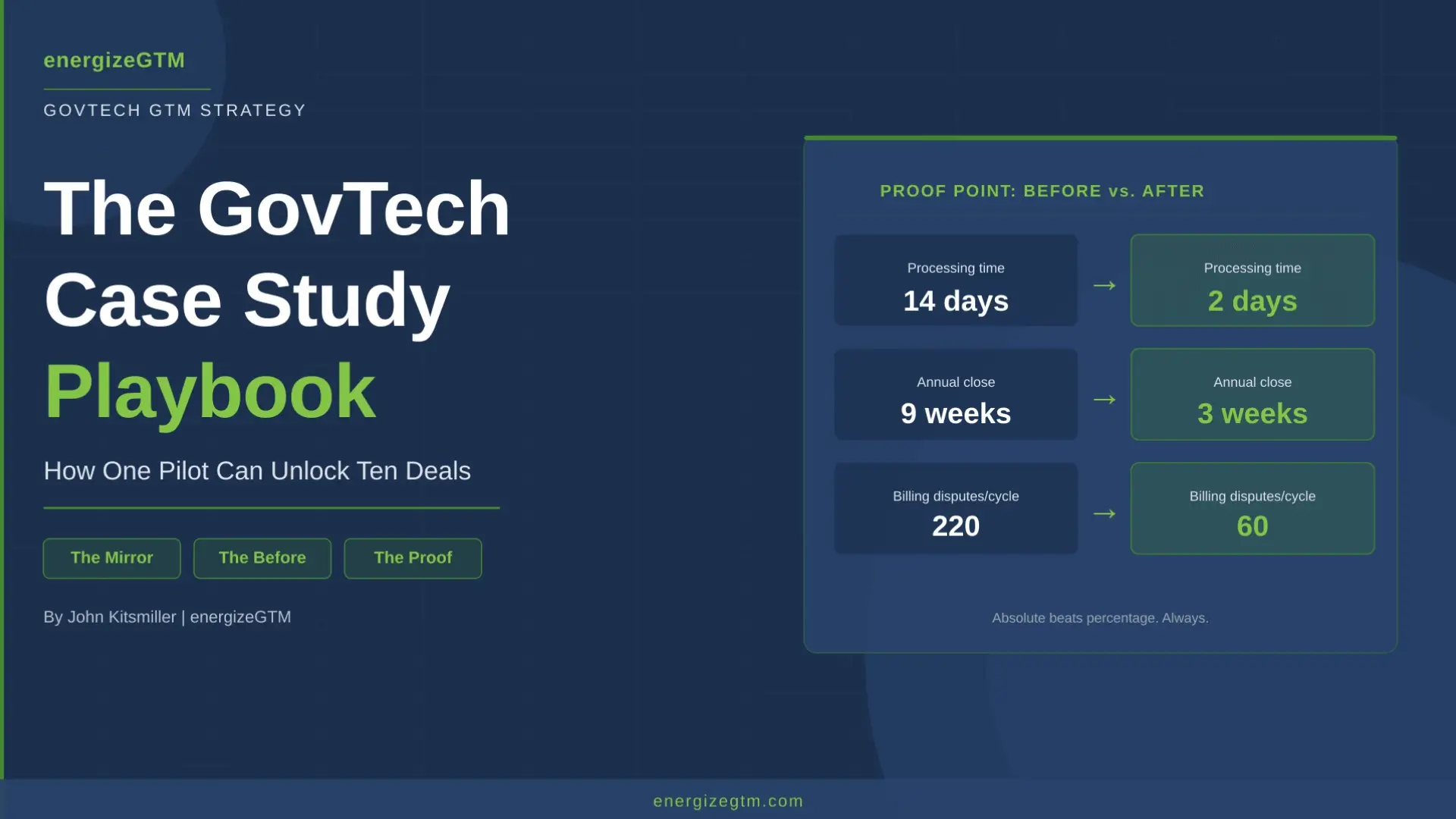
Here is the most important principle in writing GovTech proof points: absolute beats percentage.
Compare these two statements:
- “Processing time improved by 73%.”
- “Processing time dropped from 14 days to 2 days.”
The first sounds like a vendor claim. The second sounds like a log entry. Government buyers trust log entries. They have seen enough vendor decks to be skeptical of percentages.
When you use absolute numbers, you give your buyer something they can verify mentally against their own operation. “14 days to 2 days” is something a city clerk or a grants administrator can immediately map onto their own workflow. They know what 14-day processing means in their world.
Some proof point formats that work well in GovTech case studies:
- “Annual close went from nine weeks to three weeks.”
- “Grant reporting that required two FTEs is now managed by one coordinator in two days per quarter.”
- “Inspection scheduling errors dropped from an average of 40 per month to fewer than five.”
- “Water billing disputes decreased from 220 per cycle to 60 per cycle after the utility management software rollout.”
Every one of those numbers should be real. Not approximate. Not directionally accurate. Real – pulled from the data you tracked before and after the implementation.
Which means you have to track it before and after. We will cover how to set that up in the next section.
For more on how energizeGTM builds sales evidence into the GTM process, visit: How We Work
No Case Study Yet? Here Is What to Do
This is where most early-stage GovTech SaaS founders get stuck. They know they need case studies. They do not have any clients yet – or they have clients but no documented outcomes.
Here is the move: design a paid or very low-cost pilot specifically to produce the case study.
This is not about giving your product away. It is about creating a structured, short-term engagement with a single agency or firm that ends with documented proof. The pilot is the research project. The case study is the output.
Here is how to structure it:
- Define success metrics on day one. Before the pilot starts, agree in writing on what “better” looks like. Processing time, error rate, staff hours – pick two or three measurable outcomes and document the baseline before anything launches.
- Set a defined timeline. 60 to 90 days is typical. Long enough to show real results. Short enough to maintain momentum and keep the agency engaged.
- Track the before and after systematically. Do not rely on memory or anecdote. If your public sector ERP software is replacing a manual spreadsheet process, count the hours before implementation and after. Keep records.
- Ask for the reference before the pilot ends. Not after. During. When the results are fresh and the relationship is warm, that is when you ask your pilot client to agree to be a reference and to approve the case study language.
One well-designed pilot can unlock the next ten deals. That is not an exaggeration. In GovTech, where procurement committees look for comparable implementations and risk-averse buyers want precedent, a single documented outcome can carry enormous weight for 12 to 18 months.
If you are not sure whether your current GTM setup is ready to execute a structured pilot, the GovTech GTM Scorecard is a good place to start. It takes about five minutes and gives you a clear read on where your motion is strong and where it has gaps. Try the GovTech GTM Scorecard
Handling Confidentiality Without Losing Credibility
Some clients will not let you use their name. Some will not even want their state identified. That is a reality in public sector sales – and it does not have to kill your case study.
There are two approaches that work well:
Option 1: Anonymized but Specific
Strip the name but keep the operational detail. A buyer evaluating your grant management software does not need to know which county used your product. They need to know it was a county grants team managing 40 federal pass-through grants across three departments with two full-time coordinators.
That specificity is credible. “A government client in the Southeast” is not.
Option 2: Composite Case Study
If you have worked with multiple agencies in the same vertical – say, several fire departments using your fire department software, or multiple utilities using your water utility management software – you can build a composite case study that draws from several real implementations.
The rules are simple: disclose that it is a composite, and make sure every number in it is real and drawn from actual client data. A composite built ethically is still a powerful proof point. A composite that obscures made-up numbers will eventually cost you credibility you cannot recover.
Label it clearly: “Composite case study drawn from three municipal fire department implementations between 2022 and 2024.”
Transparency about the format actually increases credibility with sophisticated buyers. It tells them you are rigorous about your data.
Case Study Strategy Across GovTech Verticals
GovTech is not a monolith. The buyer for EMS management software has different priorities than the buyer for government compliance software. The procurement process for public transparency software looks different than the process for contract management software for government.
That means your case study strategy needs to be vertical-specific – at least in its framing, even if the underlying product and proof points are similar.
Here is a quick-reference table of what each vertical buyer cares most about in a case study:
GovTech Vertical | Buyer Role | Top Case Study Proof Points |
Municipal finance software / government accounting software | Finance Director, CFO | Audit findings reduced, close cycle time, staff hours saved |
Grant management software | Grants Administrator, Finance Director | Reporting hours per grant, compliance error rate, drawdown timing |
Public safety software / fire department software | Fire Chief, IT Director | Response time data accuracy, inspection compliance rate, NFIRS reporting time |
EMS management software | EMS Director, Medical Director | PCR completion time, billing accuracy, protocol compliance rate |
Wastewater management software / water utility management software | Utility Director, Operations Manager | Work order cycle time, regulatory reporting hours, billing dispute rate |
Government budgeting software | Budget Officer, City Manager | Budget cycle length, department submission accuracy, revision rounds |
Government compliance software | Compliance Officer, City Attorney | Audit pass rate, corrective action cycle time, reporting deadline compliance |
Contract management software for government | Procurement Director, City Manager | Contract renewal miss rate, processing time per contract, vendor dispute rate |
Public sector ERP software | IT Director, Finance Director | System consolidation count, total cost of ownership reduction, staff training time |
Public transparency software | City Clerk, Communications Director | FOIA response time, public portal usage, council meeting prep hours |
If your case study is being used in outbound – in email sequences, in LinkedIn outreach, in discovery call prep – it should lead with the proof points that matter most to that specific vertical’s buyer. The same underlying outcome can be framed very differently depending on who is reading it.
For a deeper look at how energizeGTM approaches vertical-specific GTM strategy, visit: Our Services
Where to Deploy Your Case Studies in the Sales Motion
A case study is only as valuable as how and when you deploy it. Building one and leaving it in a PDF on your website is not a GTM strategy. Here is where it actually belongs in your motion:
Before the First Outreach
In cold email to GovTech buyers, a case study reference in the opening email dramatically improves reply rates. You are not asking them to read the whole thing. You are using a single sentence to establish that you have done this before with someone like them.
Example: “We helped a permitting team similar to yours cut application processing from 14 days to 2 days – worth a quick call to see if the same approach makes sense for [City Name]?”
That one sentence is more persuasive than three paragraphs about your product.
In the Discovery Call
Use the case study as a mirror in discovery. When you hear a pain point that matches your documented outcome, reference it directly: “We actually built a case study around exactly this issue with a water utility in the Southeast – do you want me to send it before our next conversation?”
That moves the case study from a passive PDF to an active sales tool.
In the Proposal and Follow-Up
Include the case study as an appendix to your proposal – or as a standalone document sent the day after the proposal call. Buyers who are comparing you to other vendors will use it. Procurement committees reviewing your submission will use it. Internal champions trying to get stakeholder buy-in will use it to make the case for you when you are not in the room.
In Your Content Strategy
Case studies are also one of the most linkable, shareable assets in GovTech content marketing. A well-structured case study placed on your blog will attract backlinks from local government association sites, GovTech media, and adjacent vendors. It signals E-E-A-T (Experience, Expertise, Authoritativeness, Trustworthiness) to Google in a way that generic product pages cannot.
You can also break a single case study into multiple pieces of content – a LinkedIn post, a short-form video, a newsletter feature, a conference presentation slide. One strong outcome, many formats.
For more on how to build a content engine around your GovTech case studies, visit: energizeGTM Resources
The Quick-Start Framework: Building Your First GovTech Case Study
Here is the full framework in summary – use this as a checklist for your next pilot or your next client review call:
- The Mirror: Describe your buyer in operational terms. Role, org size, transaction volume, staffing level, geography. No names required. Make them feel recognized in the first paragraph.
- The Before: Document the pain across time, errors, staff burden, and cost. Make the status quo uncomfortable to read about. The “before” has to earn its place.
- The Proof: Use absolute numbers, not percentages. Log entry, not slogan. Track the before and after in real data – not approximations.
- The Reference: Ask during the engagement, not after. When results are fresh and the relationship is warm.
- The Format: Anonymize thoughtfully. Keep the operational specificity. Use composites if needed – but label them clearly and keep the numbers real.
- The Deployment: Put the case study in outbound, discovery calls, proposals, and content. One strong outcome should touch every stage of your funnel.
One well-designed case study, built on real data and deployed consistently across your GTM motion, can carry your pipeline for 12 to 18 months. In GovTech, where deals are long and trust is everything, that is not a small thing.
What to Do Next
If you are a GovTech or LegalTech SaaS founder working to build a repeatable sales motion around real proof – and you are not sure whether your current GTM infrastructure can support it – here are three places to start:
- Take the GovTech GTM Scorecard. It is a five-minute self-assessment that shows you exactly where your GTM motion is strong and where it has gaps. Try the GovTech GTM Scorecard here
- Learn about the energizeGTM process. See how we approach GTM strategy, outbound, and sales playbook development for public sector SaaS companies. Learn more about the energizeGTM Roadmap Process
- Get in touch directly. If you want to talk through where you are in your GTM build and whether energizeGTM is a fit, the best next step is a quick conversation. Contact us here
energizeGTM helps GovTech and LegalTech SaaS companies under $5M ARR build the GTM infrastructure they need to grow – from ICP definition and positioning to outbound systems, sales playbooks, and RevOps. Learn more at energizegtm.com