
Table of Contents
The GovTech Career Path Nobody Plans For (And Why That's a Good Thing)
Nobody writes "accidentally become a GovTech sales expert for two decades" on a career worksheet. But for a lot of the best people in public sector software, that's exactly how it happened. If your GovTech GTM strategy is stuck because you're trying to plan five years out instead of moving on what's in front of you right now, this post is for you.
How a Microsoft Recruiter on an Answering Machine Changed Everything
In 1996, John Kitsmiller came back to pick up the last of his things from his old house - including the answering machine. There was a message from a Microsoft recruiter. He didn't remember applying. He didn't think he was qualified. He went to Redmond anyway.
He got the offer walking through Denver International on his way home.
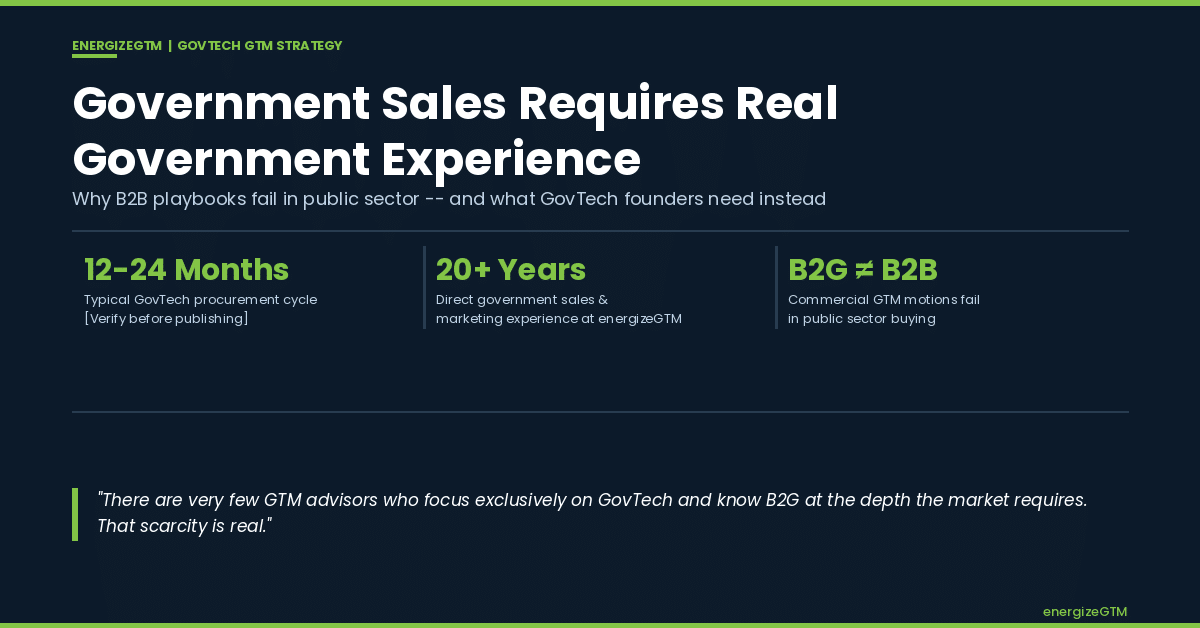
That one "accidental" phone call led to 10 years at Microsoft, then Dell, then 8 years inside public law, then 20+ years selling into government agencies - navigating RFPs, CJIS compliance, procurement cycles that stretched 14 months on average, and one deal that took five years to close. Today he runs energizeGTM, a GTM advisory firm helping GovTech and LegalTech founders build revenue strategies that actually work.
None of that was in a five-year plan.
Why Five-Year Plans Fail GovTech Founders
The five-year plan mythology goes back to high school career counseling. Pick a destination. Build a road map. Measure your progress against it. The problem is that career and business reality doesn't cooperate with that model - and in GovTech, where procurement timelines, policy shifts, and budget cycles can rewrite your entire sales motion overnight, rigid long-term planning is a liability, not an asset.
This isn't a call to operate without direction. It's a call to hold your direction loosely enough to take the door that opens next to you.
The GovTech-Specific Problem With Rigid Planning
Public sector software sales operates on cycles that no spreadsheet can fully anticipate. Municipal finance software deals can stall for 18 months while a city council changes leadership. A grant management software opportunity can materialize in six weeks because federal funding just dropped and an agency has a use-it-or-lose-it window.
The founders and sales leaders who thrive in GovTech are the ones who built enough flexibility into their GTM strategy to sprint when the window opens - and to stay patient when the cycle demands it. That's not a five-year plan skill. That's a situational intelligence skill.
If you're building a LegalTech or GovTech GTM strategy right now, the GovTech founder GTM playbook is worth reviewing before you lock in your annual operating plan.
What 20+ Years of Selling to Government Actually Teaches You
The Jobs You Don't Apply For Are Often the Best Ones
This is more than career advice. For GovTech founders building a sales team, it's a hiring insight. The rep who built a career selling public safety software because they stumbled into a territory nobody wanted often outperforms the candidate with the polished resume. Pattern recognition from doing the hard work - the long cycles, the procurement mazes, the RFP language - compounds in ways that credentials don't.
When you're hiring for GovTech roles, look for people with scars. Look for people who have closed a government deal that took two years. Those are the people who understand that this industry rewards persistence more than pedigree.
Relationships in GovTech Have a Half-Life Measured in Decades
The client who becomes a decade-long friend isn't a nice-to-have - it's a structural advantage in an industry where trust is currency. Public sector buyers move between agencies. The IT director you helped navigate a water utility management software implementation in 2018 may be the deputy city manager in a new municipality by 2025.
GovTech is a small world with long memories. The way you show up in year one - whether you over-promise on a government compliance software deal or you deliver what you said you would - follows you for the length of your career in this space.
The Industry You Fall Into Is Often the One That Fits
People who plan their way into GovTech are rarer than people who arrive through some chain of accidents and stay because they realize they're actually good at it. There's something about the complexity of public sector ERP software, the patience required for municipal procurement, the satisfaction of knowing your fire department software or EMS management software is keeping people safer - that creates a specific kind of professional loyalty you don't find everywhere.
If you're a founder who ended up in GovTech because of some version of a recruiter message on an answering machine, you're in good company. And you're probably better positioned than you think.
A Better Framework: Plan 12 Months, Hold 5 Years Loose
Here's the operating model that actually works in high-complexity B2B environments like public sector software sales:
- Pick a direction, not a destination. In GovTech GTM, your direction might be "become the most trusted vendor in wastewater management software in the Mountain West." Your destination - ARR number, market share, exit valuation - is a hypothesis, not a commitment. Hold it accordingly.
- Choose one or two skills to be known for this year. For a GovTech sales leader, that might be deep fluency in CJIS compliance requirements, or mastery of cooperative purchasing vehicles like NASPO or Sourcewell. For a founder, it might be public-facing thought leadership that builds procurement credibility. Pick two. Get sharp.
- Say yes even when it doesn't feel safe. The Microsoft recruiter opportunity felt like a mismatch. The best GovTech deals often look like wrong fits on paper. A procurement timeline that sounds impossible becomes your largest contract. An agency that seems too small becomes a reference customer that opens a whole state.
The AI Reality Filter from energizeGTM is built around this same principle - evaluating what's actually in front of you rather than projecting an idealized outcome onto a noisy situation.
Why AI Makes Rigid Career and GTM Plans Even More Dangerous
AI is moving fast. That statement is almost cliche at this point - but its implications for GovTech GTM strategy are specific and real.
Public sector software categories that looked stable 18 months ago are being restructured by AI-native competitors. Government accounting software, contract management software for government, and public transparency software are all seeing new entrants with fundamentally different cost structures and product architectures. The founders who planned five years out in 2022 are now rebuilding their GTM motion from scratch.
The founders who built flexibility into their operating model - who said yes to conversations that didn't fit the plan, who followed interesting problems instead of pre-defined markets - are the ones adapting fastest.
This is also why the Built for Government podcast has leaned so hard into practitioner conversations over the last year. The people who are actually in the trenches of GovTech sales right now are generating insights that no analyst report can replicate. That's where the real signal is.
What to Do With the Next 12 Months
For GovTech Founders Under $5M ARR
Your immediate GTM priority is not a five-year product roadmap. It's understanding exactly which buyer has the pain you solve right now - and building a motion to reach them before your budget runs out or the procurement window closes. That requires flexibility, speed, and pattern recognition over formal planning.
The GovTech founders sales guide from energizeGTM walks through the specific GTM mechanics for early-stage public sector SaaS companies - the kind of tactical playbook that actually maps to where you are right now, not where you hope to be in five years.
For GovTech Sales Leaders
If you're leading revenue at a GovTech company, the most valuable thing you can do this year is build your network deeper into adjacent agencies and roles. The person you meet at a NAGW conference who isn't a buyer today may be approving budgets in 18 months. Government careers move slowly - but they do move.
Build your pipeline like a GovTech lifer: more touchpoints, more patience, more investment in relationships that pay out over years, not quarters.
Frequently Asked Questions
What is the best GTM strategy for early-stage GovTech SaaS companies?
The most effective GovTech GTM strategy for companies under $5M ARR focuses on a narrow vertical within public sector software, deep relationship-building with agency buyers, and procurement fluency - particularly around cooperative purchasing vehicles, RFP response quality, and compliance credibility. A 12-month plan with clear direction beats a five-year plan with false precision every time at this stage.
How long does a typical GovTech sales cycle take?
GovTech sales cycles typically run 6 to 18 months for mid-market public sector deals, with enterprise-level government software contracts often extending to 24 months or longer. Factors that affect cycle length include procurement vehicle availability, budget timing, agency leadership stability, compliance requirements like CJIS or FedRAMP, and whether the solution requires a formal RFP process. The longest reported cycles in complex categories like public sector ERP software or government compliance software can exceed five years.
Should GovTech founders specialize in one public sector vertical or go broad?
Early-stage GovTech founders consistently perform better with vertical focus than with broad market positioning. Whether your product serves fire department software, wastewater management software, or municipal finance software buyers, depth of category knowledge - compliance requirements, procurement norms, buyer personas, and peer networks - compounds into a trust advantage that horizontal competitors cannot replicate. Pick the vertical where you have the most credibility and go deep before going wide.
How do I build credibility with government buyers who are skeptical of new vendors?
Government buyers are institutional risk managers. They evaluate vendors through the lens of: will this company still exist in three years, will they support us through compliance changes, and can I defend this purchase decision to my leadership? Credibility comes from reference customers in similar agencies, demonstrated compliance knowledge, a stable and responsive support model, and a sales process that treats the procurement timeline as a partnership rather than a friction point.
Conclusion
Twenty-plus years of selling public sector software didn't come from a plan. It came from picking up an answering machine message, saying yes to something that looked like a mismatch, and following the interesting problems that showed up along the way.
For GovTech founders and sales leaders right now, the lesson is the same: hold your five-year vision loosely, build a sharp 12-month plan, and stay flexible enough to take the door that opens next to you. The best opportunities in public sector software rarely announce themselves on schedule.
If you want to pressure-test your current GTM direction against the reality of where early-stage GovTech companies actually succeed, energizeGTM is built for exactly that conversation.
Ready to Build a GovTech GTM Strategy That Adapts as Fast as the Market?
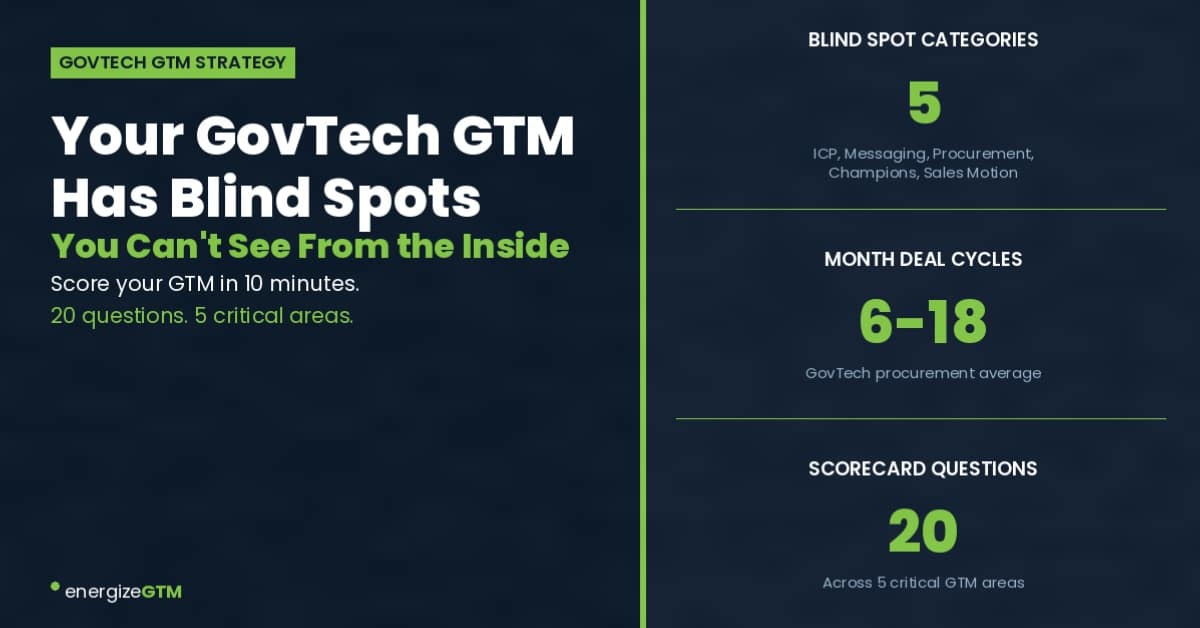
Try the GovTech GTM Scorecard to benchmark your current go-to-market strategy against what's actually working in public sector SaaS right now: Take the GovTech GTM Scorecard
Or reach out directly - the energizeGTM team works with a small number of GovTech founders at any given time, and the conversation starts here: Contact energizeGTM
Want to understand the full advisory process before you reach out? Learn more about how energizeGTM works: The energizeGTM Roadmap Process