
Table of Contents
WIIFM in Government Sales: Why Stakeholder-Specific Messaging Wins GovTech Deals
In government sales, the message that wins the room is rarely the message that won the last room. Every stakeholder evaluates your solution through a single lens - WIIFM (What's In It For Me) - and that definition shifts depending on who you're talking to. If you're selling public sector software and you haven't mapped your value proposition to each decision-maker's context, you're leaving alignment on the table and deals at risk.
Why Government Sales Is Not a Single-Stakeholder Game
In many B2B sales environments, identifying the decision maker is enough to move a deal forward. Influence is concentrated, and alignment with key individuals carries real weight. Government decisions don't work that way.
They are distributed by design. Procurement focuses on compliance and process. IT evaluates risk, integration, and security. Leadership considers outcomes and accountability. End users care about usability and workflow impact. And none of these roles share the same WIIFM.
What makes this more complex is that influence is not always visible. Individuals who aren't part of early conversations can still determine the outcome. In government environments, formal authority and actual influence often sit in different chairs.
The Victim Advocate Example
Consider a county district attorney's office evaluating a case management platform. The IT director and chief deputy are in every meeting. The procurement officer is reviewing the contract terms. But the victim advocate - a role that sits outside the core evaluation team - is the person who will use the system dozens of times a day to track case communications and victim notifications.
When that advocate raises a concern about usability in a side conversation with the chief deputy, the deal stalls. Her role was operational, but her needs were critical. That gave her influence that outweighed more senior stakeholders.
Sellers who only engage visible stakeholders create blind spots in the deal. In public sector sales, those blind spots are where momentum dies.
WIIFM Is the Core Principle of Multi-Stakeholder Alignment
At the center of every government deal is a simple but often overlooked principle: What's In It For Me. Every stakeholder evaluates your solution through this lens, but the definition of value changes depending on whom you're speaking to. This is where most sellers lose alignment - they communicate a single value proposition across a group that doesn't share the same priorities.
WIIFM is not a manipulation tactic. It's a discipline. It requires you to understand each stakeholder's world well enough to frame your solution in terms of what matters to them specifically. When you can do that consistently, you stop pitching and start having relevant conversations.
How WIIFM Varies Across Government Stakeholders
In government environments, the WIIFM calculation varies significantly by role. Getting this right is foundational to selling public sector software effectively in any vertical - from municipal finance software to fire department software to wastewater management software.
- Elected officials and department heads - Focus on public impact, constituent outcomes, and reputational risk. They evaluate your solution through the lens of how it will look to the public and whether it protects them from accountability exposure.
- Procurement officers - Care about compliance, contract structure, vendor credentialing, and staying within budget. They are rarely the champion, but they can kill the deal on a technicality if you ignore them.
- IT directors and security teams - Evaluate risk, system integration, data governance, and long-term support burden. For government compliance software and public sector ERP software especially, IT sign-off is non-negotiable.
- Operations and program managers - Focus on workflow efficiency, implementation timelines, and whether adoption will be painful for their teams.
- End users - Care about day-to-day usability, training burden, and whether the new tool makes their job easier or harder.
Treating these perspectives as one creates friction. Even if the product is strong, the message doesn't land because it isn't framed in a way that matters to the individual.
The Feature-Heavy Demo Problem
One of the most common ways sellers lose government deals is the feature-heavy demo. Instead of showing what matters to the individual stakeholder in the room, they try to show everything. Attention drops, engagement fades, and clarity is lost.
This is especially damaging in government. These are busy professionals with high-stakes operational responsibilities. A 60-minute demo that covers 30 features and addresses no one's WIIFM specifically is worse than a 20-minute demo that directly answers three questions the IT director actually has about data residency, API integration, and support SLAs.
Relevance matters more than completeness. When the message becomes broad, it loses impact. Every minute you spend showing something that doesn't matter to someone in the room is a minute you're eroding trust with the people who do care about something different.
Discipline Under Pressure
Maintaining message alignment requires discipline, especially when the deal starts moving. When champions start pushing for broader stakeholder buy-in, sellers often default to trying to show everything. It feels like the safe move. It isn't.
When you try to show everything, you make it harder for anyone to see what matters to them. That's the WIIFM trap. The safest move is the focused one - a conversation that speaks directly to the individual's context, even if it means covering less ground overall.
How to Uncover WIIFM at Each Level of the Government Deal
Understanding WIIFM requires intentional discovery. It's not enough to identify pain at a surface level. You need to understand what success looks like for each stakeholder and how your solution supports that outcome in their specific context.
This means doing the work before the meeting, not during it. You should enter every stakeholder conversation with a working hypothesis about their WIIFM, built from:
- Their role title and functional responsibility
- The organizational pressure they're operating under (budget constraints, audit cycles, compliance mandates, staff turnover)
- What prior interactions with your product or team have already revealed
- What their peers in similar roles typically care about
Then confirm or revise that hypothesis through discovery. The best discovery questions aren't generic. They're built around the hypothesis: "Based on what I know about your role, I'd expect your biggest concern here is X - is that right, or is there something more pressing I should understand first?"
That's WIIFM-driven discovery. It signals competence, saves time, and opens doors that surface-level questions never reach.
WIIFM in LegalTech Sales: A Parallel Complexity
Government sales and LegalTech sales share more overlap than most founders recognize. A LegalTech GTM strategy that ignores multi-stakeholder WIIFM faces the same structural challenges.
In a law firm or public law office evaluating contract automation software or eDiscovery tools, stakeholders include managing partners (focused on client outcomes and revenue impact), associates (focused on reducing administrative burden), IT (focused on data security and integration), and finance (focused on cost per matter and billing implications). Each has a distinct WIIFM.
A LegalTech SaaS sales playbook that collapses these into a single pitch will encounter the same resistance that GovTech sellers hit when they ignore multi-stakeholder dynamics. The principle is identical - WIIFM is not one thing, and alignment requires that each stakeholder see themselves in the solution.
For founders building a GTM for LegalTech SaaS or scaling GTM for LegalTech startups, the discovery process is the same: map the stakeholders, hypothesize their WIIFM, confirm through direct conversation, and tailor the message accordingly.
Building a WIIFM Map for Your Government Deals
A WIIFM map is a simple internal tool that forces clarity before every major stakeholder interaction. It doesn't need to be elaborate. For each active deal, map the following:
- Stakeholder name and role
- Their functional WIIFM - what success looks like in their role
- Their political WIIFM - what they're being evaluated on internally
- Your solution's relevance - specifically how it supports their WIIFM
- Current alignment level - strong, neutral, or at-risk
- Last meaningful conversation - what was confirmed, what's still a hypothesis
This is the tool that separates reactive sellers from ones who consistently advance complex deals. If you don't know each stakeholder's WIIFM going into a conversation, you're guessing. In government sales, guessing is how you lose deals you should have won.
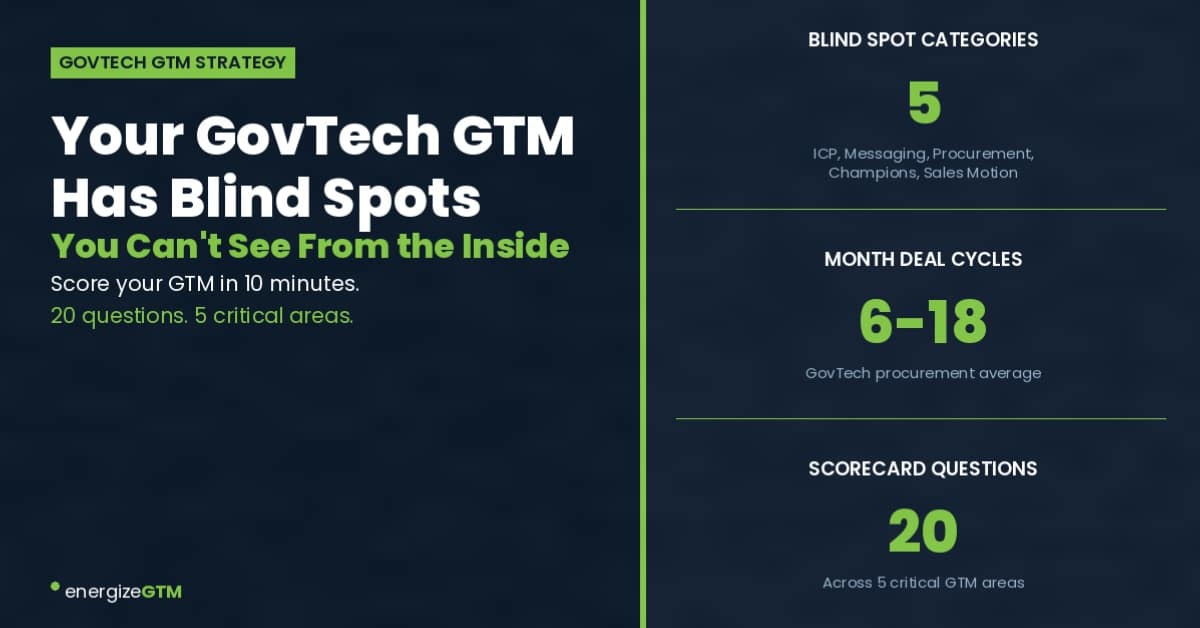
The GovTech GTM Scorecard can help you assess where your current process stands and where the gaps are in your stakeholder engagement model.
What Happens When WIIFM Is Clear
When WIIFM is clear for every stakeholder in the deal, the dynamics shift. Conversations become sharper because you're not covering everything - you're covering what matters. Demos become more relevant because you're showing solutions to real problems, not a feature parade. Alignment becomes easier to build because each stakeholder has been shown that their specific context was considered.
That clarity also accelerates decision-making. Government deals are slow by nature - procurement cycles, budget approvals, and committee reviews all create friction. But deals where every stakeholder has a clear individual reason to say yes move faster through those stages than deals where the value is understood at a general level but not specific to anyone.
WIIFM doesn't just win deals. It shortens them.
WIIFM and the GovTech Sales Process
For founders and early-stage sales teams selling into government, the WIIFM principle should be embedded into every stage of your process - from initial prospecting through final close.
At the prospecting stage, your outbound messaging should be role-specific. A cold email to a procurement director should look nothing like a cold email to a CIO. The pain is different. The language is different. The WIIFM is different.
At the discovery stage, your question framework should be built around uncovering each stakeholder's WIIFM, not just confirming that a general problem exists.
At the demo and proposal stage, every section of your presentation should be filterable by stakeholder - what does this mean for IT, for procurement, for the end user, for leadership?
The GovTech Founders Sales Guide walks through this process in detail, including how to build a discovery framework that surfaces WIIFM at every level of the buying committee.
Frequently Asked Questions About WIIFM in Government Sales
What does WIIFM mean in a B2B sales context?
WIIFM stands for "What's In It For Me." In B2B sales, it refers to the individual value that a specific stakeholder receives from your solution - not the general value proposition of the product overall. In government and LegalTech sales, where multiple stakeholders with different roles evaluate the same solution, understanding each person's WIIFM is essential to building alignment across the buying committee.
Why is WIIFM especially important in government software sales?
Government purchasing decisions involve multiple stakeholders with fundamentally different priorities - procurement, IT, leadership, and end users. Each evaluates the same solution through a different lens. A message that resonates with IT may not land with procurement. A demo built for department heads may frustrate the operational staff who will use the system daily. WIIFM-driven selling addresses each stakeholder individually, which is the only way to build consistent alignment across the government buying committee.
How do I uncover each stakeholder's WIIFM in a government deal?
Start with a working hypothesis based on their role and the organizational pressures typical for that function. Then confirm or revise through direct discovery conversations. The most effective approach is hypothesis-led: "Based on your role, I'd expect your primary concern here is X - is that accurate, or is there something more pressing I should understand?" This approach signals competence, saves time, and surfaces the real WIIFM faster than generic questions.
Does WIIFM apply to LegalTech sales the same way?
Yes. LegalTech sales involves the same multi-stakeholder complexity. Managing partners, associates, IT teams, and finance all evaluate contract automation, eDiscovery software, or practice management tools through different WIIFMs. A LegalTech SaaS sales playbook that ignores this will face the same alignment failures that GovTech sellers encounter when they deliver a single unified pitch to a diverse buying committee.
What's a simple way to track WIIFM across a complex government deal?
Build a WIIFM map for each active deal. For every stakeholder, document their functional WIIFM, their political WIIFM, how your solution supports both, their current alignment level, and what your last meaningful conversation confirmed or left as a hypothesis. This doesn't need to be sophisticated - it can live in a notes field in your CRM. The discipline of building and maintaining it is what produces results.
Conclusion: WIIFM Is the Discipline That Moves Government Deals
Government deals are slow, complex, and full of stakeholders whose priorities don't align by default. WIIFM - What's In It For Me - is the principle that creates that alignment. Not by simplifying the sale into one message, but by doing the work to understand what each stakeholder needs to see and hear to believe your solution is the right answer for them specifically.
This is a discipline, not a technique. It requires consistent discovery, thoughtful message tailoring, and the restraint to not show everything when showing less will create more impact. The sellers and founders who internalize WIIFM as a process - not a tactic - are the ones who build momentum in complex government and LegalTech deals where others stall out.
If you're building or refining your GovTech GTM strategy, the Built for Government podcast covers conversations with founders who've navigated this exact complexity - including how they learned to read multi-stakeholder buying committees and adapt their messaging accordingly.
Ready to Build a WIIFM-Driven GTM Strategy?
energizeGTM works with GovTech and LegalTech SaaS founders under $5M ARR who are building repeatable sales processes for complex, multi-stakeholder environments. If your deals are stalling in government procurement or you're losing alignment with buying committees, that's a fixable problem.
Contact us to learn more about how energizeGTM helps founders build WIIFM-driven sales systems that move government deals forward.
Or explore the energizeGTM Roadmap Process to see how the engagement works from first conversation to full GTM deployment.