GTM Strategy for GovTech & LegalTech SaaS

Every playbook, brief, and
episode. One filter.

Downloads for the lever you’re about to pull. Articles for the argument you’re making internally. Episodes for the context on a specific buyer’s room.

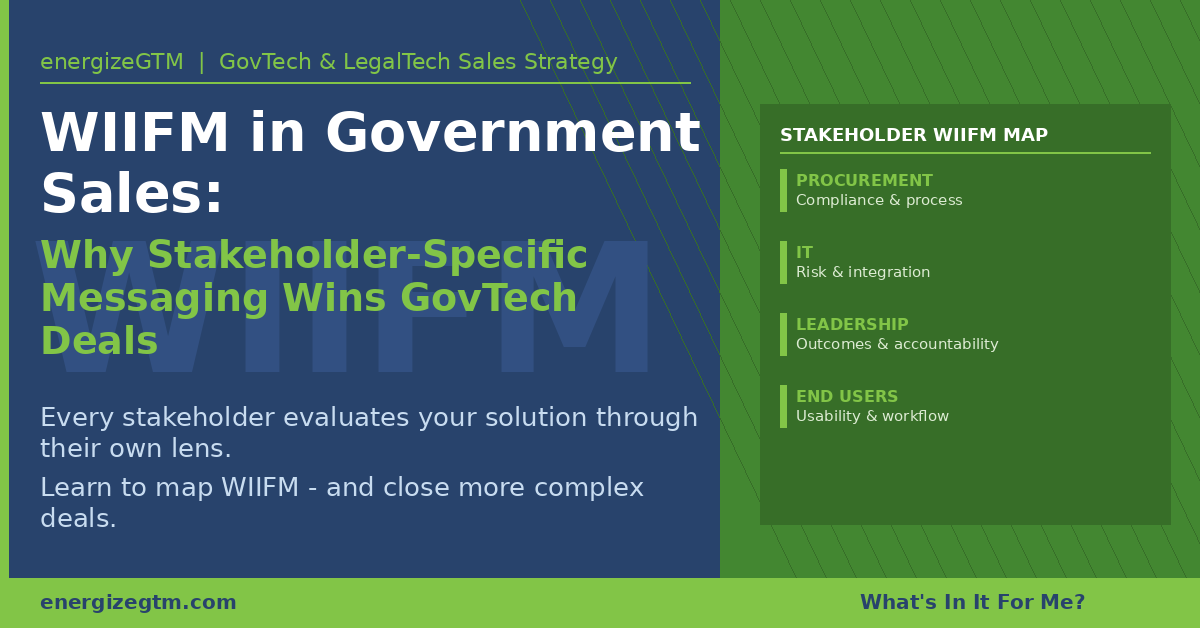
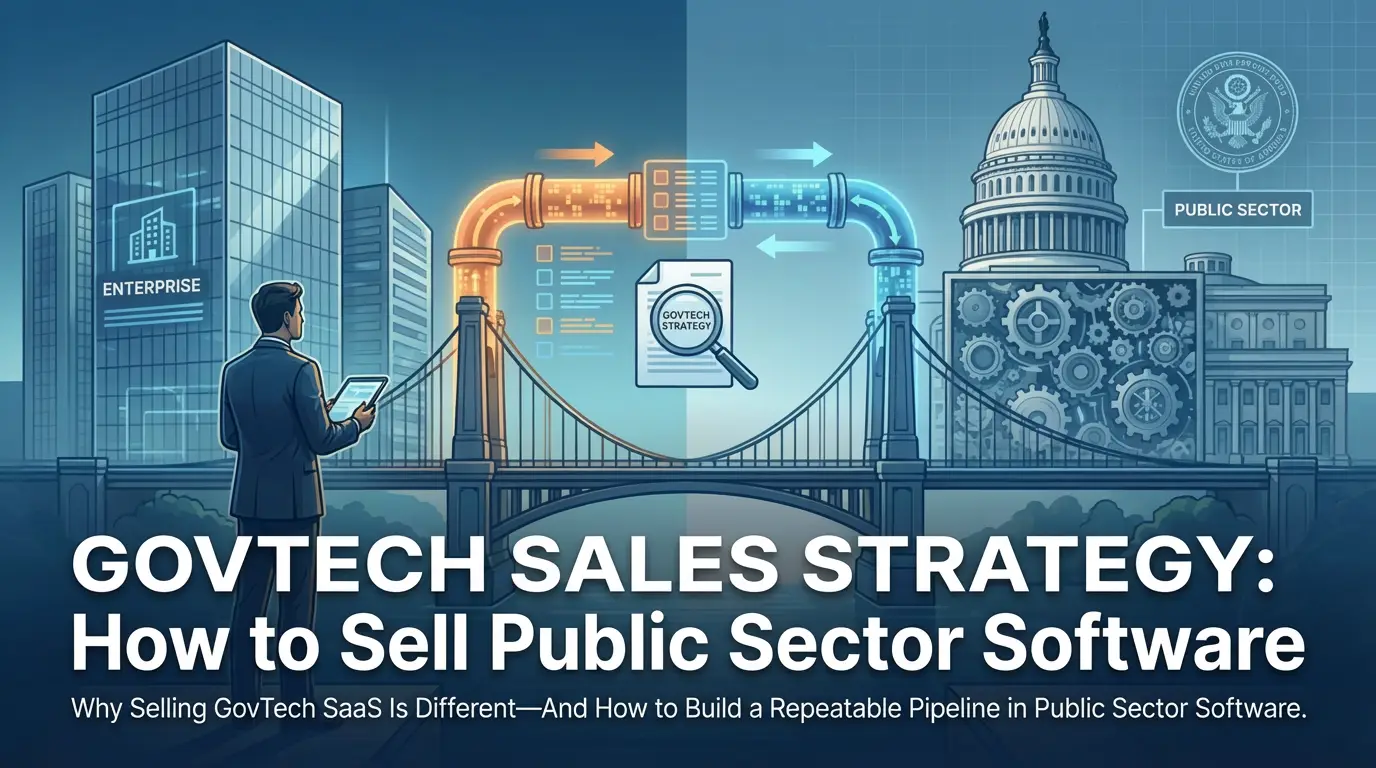
In government sales, every stakeholder evaluates your solution through their own WIIFM lens. Learn how to map and address each one to build alignment and win complex deals.
The best GovTech careers and GTM strategies rarely follow a script. Here's why a 12-month direction beats a rigid five-year plan -- and how public sector SaaS founders can build a motion that adapts as fast as the market moves.
LinkedIn's new AI-powered algorithm evaluates content by context and depth, not just engagement. Most creators miss the underground society of lurkers watching silently. Here's what actually works now and why no engagement doesn't mean no results.
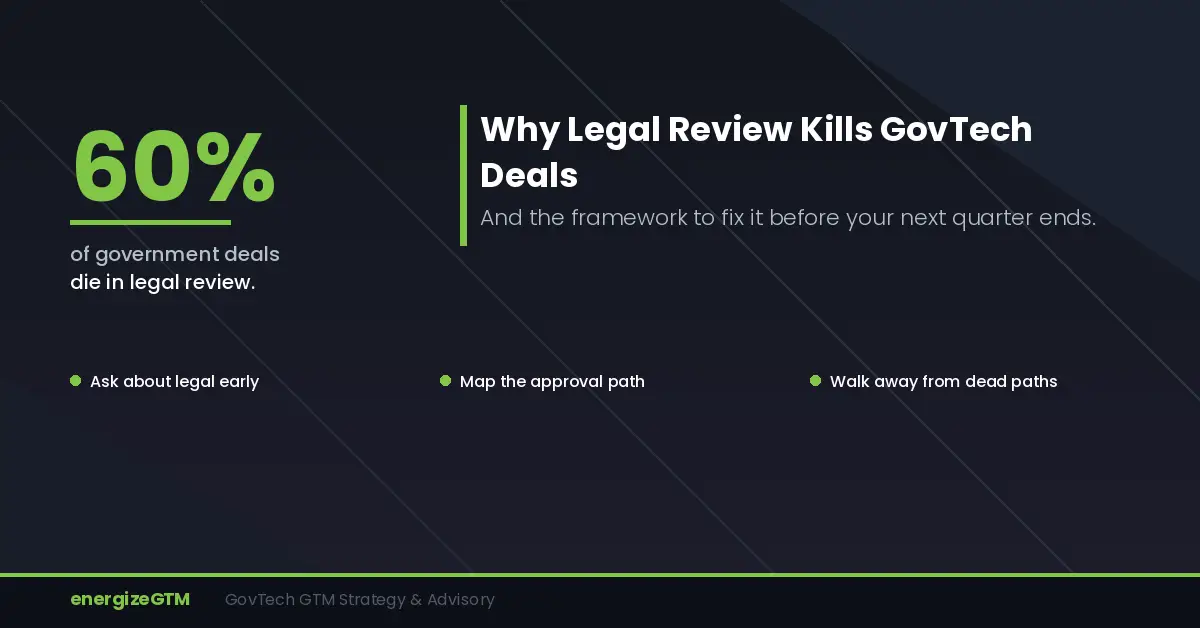
Roughly 60% of government deals die during legal review, not because the tech fails but because founders never map how the agency is allowed to buy. This post breaks down the three mistakes GovTech founders make and provides a practical framework for surviving government procurement and legal review.
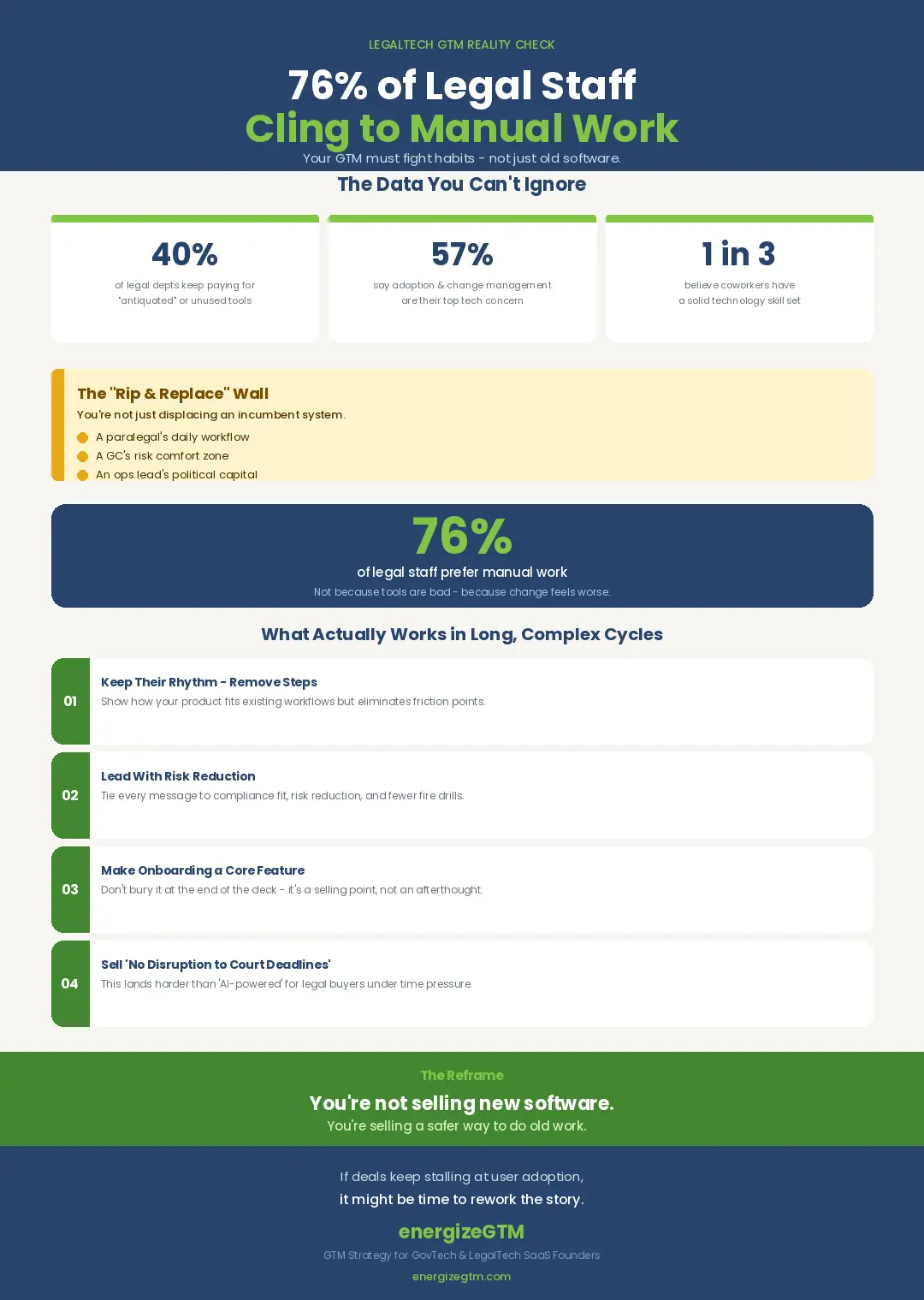
Most LegalTech deals stall because GTM messaging addresses product features while buyers are defending entrenched workflows. Here is how to fix the story and close more deals.
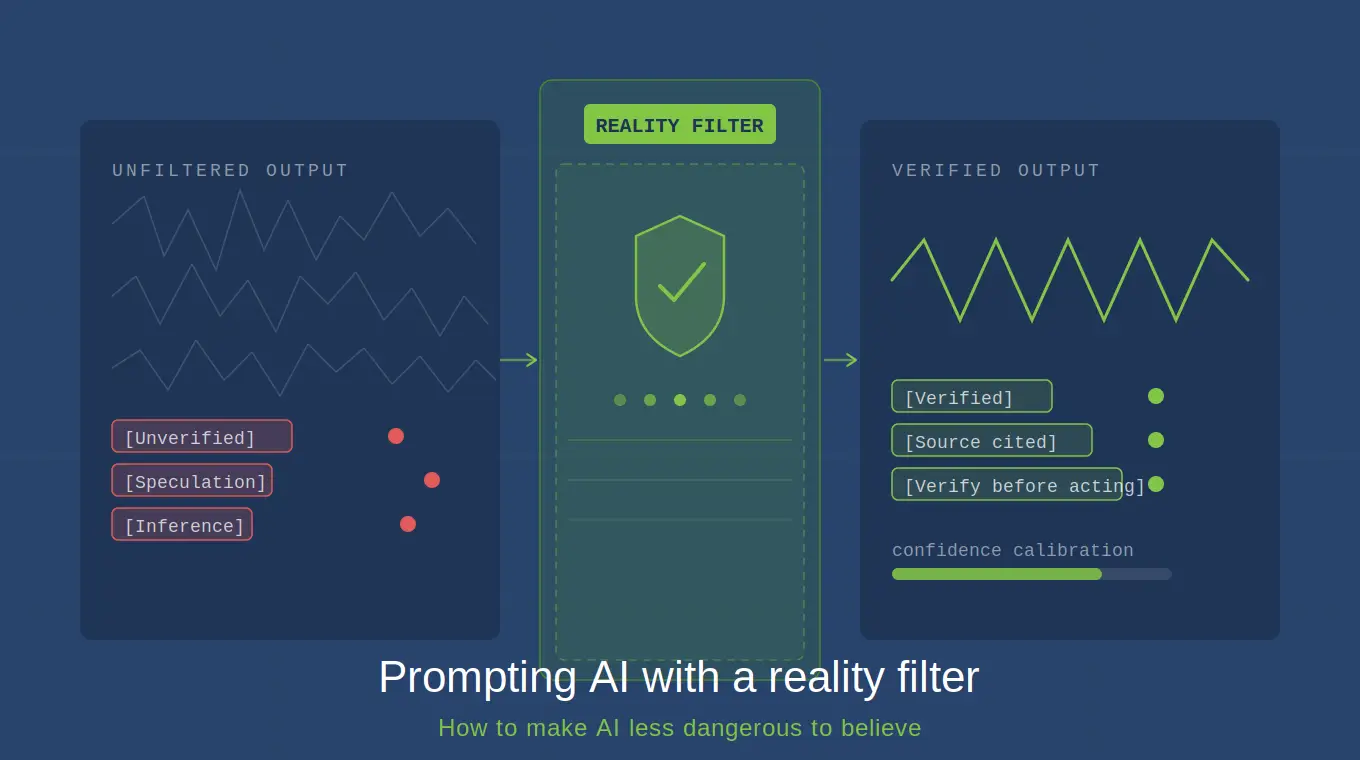
AI sounds confident even when it's wrong. That's the problem. Without guardrails, language models fill gaps with plausible-sounding answers - and most users have no way to tell the difference between a verified fact and a well-dressed hallucination. A reality filter is a prompt directive that forces AI to label what it knows, what it's inferring, and what you should verify before acting on. This post breaks down exactly how to build one, what to include, and why it makes AI output dramatically safer to use in real business decisions. If you use AI for research, content, strategy, or client work - this is worth five minutes of your time.
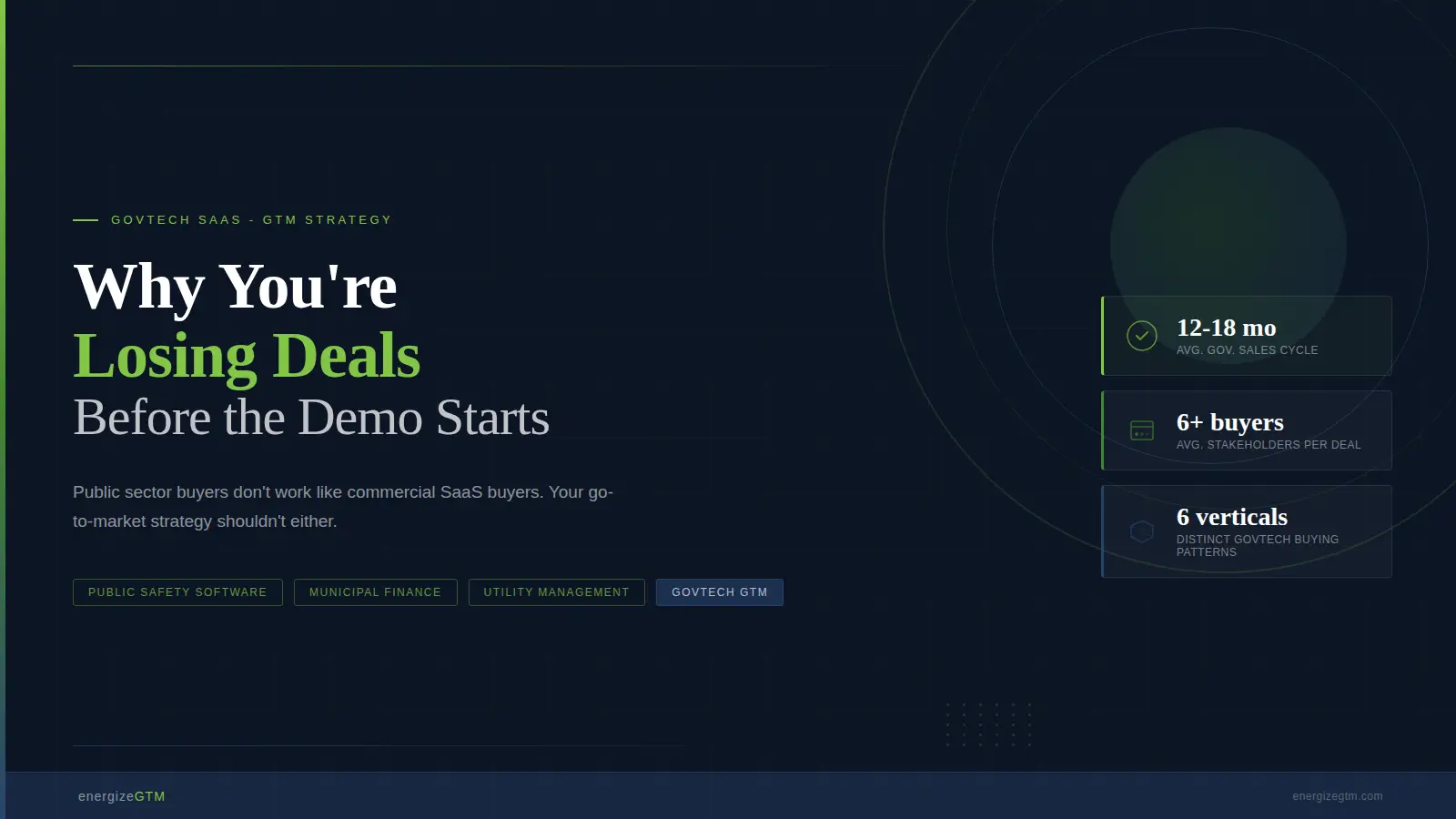
GovTech SaaS deals don't stall because your product is weak. They stall because your GTM strategy wasn't built for the way government actually buys. This post breaks down the six verticals where GovTech founders get it wrong - and what a vertical GTM strategy actually looks like in practice.
Email warmup is the process of gradually building a positive reputation for a new (or inactive) email address or domain so that your messages land in people’s inboxes instead of spam.
GovTech SaaS deals don't stall because your product is weak. They stall because your GTM strategy wasn't built for the way government actually buys. This post breaks down the six verticals where GovTech founders get it wrong - and what a vertical GTM strategy actually looks like in practice.
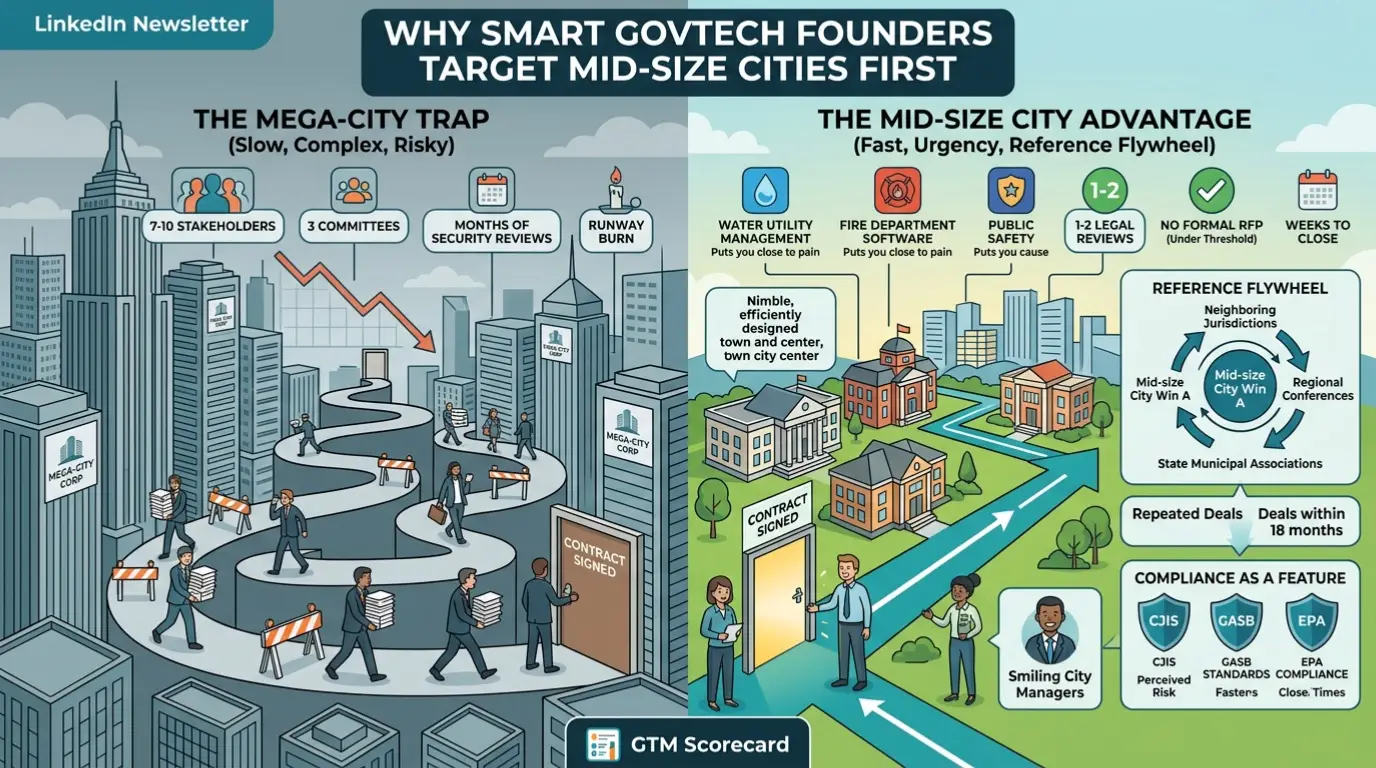
Mid-size cities offer GovTech SaaS founders shorter procurement cycles, fewer decision layers, and a reference network effect that mega-city deals simply cannot match at early stage.
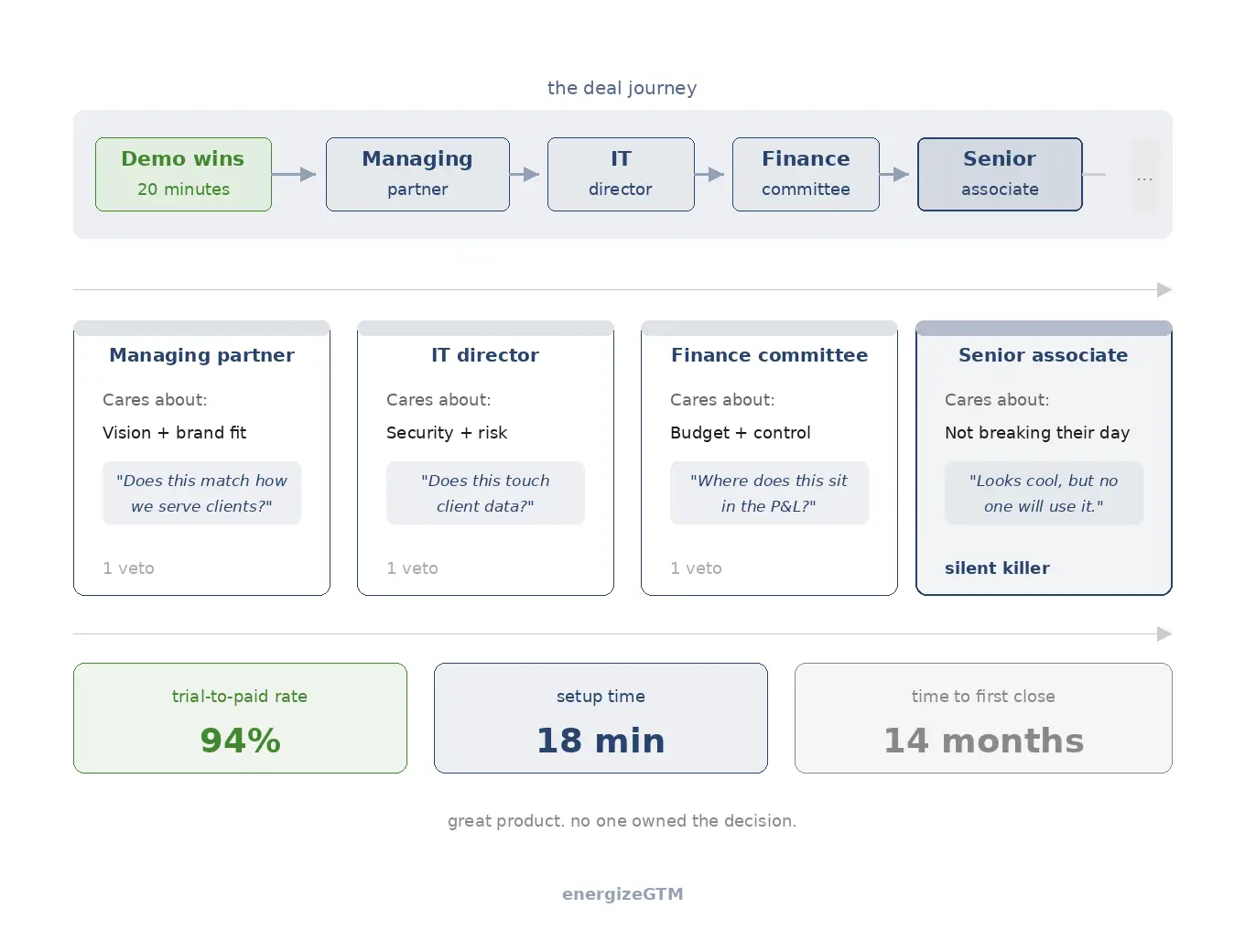
LegalTech has a buying problem, not a product problem. This post breaks down the four-veto buyer structure inside law firms and the GTM playbook that actually moves deals forward.
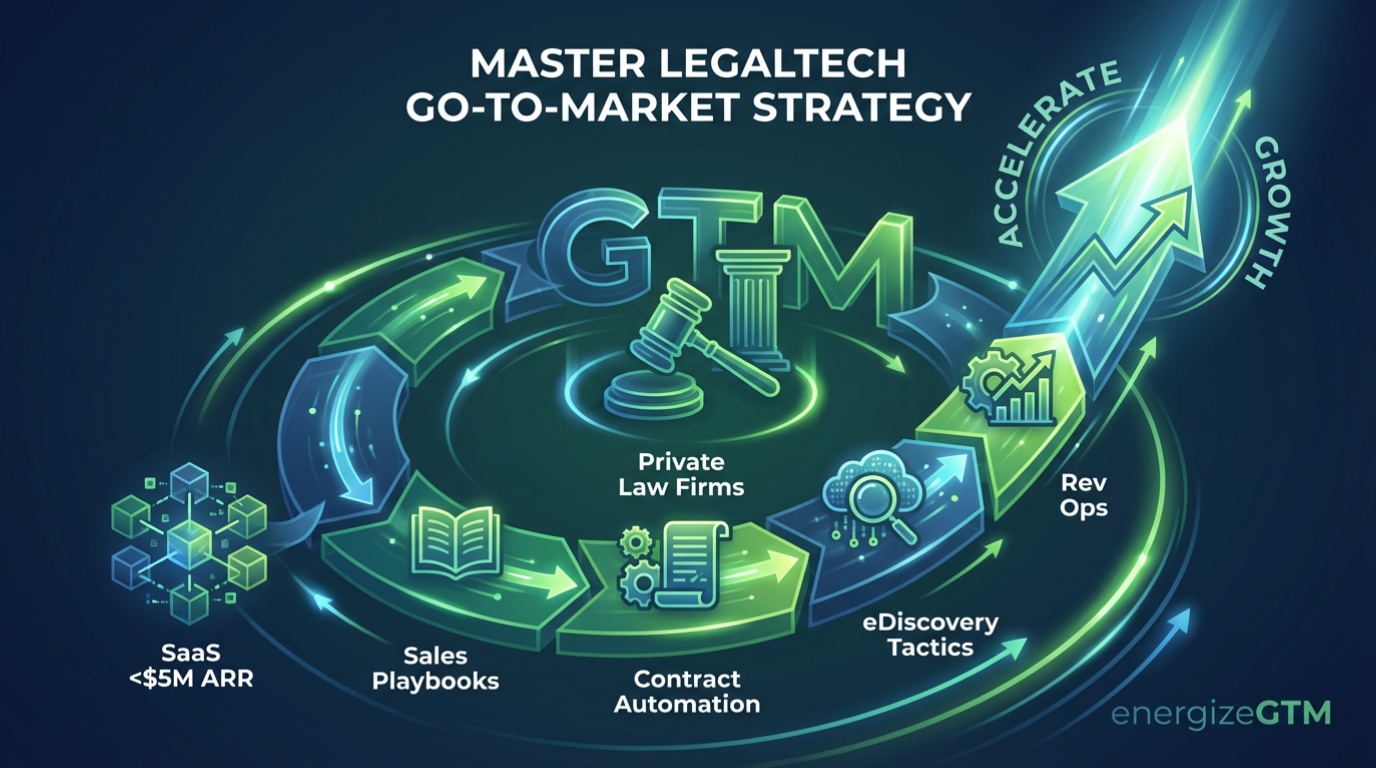
Master LegalTech go-to-market strategy for SaaS under $5M ARR targeting private law firms. Get GTM for LegalTech SaaS, sales playbooks, contract automation, eDiscovery tactics & rev ops to accelerate growth.
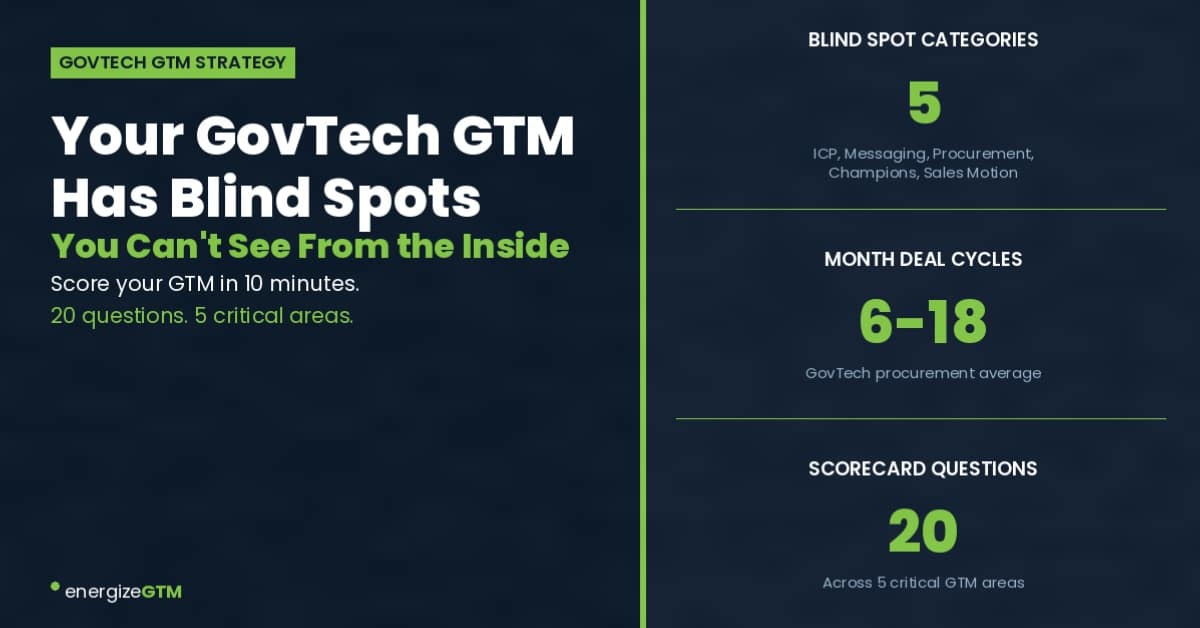
GovTech sales isn’t just “relationship plus demo” — it’s a system that most founders never fully build. If you’re stuck in long sales cycles, thin pipeline, and deals that keep slipping, the problem usually isn’t your product or your hustle; it’s the missing structure in your go-to-market motion. The GovTech GTM Scorecard helps founders quickly benchmark how well they define who they sell to, why agencies say yes, and how those agencies actually buy — from RFP paths to security reviews and legal steps. In 5–7 minutes, you’ll get a clear numeric score and visibility into gaps like ICP focus, mission‑driven messaging, and stage‑by‑stage funnel tracking, so you can turn unpredictable deals into a repeatable revenue engine.
Learn how you can create a modern, predictable outbound system.
After 25 years in enterprise sales, I finally stopped “translating” big-company playbooks and decided to build something built-for-purpose for lean GovTech and LegalTech SaaS teams. energizeGTM exists for founders with 2–5 person teams, long sales cycles, and complex public or legal buyers who are tired of copying Salesforce-sized GTM decks that burn people out and stall pipeline. Instead, we focus on clear ICP and segments, targeted list building and messaging, and simple motions a small team can run every week to move multi-threaded deals forward without bloated processes. If you’re a GovTech or LegalTech founder looking for a go-to-market system that fits your stage, your values, and how your buyers actually purchase, this is exactly what energizeGTM was built to deliver.
Most outbound teams are still overpaying for bloated legacy tools, stale data, and guesswork deliverability, then wondering why they’re stuck at 0.5–1% reply rates while burning time and domains. A modern system uses deep deliverability discipline, 100+ micro data sources, and short, human emails to consistently hit 2.5–4% replies at $20–30K a year instead of $100K+. When you layer that on top of clean data, tight TAM, a strong offer, solid unit economics, and a sales team that actually follows up 5–7 times, 3–5x pipeline improvement becomes normal in 2026. Teams that upgrade their stack and discipline now win more meetings and revenue from the same volume, while those clinging to legacy tools keep paying more for less.
Most GovTech teams have strong products, but their GTM still feels loud, slow, and random because they never start with a clear, real customer in mind. The fastest fix is a simple, repeatable system: sharp ICP, value written in agency language, a mapped buyer path from discovery to procurement, and data that shows which messages and moves actually work. When you stay present between budget cycles with helpful follow up, short check-ins, and one useful resource instead of constant pitching, you start to win in years, not weeks. You don’t need a bigger tech stack; you need a disciplined plan you run again and again until $30M-style outcomes feel normal, not lucky.
Enterprise sales are hard, but selling SaaS to government is a different beast entirely, with 6–36 month cycles, RFx traps, compliance gates, and approvals that can reset overnight. The real killer isn’t “government is slow,” it’s founders chasing every logo instead of a precise set of 3–5 repeatable agency types that actually renew and expand. The teams winning now treat agencies like micro-ICP clusters, map procurement calendars and pain triggers, and run pre-RFP intel sprints so they’re shaping the RFx instead of becoming column fodder. When you narrow your focus and work the calendar, you stop guessing your pipeline and start driving GovTech deals with intention.
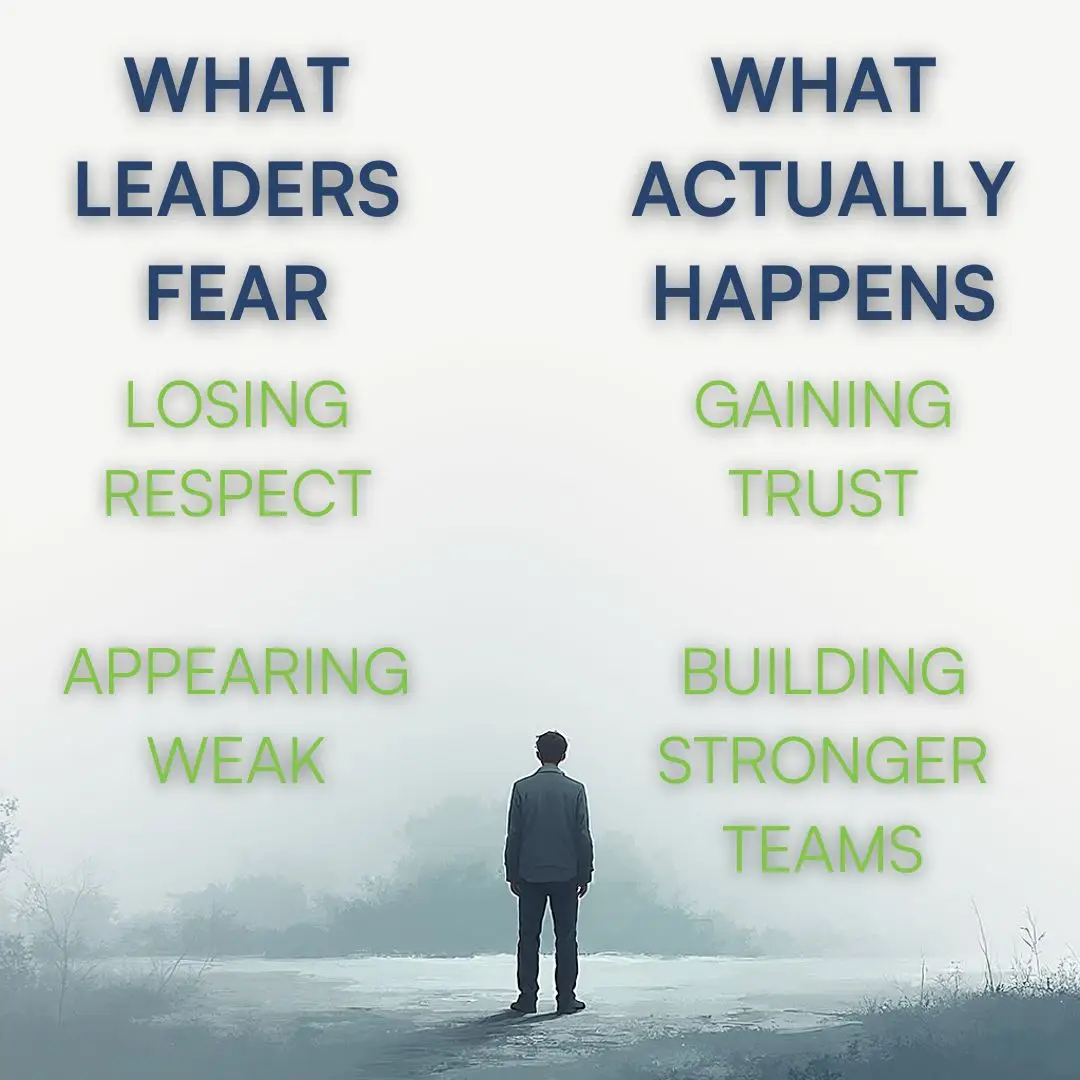
Early in my career, I spent 7 years at Microsoft in the late 90s, when we walked around like we had already won the future and arrogance felt like part of the job. In one meeting, a junior engineer challenged my manager in front of the entire team—and instead of shutting him down, my manager listened, admitted he was right, and changed direction on the spot. That moment taught me that real leadership is staying humble enough to be challenged, even when you’re “on top.” Success breeds arrogance, arrogance kills listening, and the second you believe you’re untouchable is the moment you start becoming irrelevant.
GovTech SaaS isn’t about flashy feature sets; it’s about trust, compliance, and a patient sales motion that matches how public agencies actually buy. Cities and counties don’t purchase for speed—they buy safety, process, and proof that your product won’t break rules, fail an audit, or clash with systems from 1998. The founders who win here bake security, compliance, and audit-ready records into their product and forecasts from day one, then stay disciplined through RFPs, committees, and legal reviews instead of chasing quick wins. When you treat compliance as a feature, align to the customer mission, and deliver for one agency, deals may be slow to close but they spread fast through the public sector once trust is earned.

In government sales, every stakeholder evaluates your solution through their own WIIFM lens. Learn how to map and address each one to build alignment and win complex deals.
AI sounds confident even when it's wrong. That's the problem. Without guardrails, language models fill gaps with plausible-sounding answers - and most users have no way to tell the difference between a verified fact and a well-dressed hallucination. A reality filter is a prompt directive that forces AI to label what it knows, what it's inferring, and what you should verify before acting on. This post breaks down exactly how to build one, what to include, and why it makes AI output dramatically safer to use in real business decisions. If you use AI for research, content, strategy, or client work - this is worth five minutes of your time.
GovTech SaaS deals don't stall because your product is weak. They stall because your GTM strategy wasn't built for the way government actually buys. This post breaks down the six verticals where GovTech founders get it wrong - and what a vertical GTM strategy actually looks like in practice.
Mid-size cities offer GovTech SaaS founders shorter procurement cycles, fewer decision layers, and a reference network effect that mega-city deals simply cannot match at early stage.
Most outbound teams are still overpaying for bloated legacy tools, stale data, and guesswork deliverability, then wondering why they’re stuck at 0.5–1% reply rates while burning time and domains. A modern system uses deep deliverability discipline, 100+ micro data sources, and short, human emails to consistently hit 2.5–4% replies at $20–30K a year instead of $100K+. When you layer that on top of clean data, tight TAM, a strong offer, solid unit economics, and a sales team that actually follows up 5–7 times, 3–5x pipeline improvement becomes normal in 2026. Teams that upgrade their stack and discipline now win more meetings and revenue from the same volume, while those clinging to legacy tools keep paying more for less.
The best GovTech careers and GTM strategies rarely follow a script. Here's why a 12-month direction beats a rigid five-year plan -- and how public sector SaaS founders can build a motion that adapts as fast as the market moves.
LinkedIn's new AI-powered algorithm evaluates content by context and depth, not just engagement. Most creators miss the underground society of lurkers watching silently. Here's what actually works now and why no engagement doesn't mean no results.
Roughly 60% of government deals die during legal review, not because the tech fails but because founders never map how the agency is allowed to buy. This post breaks down the three mistakes GovTech founders make and provides a practical framework for surviving government procurement and legal review.
Most LegalTech deals stall because GTM messaging addresses product features while buyers are defending entrenched workflows. Here is how to fix the story and close more deals.
Email warmup is the process of gradually building a positive reputation for a new (or inactive) email address or domain so that your messages land in people’s inboxes instead of spam.
GovTech SaaS deals don't stall because your product is weak. They stall because your GTM strategy wasn't built for the way government actually buys. This post breaks down the six verticals where GovTech founders get it wrong - and what a vertical GTM strategy actually looks like in practice.
LegalTech has a buying problem, not a product problem. This post breaks down the four-veto buyer structure inside law firms and the GTM playbook that actually moves deals forward.
Master LegalTech go-to-market strategy for SaaS under $5M ARR targeting private law firms. Get GTM for LegalTech SaaS, sales playbooks, contract automation, eDiscovery tactics & rev ops to accelerate growth.
GovTech sales isn’t just “relationship plus demo” — it’s a system that most founders never fully build. If you’re stuck in long sales cycles, thin pipeline, and deals that keep slipping, the problem usually isn’t your product or your hustle; it’s the missing structure in your go-to-market motion. The GovTech GTM Scorecard helps founders quickly benchmark how well they define who they sell to, why agencies say yes, and how those agencies actually buy — from RFP paths to security reviews and legal steps. In 5–7 minutes, you’ll get a clear numeric score and visibility into gaps like ICP focus, mission‑driven messaging, and stage‑by‑stage funnel tracking, so you can turn unpredictable deals into a repeatable revenue engine.
Learn how you can create a modern, predictable outbound system.
After 25 years in enterprise sales, I finally stopped “translating” big-company playbooks and decided to build something built-for-purpose for lean GovTech and LegalTech SaaS teams. energizeGTM exists for founders with 2–5 person teams, long sales cycles, and complex public or legal buyers who are tired of copying Salesforce-sized GTM decks that burn people out and stall pipeline. Instead, we focus on clear ICP and segments, targeted list building and messaging, and simple motions a small team can run every week to move multi-threaded deals forward without bloated processes. If you’re a GovTech or LegalTech founder looking for a go-to-market system that fits your stage, your values, and how your buyers actually purchase, this is exactly what energizeGTM was built to deliver.
Most GovTech teams have strong products, but their GTM still feels loud, slow, and random because they never start with a clear, real customer in mind. The fastest fix is a simple, repeatable system: sharp ICP, value written in agency language, a mapped buyer path from discovery to procurement, and data that shows which messages and moves actually work. When you stay present between budget cycles with helpful follow up, short check-ins, and one useful resource instead of constant pitching, you start to win in years, not weeks. You don’t need a bigger tech stack; you need a disciplined plan you run again and again until $30M-style outcomes feel normal, not lucky.
Enterprise sales are hard, but selling SaaS to government is a different beast entirely, with 6–36 month cycles, RFx traps, compliance gates, and approvals that can reset overnight. The real killer isn’t “government is slow,” it’s founders chasing every logo instead of a precise set of 3–5 repeatable agency types that actually renew and expand. The teams winning now treat agencies like micro-ICP clusters, map procurement calendars and pain triggers, and run pre-RFP intel sprints so they’re shaping the RFx instead of becoming column fodder. When you narrow your focus and work the calendar, you stop guessing your pipeline and start driving GovTech deals with intention.
Early in my career, I spent 7 years at Microsoft in the late 90s, when we walked around like we had already won the future and arrogance felt like part of the job. In one meeting, a junior engineer challenged my manager in front of the entire team—and instead of shutting him down, my manager listened, admitted he was right, and changed direction on the spot. That moment taught me that real leadership is staying humble enough to be challenged, even when you’re “on top.” Success breeds arrogance, arrogance kills listening, and the second you believe you’re untouchable is the moment you start becoming irrelevant.
GovTech SaaS isn’t about flashy feature sets; it’s about trust, compliance, and a patient sales motion that matches how public agencies actually buy. Cities and counties don’t purchase for speed—they buy safety, process, and proof that your product won’t break rules, fail an audit, or clash with systems from 1998. The founders who win here bake security, compliance, and audit-ready records into their product and forecasts from day one, then stay disciplined through RFPs, committees, and legal reviews instead of chasing quick wins. When you treat compliance as a feature, align to the customer mission, and deliver for one agency, deals may be slow to close but they spread fast through the public sector once trust is earned.
Free diagnostic · No email required

Is your GovTech GTM firing on all cylinders?

Five pillars. Twenty yes/no questions. A specific score per pillar — and the single lever most likely to unstick your next quarter.

5 min to complete

No signup to see results

Built for under-$5M ARR founders

The GTM Scorecard
Score your 5 GTM pillars – in 5 minutes
Instant results · No email required
×

Thank you! Your message has been sent.