Table of Contents
Your demo takes 20 minutes. The buying committee takes 20 weeks — if you’re lucky.
If you’re a founder, CEO, or VP of Sales at a LegalTech SaaS company under $5M ARR, you’ve probably lived this story. A promising trial. A champion inside the firm. A pipeline that looks healthy in your CRM. Then silence — not because your product failed, but because no one inside the firm owns the buying decision.
LegalTech has a buying problem, not a product problem. And until your go-to-market strategy is built around that reality, you will keep watching strong demos collapse into months-long dead zones.
This post gives you the LegalTech go-to-market strategy frameworks, sales playbooks, and revenue operations tactics that are working right now for startups at your stage — built specifically for the structural complexity of selling into law firms, courts, and legal departments.
Why LegalTech GTM Stalls — and It’s Not Your Product
Most SaaS GTM advice was written for B2B software sold into a clear economic buyer: a VP of Engineering, a CMO, a Head of Operations. One champion. One signature. One check.
Law firms don’t work that way. Neither do legal departments inside enterprise companies. And neither does the broader public-sector legal market.
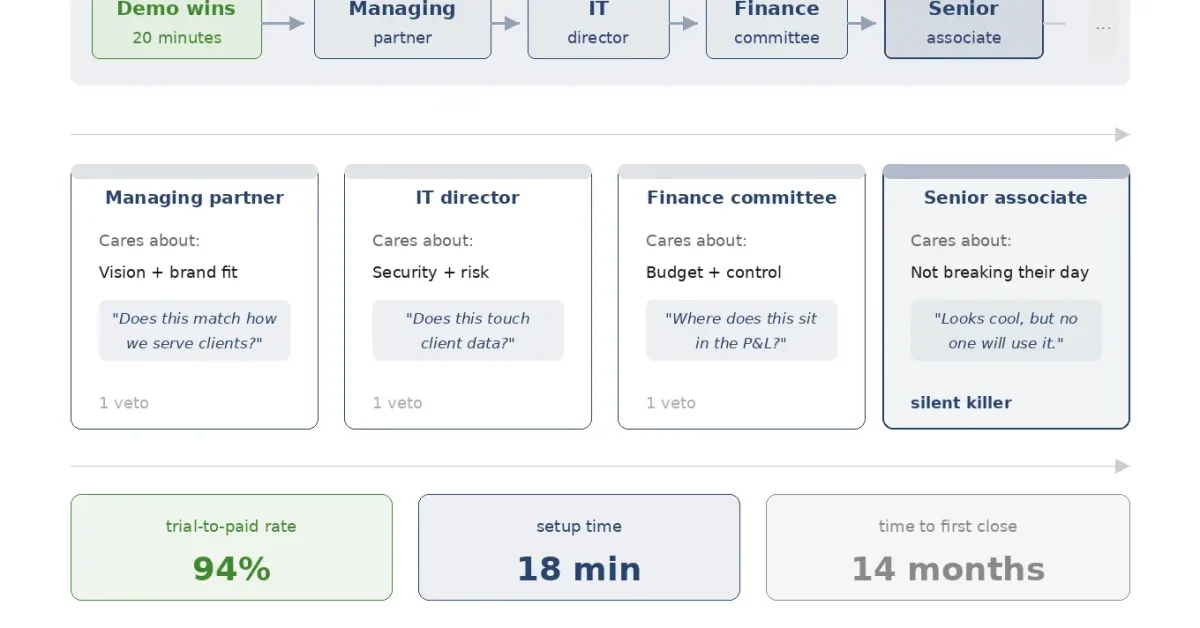
When a founder told me last year that their product took 18 minutes to set up and had a 94% trial-to-paid conversion rate — yet still took 14 months to close their first firm — that wasn’t a product failure. It was a GTM failure. Specifically, a failure to architect a GTM for LegalTech SaaS around the actual decision anatomy of the buyer.
The root causes are consistent across the category:
- No single budget owner. In most firms under 50 attorneys, software spend is fragmented across partners, admin, and IT.
- Risk aversion is structural. Legal professionals are trained to find the fatal flaw. They will find one in your contract, your security posture, or your pricing model.
- Change management is invisible in the budget. Even if IT approves and finance signs off, adoption failure is common because rollout support was never scoped.
- Your champion has limited internal capital. A mid-level associate who loves your tool may not have the standing to get it on the partners’ agenda.
Understanding these dynamics is the foundation of any effective LegalTech go-to-market strategy. Tactics built on top of a misread buyer landscape will always underperform.
The Four-Veto Buyer Problem Unique to Law Firms
When you sell into a law firm, you’re not selling to a buyer. You’re selling to a coalition — and every member of that coalition holds veto power.
The Managing Partner: Vision and Brand
The managing partner isn’t evaluating your feature set. They’re asking one question: “Does this align with how we say we serve clients?” Your pitch needs to connect to client outcomes and firm reputation — not workflow efficiency. Lead with transformation, not tasks.
The IT Director: Security and Risk
Does your product touch client data? If yes, expect a security review that will ask about encryption at rest, SSO compatibility, audit logs, backup protocols, and data residency. If you don’t have a security one-pager or a SOC 2 Type II in progress, you will lose deals here — especially in Am Law 200 firms or legal departments with enterprise parents.
The Finance Committee: Budget and Control
Finance wants to know where your line item lives in the P&L and what it replaces. Subscription software that doesn’t have a clear offset — something the firm stops paying for — faces budget battles every renewal. Build a displacement narrative into your sales process early.
The Senior Associate: Daily Workflow
This is the buyer most LegalTech founders underestimate. The senior associate doesn’t fear your price or your security posture. They fear more clicks. More context switching. More training. One skeptical comment in a hallway — “Looks cool, but no one here will use it” — can slow a deal by months.
Your LegalTech SaaS sales playbook must address all four of these personas with tailored materials, sequenced outreach, and a clear internal champion strategy before a single demo is scheduled.
The 5 Most Common GTM Mistakes LegalTech Startups Make
After working with multiple LegalTech and GovTech founders on their go-to-market strategies, patterns emerge. Here are the five mistakes that kill LegalTech pipeline most often:
- Pitching features, not outcomes. A contract automation tool that saves associates 4 hours per contract review is interesting. A contract automation tool that lets a 10-attorney firm handle the deal volume of a 15-attorney firm without adding headcount is a business case. Sell the business case.
- Building ICP around firm size only. Firm headcount matters, but practice area, growth stage, and tech-forwardness matter more. A 25-attorney IP boutique with a tech-forward managing partner is a better fit than a 200-attorney regional firm that’s never replaced their document management system.
- Skipping the security package. If you don’t have a security FAQ, a data processing addendum (DPA) template, and a one-page compliance overview before you enter a serious pipeline, you will lose weeks reacting to IT requests mid-cycle.
- Letting the champion carry the deal alone. Equip your internal champion with business case materials, ROI calculators, and executive-level slide decks they can use inside the firm without you in the room. Your champion needs tools, not just enthusiasm.
- No post-demo follow-up cadence. LegalTech buyers go quiet — not because they lost interest, but because competing priorities bury your deal. A structured 60-day follow-up cadence with value-add content (case studies, ROI data, peer references) is not optional. It’s the difference between a closed deal and a ghost.
The Winning LegalTech SaaS Sales Playbook
There is no shortcut through the complexity of selling to law firms. But there is a repeatable structure. Here’s how high-performing LegalTech teams architect their sales motion:
A six-stage LegalTech SaaS sales playbook designed for multi-stakeholder law firm deals
Stage 1: ICP Precision (Weeks 1–2)
Define your Ideal Customer Profile at the practice area and persona level — not just firm size. Map your best current customers. What practice areas? What growth stage? What’s the trigger that made them buy?
Stage 2: Champion Identification (Weeks 2–3)
Find the person inside the target firm who has pain AND some organizational standing. Mid-level associates may have pain but lack authority. Senior partners may have authority but not daily pain. The best champion has both — and knows how to navigate internal politics.
Stage 3: Multi-Stakeholder Mapping (Week 3)
Before you schedule a demo, map all four veto buyers. Know who they are, what they care about, and how your champion connects to them. This mapping should live in your CRM and be updated after every call.
Stage 4: Sequenced Outreach and Demo Architecture
Don’t do one demo for everyone. Do a champion demo first. Then an IT-focused security review. Then a business case presentation for the managing partner and finance. Each audience needs its own narrative.
Stage 5: Mutual Action Plan
At the end of your champion demo, co-create a Mutual Action Plan (MAP): a shared document that names every remaining step, who owns it, and target dates. This converts a passive prospect into an active participant — and surfaces blockers early.
Stage 6: Post-Close Adoption Sprint
The deal isn’t done at signature. In LegalTech, the biggest churn risk is 90-day non-adoption. Build a structured onboarding sprint: assigned CSM, named power users, 30-day check-in milestone, and a 60-day adoption review tied to renewal.
LegalTech Sales Motion: Common vs. Optimized
| GTM Element | Common Approach | Optimized Approach |
|---|---|---|
| ICP Definition | Firm size only | Firm size + practice area + tech readiness + trigger event |
| Demo Strategy | One demo for all stakeholders | Sequenced demos by persona with tailored narratives |
| Security Review | Reactive to IT requests | Proactive security package delivered at first IT touchpoint |
| Champion Enablement | Verbal enthusiasm only | ROI deck, business case doc, peer references |
| Follow-Up Cadence | Ad-hoc check-ins | Structured 60-day value-add cadence |
| Post-Close | Handoff to onboarding doc | Named CSM, adoption sprint, 30/60-day milestones |
GTM Nuances: Contract Automation vs. eDiscovery
Not all LegalTech categories sell the same way. Two of the highest-growth segments — contract automation and eDiscovery — require meaningfully different GTM approaches.
Contract Automation GTM Strategy
Contract automation tools live at the intersection of legal, operations, and sales. Your buyers are often GCs and contract operations managers — not practicing attorneys. This means:
- Faster cycles in in-house legal departments vs. law firms, because budget ownership is clearer
- Integration-led selling — Salesforce, DocuSign, and Slack integrations are often the make-or-break factor
- Volume metrics matter: annual contract volume, average review time, and cycle-time compression are your ROI anchors
- Bottoms-up PLG can work if you can get a single contract manager to start a trial — but you’ll still need executive alignment to scale
eDiscovery Software Sales Strategy
eDiscovery is a different animal. Deals are larger, cycles are longer, and the competitive dynamics are brutal (Relativity, Exterro, and Disco dominate enterprise). For a sub-$5M ARR eDiscovery startup, winning requires extreme ICP specificity:
- Focus on underserved segments: regional firms, insurance defense, government legal departments, or specialty boutiques where enterprise vendors are over-built and over-priced
- Matter-based pricing resonates with cost-conscious litigation teams that are used to per-GB billing
- Proof of speed is the differentiator — time from data ingestion to review-ready matters enormously under court deadlines
- Reference selling is non-negotiable: no firm will be your first eDiscovery vendor without peer references from counsel they respect
LegalTech Revenue Operations: Building the Engine
Most LegalTech startups under $5M ARR have a founder-led sales motion — which means revenue operations is informal at best and nonexistent at worst. That’s fine at $500K ARR. It becomes a ceiling at $2M ARR.
Here’s what LegalTech revenue operations infrastructure needs to look like before you try to scale:
CRM Hygiene Built for Long Cycles
Standard CRM stages break in LegalTech because cycles run 6–18 months. Your pipeline stages should reflect the actual multi-stakeholder journey: Champion Identified → IT Review Scheduled → Finance Reviewed → Partner Consensus → Legal Review → Closed Won. Each stage should have entry criteria, not just labels.
Multi-Touch Attribution
In long cycles, the first touch that created awareness and the last touch that triggered the signature are often months apart. Build attribution models that give credit to the content, events, and referrals that started relationships — not just the rep who closed.
Win/Loss Analysis
Interview every lost deal within 30 days of the loss. The data is remarkably consistent: most LegalTech losses are attributed to one of four factors — security concerns, budget displacement failure, adoption skepticism from associates, or a competitor who had a reference inside the firm. This data should directly shape your next quarter’s playbook.
Renewal and Expansion Signals
For subscription LegalTech tools, expansion signals are often hidden in usage data. Set up automated alerts for accounts that have added users, processed high transaction volumes, or used new feature categories. These are your expansion conversation triggers — not calendar-driven QBRs.
Explore additional GTM resources and frameworks to accelerate your revenue operations build-out.
Revenue operations infrastructure for LegalTech SaaS companies scaling from $1M to $5M ARR
Scaling GTM for LegalTech Startups Under $5M ARR
Scaling a LegalTech go-to-market strategy when you’re under $5M ARR means doing more with less — and making bets on the right levers at the right stage.
Here’s a stage-matched framework:
$0 – $1M ARR: Founder-Led, Pattern-Recognition Phase
- The founder closes every deal. That’s intentional — every conversation is GTM research.
- Goal is to find 3–5 “lighthouse” customers who match the ICP exactly and can serve as references.
- Document every objection, every stakeholder who slowed the deal, and every reason you won.
$1M – $2.5M ARR: Playbook Codification
- Hire your first dedicated sales rep — but only after the founder has a repeatable process they can teach.
- Invest in a security package, champion enablement kit, and Mutual Action Plan template.
- Formalize your CRM pipeline stages and build your first win/loss review cadence.
$2.5M – $5M ARR: Scalable Acquisition + Retention Infrastructure
- Add a second AE and your first dedicated customer success hire.
- Build outbound sequences by ICP segment — law firm size, practice area, geography.
- Launch a referral program for power users and champions who’ve converted colleagues.
- Begin content marketing tied to the specific search terms your buyers use when they have pain — not when they’re evaluating vendors.
Have questions about where your specific GTM motion stands? Visit the energizeGTM FAQ for answers to common questions from LegalTech and GovTech founders at every stage.
Your 90-Day LegalTech GTM Action Plan
Theory without execution is noise. Here’s a concrete 90-day sequence to start strengthening your LegalTech SaaS sales playbook today:
| Timeframe | Priority Actions | Owner |
|---|---|---|
| Days 1–30 |
| CEO / VP Sales |
| Days 31–60 |
| Sales + Marketing |
| Days 61–90 |
| RevOps / Founder |
This isn’t about doing more. It’s about doing the right things in the right order for the specific buying complexity of your market.
The Bottom Line
LegalTech is one of the most rewarding and most frustrating markets to sell into. The pain is real. The ROI is provable. The buyers are intelligent. But the structural complexity of the purchase — four veto buyers, no clear budget owner, and deep risk aversion — means that standard SaaS GTM playbooks will fail you consistently.
The founders and sales leaders who win in this space build their entire go-to-market strategy around that complexity. They don’t fight the buying committee. They architect their sales motion to work with it.
If you’re ready to stop guessing and build a LegalTech go-to-market strategy that’s engineered for the way your buyers actually buy, energizeGTM can help.
Ready to build a GTM motion that works for LegalTech?
Schedule a conversation with John.
Learn more about the energizeGTM Roadmap Process →
energizeGTM helps GovTech and LegalTech SaaS companies under $5M ARR build go-to-market strategies that match the complexity of their buyers. Learn more about our team and approach.