The GovTech Pilot Window: Why Sub-$5M ARR Founders Should Stop Waiting for the Big RFP
The highest-percentage move available to a sub-$5M ARR GovTech SaaS company right now is not chasing a massive enterprise contract. It is getting into a federal pilot before the window closes. The federal AI adoption surge is creating a discrete opportunity for smaller public sector software vendors to land real government references without surviving a full procurement cycle. Here is exactly what that looks like and how to move on it.
What the Federal AI Pilot Surge Actually Means for GovTech Founders
The phrase "federal AI adoption" gets thrown around a lot, but what matters for GovTech founders is where the budget is sitting and who controls it. Right now, a significant portion of federal AI investment is flowing through experimentation and pilot line items, not traditional enterprise contracts.
Agency program managers have discretionary budget authority for pilots that can bypass the full procurement cycle entirely. That is the mechanism that makes this window real. You do not need a cooperative vehicle. You do not need an 18-month procurement runway. You do not need to compete against a Deloitte or a Leidos on paper.
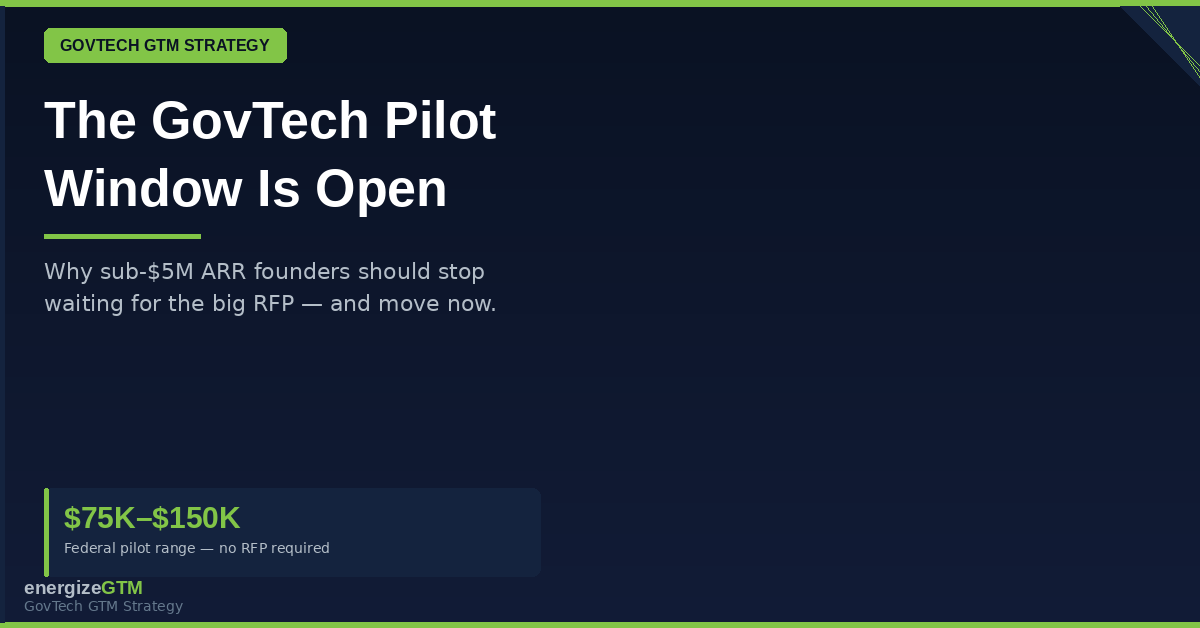
A $75K-$150K pilot with a federal agency is within reach for a smaller GovTech vendor right now. [Verify before publishing: confirm current federal discretionary pilot budget thresholds by agency type.] That is a number that a program manager can move without triggering the full acquisition apparatus. And for a sub-$5M ARR company, a single federal pilot reference changes everything downstream.
Why the Reference Is Worth More Than the Revenue
When I ran sales, marketing, and GTM for a SaaS company selling into Prosecutor's Offices across the US, we tripled the user base. That growth did not start with a massive contract win. It started with getting in the door at one office, delivering real outcomes, and letting the reference close the next deal.
Government buyers do not trust vendors. They trust other government buyers. A reference from a federal agency carries more weight with a state agency director than any pitch deck you will ever produce. It answers the question they are all actually asking: has anyone in government taken this risk before me?
The math is straightforward. A $100K pilot that generates a federal reference is not a $100K deal. It is the proof point that compresses future sales cycles, justifies skipping certain due diligence steps, and opens doors that are otherwise closed to vendors without a government track record. If you want to understand how to position that proof point across your full GovTech sales motion, that framing matters from day one of the pilot.
How to Target the Right Federal Pilot Opportunity
Look for Program Managers, Not Procurement Officers
The traditional GovTech sales motion starts with procurement. The pilot motion starts with program managers. These are the people with mission pressure and discretionary budget authority. They are trying to solve a problem, not run an acquisition process.
Find program managers at agencies where your public sector software solves a real operational problem. Look for agencies that have publicly announced AI experimentation mandates or received supplemental appropriations for technology pilots. Those signals tell you where discretionary authority is most likely to be exercised.
Position as an Experiment, Not a Commitment
The language you use matters. "Pilot" is a safer word than "contract" in a federal context right now. A pilot is bounded in time, bounded in scope, and reversible. It is designed to generate learning. That framing reduces the perceived risk on the agency side and shortens the internal approval chain.
Your pilot proposal should define clear success metrics, a defined time horizon, and a low-friction offboarding path if it does not work out. That last piece sounds counterintuitive, but it signals confidence and reduces the agency's perceived downside. Buyers take more risks when the exit is clearly marked.
Use Compliance-Forward Positioning to Lower the Trust Barrier
FedRAMP 20x is lowering authorization barriers for smaller vendors. If you are not already tracking your path to FedRAMP readiness, start now. Even a "FedRAMP In Process" designation signals that you understand the government compliance environment and are not going to create a security headache for the agency six months into the relationship.
Government compliance software and government budgeting software vendors that lead with compliance credentials close pilots faster because they reduce the agency's internal risk calculus. Compliance-forward positioning is not just a checkbox. It is a trust signal that replaces the track record you have not built yet. The GovTech founder GTM playbook walks through exactly how to sequence compliance positioning within your broader go-to-market strategy.
Cooperative Vehicles and Source Lists: The Parallel Track
The federal pilot is the highest-hit-rate move, but it is not the only path into the pipeline right now. Cooperative purchasing vehicles and source lists are running in parallel and are equally worth pursuing.
Canada's AI Source List and similar mechanisms are creating structured on-ramps for smaller vendors that bypass traditional procurement timelines. These are not shortcuts. They are legitimate procurement pathways designed specifically for the kind of agile, AI-forward public sector software that sub-$5M ARR GovTech companies are building.
The advantage of source list positioning is cumulative. Once you are on a list, you are inside a procurement shortcut that your competitors who waited cannot access. Contract management software for government, grant management software, and government accounting software vendors that have established cooperative vehicle presence are already seeing that advantage compound.
Why the Window Is Real and Why It Will Close
This is not a permanent market condition. It is a discrete window created by a specific policy and budget environment, and that environment will shift.
Here is what is going to change:
- Larger incumbents are watching the same policy signals and mobilizing their own pilot strategies. FedRAMP 20x lowers barriers for them too, not just for you.
- OMB procurement guardrails will mature. The current experimental posture will stabilize into structured process. When that happens, the full acquisition apparatus comes back online and the advantage of moving early evaporates.
- The founders who move now will accumulate references, contract vehicles, and compliance credentials that create a durable competitive moat. The founders who wait will be competing against those moats from the outside.
I have been selling into government markets since my days as a Government AE at Microsoft and Dell. I have watched this pattern play out across every government vertical I have ever worked. The early movers in a policy-driven window do not just win contracts. They build structural advantages that reshape the competitive landscape for the next several years.
The Built for Government GovTech podcast has covered this dynamic across multiple episodes if you want to hear how other founders have navigated similar windows.
What to Do Right Now If You Are Under $5M ARR
Stop optimizing for the deal you wish you could close and start optimizing for the reference that makes the next ten deals faster. Here is the practical sequence:
- Identify two or three federal agencies where your public sector software solves a documented operational problem and where discretionary pilot budget authority exists.
- Map to program managers, not procurement officers. The goal is a mission conversation, not an acquisition conversation.
- Build a pilot proposal with bounded scope, clear success metrics, and defined timeline. Price it to be approachable on discretionary authority - the $75K-$150K range is your target.
- Lead with compliance credentials. FedRAMP readiness, data handling standards, security posture. These are trust accelerators, not afterthoughts.
- Run cooperative vehicle and source list applications in parallel. Do not wait for the pilot to close before pursuing list inclusion.
- Document everything from the pilot. The outcomes, the testimonial, the agency contact willing to serve as a reference. That documentation is the moat you are building.
If you want a structured framework for assessing where you stand on this right now, the 9 AI reality filters is a useful lens for pressure-testing your positioning before you go to market.
The Compounding Value of Moving First
Government markets reward incumbency. Once an agency has invested in onboarding your GovTech SaaS platform, trained their staff, and integrated your public sector ERP software or utility management software into their workflow, switching costs become a natural barrier to competitors. That is true even at the pilot stage.
Pilots that deliver real outcomes convert to longer-term agreements. Longer-term agreements generate the kind of references that compress your next sales cycle from eighteen months to three. Three closed deals with federal references change how every subsequent conversation starts. At that point, you are no longer selling from outside the moat. You are the moat.
The founders who understand this are not waiting for certainty. They are using the current window's reduced friction to build the structural advantages that will protect them when that friction returns. Municipal finance software, public transparency software, government compliance software, EMS management software, and fire department software companies that get into the pipeline now will not just have a reference. They will have a wedge that reshapes their entire competitive position.
Frequently Asked Questions
What is a federal pilot program and how does it work for GovTech vendors?
A federal pilot program is a bounded, time-limited technology engagement that allows an agency program manager to test a solution within defined parameters before committing to a full contract. Program managers often have discretionary budget authority in the $75K-$150K range that bypasses the standard acquisition process, making pilots accessible to smaller GovTech vendors who would not survive a full RFP competition against larger incumbents. The pilot is scoped, time-limited, and designed to generate documented outcomes that support a broader procurement decision.
Does a sub-$5M ARR GovTech company actually compete for federal business without a cooperative vehicle?
Yes. Cooperative vehicles like GSA schedules or NASPO agreements are valuable but not required for pilot engagements. Program managers exercising discretionary budget authority can award pilot agreements directly to vendors who can demonstrate relevance, compliance readiness, and a credible delivery capability. Smaller vendors often have an advantage in this context because they are faster to engage, more flexible on scope, and not carrying the overhead that makes large-firm pricing uncompetitive on small-dollar engagements.
How long does the current GovTech pilot opportunity window last?
The window is driven by a specific combination of policy environment, discretionary budget availability, and reduced procurement friction around AI experimentation. That combination will not persist indefinitely. OMB guardrails will mature. Larger incumbents are already mobilizing. Founders who enter the pipeline via pilots, cooperative vehicles, and compliance-forward positioning in the next 12-18 months [Verify before publishing: confirm current policy trajectory timelines] will accumulate references and contract vehicles that create a durable moat. The window is open now, but it is not permanent.
What makes a federal pilot proposal compelling to an agency program manager?
The strongest pilot proposals define a specific operational problem the agency is already trying to solve, propose a bounded scope with clear success metrics, include a defined time horizon, and demonstrate compliance readiness from the opening page. Program managers are not evaluating technology. They are managing mission risk. A proposal that reduces their perceived downside, documents what success looks like, and signals that the vendor understands the government operating environment will outperform a feature-heavy pitch every time.
The Bottom Line for GovTech Founders
The federal AI adoption surge has created a discrete window where a sub-$5M ARR GovTech SaaS company can enter the government pipeline at meaningful scale without surviving a traditional enterprise procurement cycle. That window is real. It is also temporary.
The move is not complicated. Find the right agency. Reach the right program manager. Propose a bounded pilot at a price point within discretionary authority. Deliver real outcomes. Document everything. Let the reference do the next sale.
That pattern has held across every government market I have ever worked. It held in Prosecutor's Offices. It held in federal civilian agencies. It held at Microsoft and Dell. The mechanism does not change. The window just opened wider than usual, and it will not stay that way.
If you are building GovTech under $5M ARR and want to work through how this applies to your specific situation, reach out to energizeGTM directly. This is exactly the work we do.
You can also start with the GovTech GTM Scorecard to benchmark where your go-to-market stands today, explore the energizeGTM Library for frameworks and playbooks built specifically for public sector software founders, or learn more about the energizeGTM Roadmap Process to understand how we structure go-to-market engagements. And if stakeholder alignment inside a government agency is your bottleneck, download the WIIFM Framework for a practical approach to navigating multi-stakeholder government sales.