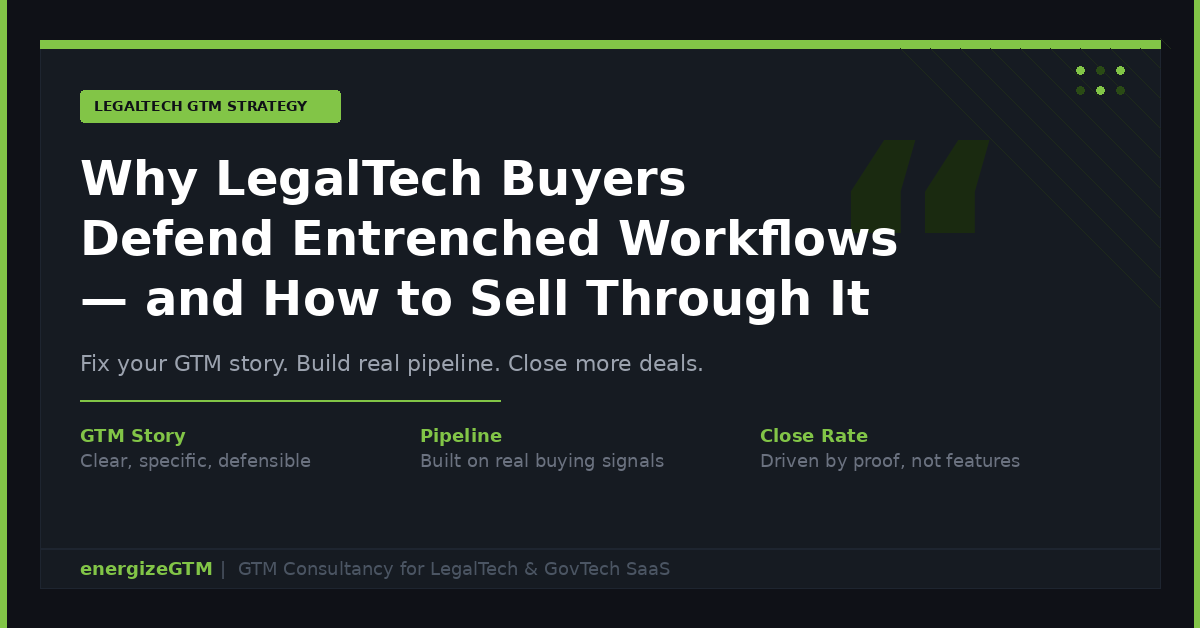
Why LegalTech Buyers Defend Entrenched Workflows — and How to Sell Through It
LegalTech go-to-market strategy fails most often not because the product is weak, but because the sales story lands wrong. Legal buyers have spent years building workflows around tools they know, processes they trust, and habits that keep their firms running. When your pitch asks them to change any of that, their default answer is no — and the longer you take to fix that dynamic, the more pipeline you burn. Here is what is actually happening, and how to sell through it.
The Real Reason LegalTech Buyers Resist Change
Legal professionals are trained to assess risk. Every contract, every filing, every process step carries liability. When a new piece of software shows up at the door, their internal risk calculator runs immediately: What breaks if this fails? Who owns the outcome? What does migration cost?
That is not obstruction — that is professional competence. The firms still running legacy matter management software or manual billing workflows are not ignorant. They made a deliberate calculation that switching costs outweigh switching benefits. Your GTM for LegalTech SaaS has to change that math.
Three forces reinforce the resistance:
- Bar compliance pressure. Attorneys are accountable to their state bar for client data security and confidentiality. Any new tool triggers compliance review, and in smaller firms, that review can stall a deal for months with no clear champion to push it through.
- Billable hour economics. Time spent learning new software is time not billed. Partners feel this viscerally. Unless your onboarding ROI story is airtight, the math does not favor adoption.
- Social proof gaps. Legal is a referral-driven profession. If a partner cannot call three peers who use your product and vouch for it, you are selling into a trust deficit that no feature list closes.
Why Most LegalTech GTM Stories Break Down at the Demo Stage
The most common mistake energizeGTM sees in early-stage LegalTech SaaS sales playbooks is leading with capability instead of consequence. Founders spend the first ten minutes of a demo explaining what the software does. Buyers spend those same ten minutes calculating whether they care.
Legal buyers want to know two things first: What does this replace, and what happens to my existing data? Everything else — the UX, the integrations, the roadmap — is secondary until those two questions are answered with specificity.
A strong GTM for LegalTech SaaS flips the demo structure:
- Open with the workflow problem in the buyer’s language, not your product language
- Show the before-and-after using their practice area as the frame
- Address data migration and compliance in the first five minutes, not in a follow-up email
- Anchor the ROI story to billable hours recovered, not features shipped
This structure does not happen by accident. It requires a deliberate LegalTech SaaS sales playbook built around how legal buyers actually evaluate software — not how SaaS buyers in adjacent industries do it.
Building Pipeline When Buyers Are Trained to Say No
Fix Your ICP Before You Fix Your Pitch
Most LegalTech startups under $5M ARR are selling to everyone and closing no one. The firm size ranges are too wide, the practice area targeting is too vague, and the messaging tries to speak to managing partners, associates, and ops directors all at once. That diffusion kills pipeline velocity.
A tighter ICP does more revenue work than a better deck. If your strongest retention and fastest time-to-value cluster in 20-to-50-attorney litigation firms in three states, that is your ICP — and your entire GTM for LegalTech SaaS should build outward from there.
Scaling GTM for LegalTech startups starts with surgical targeting, not broader outreach. The instinct to widen the net when pipeline is thin usually makes the problem worse. Narrowing produces better conversations, shorter cycles, and higher close rates — which then funds the expansion into adjacent segments.
Use Loss Aversion, Not Feature Enthusiasm
Legal buyers respond to what they stand to lose more strongly than to what they might gain. This is behavioral economics in a profession that lives by precedent — and your messaging should account for it.
Frame your value proposition around risk reduction and workflow continuity rather than innovation and disruption. No managing partner wants to hear that your eDiscovery software sales strategy involves “reimagining” how they review documents. They want to hear that their current process has a $40,000-per-matter cost exposure that your software closes.
Specific numbers outperform categories. “Reduces review time by 34%” beats “accelerates document review.” “Identifies billing leakage averaging $8,200 per attorney per year” beats “improves billing accuracy.” Wherever you can anchor claims to dollars or hours, do it — and if you need to validate those figures with your existing customers, do that work before your next sales cycle opens.
Build a Reference Engine Before You Scale Outbound
LegalTech revenue operations at the early stage depend on reference customers more than almost any other vertical. Legal professionals trust peer recommendations with a weight that advertising and content cannot replicate.
If you have five to ten customers getting strong results, your next investment should be in making those customers evangelists, not in buying more ad impressions. That means structured case studies with verifiable metrics, customer advisory boards that keep champions engaged, and a warm intro program that makes it easy for satisfied customers to refer peers.
The GTM playbook for founders at energizeGTM dedicates significant attention to reference architecture because it is consistently the highest-ROI pipeline driver in trust-sensitive verticals — and legal is one of the most trust-sensitive verticals in enterprise software.
The GTM Story Problem Sitting Under Your Pipeline Problem
Here is a pattern energizeGTM encounters regularly with LegalTech founders approaching $1M ARR: the pipeline looks thin, the sales cycle looks long, and the win rate looks low. The instinct is to fix outbound volume or optimize the demo. The actual problem is upstream.
The GTM story — the core narrative of who you are for, what you replace, and why now — is either unclear or inconsistent. Marketing says one thing. Sales says another. The website says a third thing. By the time a buyer gets to a demo, they are already confused about whether this is a fit, and confused buyers default to no.
A clear, defensible LegalTech go-to-market strategy aligns the whole funnel around a single, specific promise: We are built for [specific buyer], we replace [specific workflow or tool], and firms like yours see [specific outcome] within [specific timeframe]. Everything — SEO, outbound, demo flow, proposal structure, onboarding — should connect back to that promise.
The 9 AI reality filters from energizeGTM offer a useful diagnostic here: are you using technology and automation to paper over a story problem, or to accelerate a story that already works?
What a Fixed GTM Story Unlocks in LegalTech Sales
Shorter Sales Cycles Through Pre-Qualification
When your GTM story is precise, you stop getting meetings with firms that were never going to buy. That sounds painful, but it is the opposite — it means your pipeline contains deals that can actually close, and your sales motion stops burning cycles on fits that unravel at procurement.
Contract automation GTM strategy, for example, works very differently when you lead with “we are built for in-house legal teams at mid-market companies running more than 200 contracts per year” versus “we help legal teams manage contracts.” The first statement disqualifies the wrong buyers before they enter your pipeline. The second fills your pipeline with work that does not convert.
Better Win Rates Through Stakeholder Mapping
LegalTech deals rarely have a single decision-maker. The managing partner cares about liability and revenue. The senior associate cares about workflow efficiency. The IT director cares about security and integrations. The office manager cares about billing reconciliation. Your sales motion needs to speak to all of them in sequence — and most early-stage LegalTech SaaS teams are only speaking to one.
A mature LegalTech SaaS sales playbook includes a stakeholder map for each deal tier, with tailored talk tracks and objection responses for each role. This is not a nice-to-have at $3M ARR — it is a requirement if you want to sustain growth beyond it.
Faster Ramp for New Sales Hires
If your GTM story lives in the founder’s head, every new sales hire starts from scratch. Deals depend on institutional memory that does not transfer. A documented, structured playbook codifies what works — and gets new reps producing at 80% capacity in weeks instead of quarters.
The founders sales guide at energizeGTM walks through exactly how to externalize institutional sales knowledge in a way that scales — including how to run call reviews, how to build an objection library, and how to document your winning deal patterns before you have enough data to call them patterns.
LegalTech Revenue Operations: What Gets Measured Gets Fixed
Most LegalTech startups under $5M ARR are underinvested in revenue operations. They track pipeline in a spreadsheet, measure close rate loosely, and have no reliable data on where deals stall. That makes it nearly impossible to improve the sales motion systematically.
LegalTech revenue operations does not require a full RevOps hire at this stage. It requires three things:
- Stage-level conversion tracking. Know your move rate from first meeting to demo, demo to proposal, and proposal to close — by ICP segment, not in aggregate. Aggregate numbers hide the problems.
- Loss reason documentation. Not “not the right fit” or “went with a competitor” — actual reasons with enough specificity to drive coaching and positioning changes. Did the deal die at compliance review? At the economic buyer stage? At contract negotiation? Each answer points to a different fix.
- Velocity metrics. How long does a deal sit at each stage? Where are deals aging without movement? Velocity data tells you where your sales motion has friction before that friction kills the quarter.
Once you have clean data at the stage level, you can start running structured experiments: change the demo sequence for one segment, test a new objection response on compliance concerns, try a different pricing frame for mid-market versus enterprise. Without the data, you are optimizing by feel, and feel does not scale.
Frequently Asked Questions: LegalTech GTM Strategy
What is a LegalTech go-to-market strategy?
A LegalTech go-to-market strategy is the documented plan that defines who you sell to, how you reach them, what you say to move them through a buying decision, and how you convert interest into revenue. For LegalTech SaaS companies specifically, a strong GTM strategy accounts for the unique dynamics of legal buyers: risk aversion, compliance requirements, referral-driven trust, and multi-stakeholder decision processes. It aligns marketing, sales, and customer success around a single, consistent value promise.
Why do LegalTech sales cycles take longer than other SaaS verticals?
LegalTech sales cycles are longer because legal buyers face higher personal liability for technology decisions than buyers in most other industries. Any new software that touches client data, billing, or case management triggers compliance reviews, security assessments, and multi-stakeholder approval processes that can run six to twelve months in larger firms. Early-stage LegalTech companies shorten these cycles by doing compliance legwork upfront, targeting smaller firms with faster decision processes, and building reference customers who can speak to the evaluation process from a peer perspective.
How do I build LegalTech pipeline when buyers keep saying they are happy with what they have?
Buyers who say they are happy with existing workflows are usually reacting to the perceived switching cost, not the actual value of what they have. The most effective pipeline approach targets the moments when those workflows break — billing errors, missed deadlines, compliance gaps, or associate turnover that disrupts institutional knowledge. Outbound and content built around those trigger events reaches buyers when their pain is active, not theoretical. Pair that with strong reference customers in the same practice area, and the “we’re fine” objection loses its foundation.
What does energizeGTM do differently for LegalTech founders?
energizeGTM works specifically with LegalTech and GovTech SaaS founders under $5M ARR who need to fix their GTM story, build repeatable pipeline, and close more deals without a full enterprise sales infrastructure. The work starts with diagnosing where the current GTM is breaking — story, targeting, sales motion, or revenue operations — and then builds structured fixes that a lean team can execute. The focus is practitioner-level output, not strategy decks that sit on a shelf.
What to Do Next If This Is Your Problem
If your LegalTech pipeline is thin, your sales cycles are long, and your win rate is stuck, the path forward starts with an honest audit of your GTM story. Not your product roadmap, not your pricing structure — your story. Who is it for, what does it replace, and why does it matter now?
energizeGTM helps LegalTech founders under $5M ARR answer those questions with the specificity that actually moves buyers — and then builds the sales motion and pipeline engine to deliver consistent results. The work is documented, executable, and built for teams that do not have the luxury of a six-month strategy engagement before they need to hit number.
If you want a structured look at where your GTM stands today, the energizeGTM Roadmap Process walks through how the diagnostic and build phases work — from first conversation to a GTM system your team can run.
Ready to get into specifics? Contact energizeGTM directly and let us look at what your pipeline and GTM story need right now.