Niche Beats Noise: The LegalTech GTM Strategy That Actually Wins Law Firm and Legal Ops Deals
In LegalTech, trying to sell to every firm type is a guaranteed way to resonate with none of them. Law firms and legal operations buyers are among the most skeptical evaluators in any software category — and they can smell a generic pitch from the first sentence of your outreach. A sharp LegalTech go-to-market strategy built around a specific segment, a specific use case, and a documented refusal list will consistently outperform a broad-based approach. This post breaks down how to build that focus — and why the discipline of saying no is one of the most powerful sales moves you can make.
Why Generic Positioning Fails in LegalTech SaaS Sales
There is a version of every LegalTech pitch deck that tries to cover every base. The TAM slide is enormous. The use cases span BigLaw, regional firms, boutique practices, and in-house legal teams. The homepage says something like "The platform for modern legal teams" or "Built for every law firm."
Founders who build this way are not naive — they are scared. Scared of leaving revenue on the table. Scared that a narrow LegalTech go-to-market strategy means a small market. Scared that a prospect will ask "do you work with firms like ours?" and they will have to say no.
But attorneys are paid to find the risk in everything, and they apply that same instinct to vendor evaluation. If a product or a pitch feels generic, it gets passed over. If it feels designed for their practice area, their firm size, and their specific workflow challenge, it earns a conversation.
The fastest way to lose a LegalTech deal is to walk in without a clear, specific answer to the question "have you done this for firms like ours?" Niche beats noise — every single time.
What Niching Down Actually Means for LegalTech SaaS
Niching is not about making your product smaller. It is about making your GTM for LegalTech SaaS sharper.
Your contract automation, eDiscovery, or practice management platform might technically work for a 500-attorney BigLaw firm, a 40-person regional litigation shop, and an in-house legal team at a mid-market company. That does not mean you should sell to all three simultaneously — especially when you are still building your reference base and refining your motion.
Niching down means making three deliberate decisions:
- Who you serve. Your Ideal Customer Profile should be specific enough that a new sales hire can qualify or disqualify a prospect in the first five minutes of a discovery call. Not "law firms" — but "regional litigation firms with 50 to 200 attorneys managing high-volume commercial discovery." Not "legal operations" — but "in-house legal teams at mid-market companies with 500 to 2,000 employees where legal ops reports directly to General Counsel." Specificity is credibility.
- Who you refuse. Your ICP is incomplete without a documented list of who you will not pursue — even when they have budget and want to buy. Solo practitioners and firms under 10 attorneys when your pricing model does not deliver value at that scale. Contingency-fee firms when your ROI story is built around billable hour recovery. BigLaw until you have three reference-quality wins at the Am Law 200 level. Every "yes" to the wrong customer costs you three right ones.
- How you show up. Your messaging, case studies, references, and demo should reflect the world your buyer lives in. If you are selling eDiscovery software to litigation firms, your demo should show custodian collection workflows and privilege review — not generic document management. If you are selling contract automation to legal ops, your ROI story should be in cycle time reduction and redline rounds saved — not vague "process efficiency."
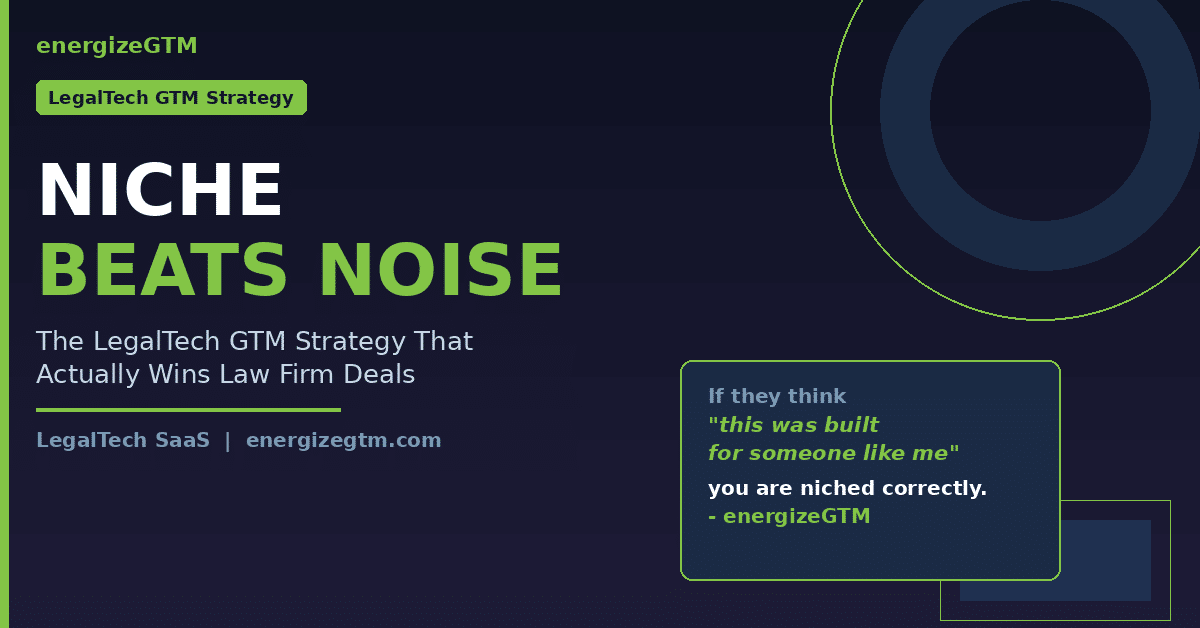
The rule of thumb: if a prospect reads your website and thinks "this was built for someone exactly like me," you are niched correctly. If they think "this could work for us," you are not niched enough.
Why Niche Focus Is Especially Critical in LegalTech Go-to-Market
The legal market looks large from the outside. From the inside, it is a series of distinct segments with almost nothing in common. BigLaw is a different universe from regional litigation firms. Regional litigation firms are different from solo practitioners. Solo practitioners are different from in-house legal operations. In-house legal ops at a Fortune 500 company is different from in-house legal ops at a Series B startup.
Selling across all of those segments simultaneously means your messaging resonates with none of them. A LegalTech SaaS sales playbook that tries to cover every firm type ends up being a playbook that does not work in any of them.
Practice Area Specificity Is a Superpower
If your contract automation GTM strategy targets real estate transactional work, say that. If your eDiscovery software sales strategy is built for multi-party commercial litigation, say that. Practice area specificity signals depth — and depth is what legal buyers are looking for from a vendor they are about to trust with client matters.
The buying dynamics in legal are also heavily relationship-driven. Bar associations, local legal technology groups, practice-specific conferences, and LinkedIn communities built around specific practice areas are where reputations are built. A LegalTech vendor known as the go-to solution for a specific practice area or firm type has a referral engine that no amount of broad-based marketing can replicate.
If you are still figuring out where your niche positioning sits relative to your current customers, the practitioner-level GTM guide from energizeGTM includes frameworks that apply directly to LegalTech segment selection and ICP definition.
The Law Firm Buyer vs. the Legal Ops Buyer
Law firm buyers and in-house legal operations leaders are not the same buyer — and treating them as if they are will cost you deals in both segments.
Law firm buyers — managing partners, practice group leaders, and firm administrators — are evaluating risk first. They are conservative by training and by culture. They buy on reference, peer validation, and demonstrated fit with their practice type. A vendor who has worked with 10 similar firms in the same practice area with documented outcomes will always beat the vendor with the more impressive feature list.
Legal ops buyers — general counsel, legal operations managers, and chief legal officers — often have more budget authority than their law firm counterparts, but they answer to procurement and to the business. They are buying for scale and efficiency. They want to reduce legal spend, speed up contract cycles, and reduce outside counsel reliance. They need vendors who understand that business context — not vendors who pitch them the same way they pitch a litigation boutique.
If you are selling to both segments with the same message, you are leaving deals in both segments on the table.
Scaling GTM for LegalTech Startups: Why Refusal Criteria Are as Important as ICP
The most clarifying exercise for any LegalTech founder is writing two lists. The first is your ICP — made specific enough that a new sales hire could use it to qualify or disqualify a prospect in the first conversation. The second is who you refuse: a documented, intentional set of criteria for deals you will not pursue.
Most founders resist the second list. It feels like leaving money on the table. But consider what chasing the wrong deals actually costs when you are scaling GTM for LegalTech startups:
- Sales cycles that drag on and never close because the fit was never right
- Implementation effort that pulls your team away from customers you can actually make successful
- References that are lukewarm because you were never a great fit to begin with
- A product roadmap pulled in six directions because your customers have nothing in common
- A LegalTech revenue operations model that cannot achieve predictable pipeline because your segments behave so differently
Here is a sample "Who We Refuse" list for a LegalTech company focused on contract automation:
- We do not pursue solo practitioners or firms under 10 attorneys — our pricing model does not deliver value at that scale
- We do not pursue firms with exclusively contingency-fee practices — our ROI story is built around billable hour recovery, which does not apply
- We do not pursue BigLaw until we have three reference-quality wins at the Am Law 200 level
- We do not pursue in-house legal teams where procurement, not legal ops, controls the buying decision — our sales cycle is not designed for that dynamic
When you can say "that is not a firm we work with, and here is why," buyers trust you more — not less. It signals that you know exactly who you are built for. That confidence is a form of positioning that closes deals.
Where LegalTech Niche Positioning Creates the Biggest Advantage
The LegalTech landscape includes dozens of distinct buyer segments, each with its own decision-making dynamics, buying criteria, and competitive set. The founders who win are the ones who pick a segment and become the obvious choice in it — rather than trying to be a reasonable option across all of them.
eDiscovery Software Sales Strategy
eDiscovery is one of the most competitive categories in LegalTech, but it is also highly segmented by matter type, firm size, and pricing model. A vendor positioned specifically for mid-size litigation firms managing multi-party commercial disputes — with a reference base in that segment and a pricing model that fits — will win against a larger generalist platform in that specific buyer's evaluation.
Contract Automation GTM Strategy
Contract automation is the fastest-growing LegalTech category right now [Verify before publishing], and the buyer profiles are wildly different. A corporate transactional practice has different volume, risk tolerance, and workflow requirements than an in-house legal team managing vendor agreements. A contract automation GTM strategy that tries to serve both equally will be beaten by a vendor who owns one segment completely.
LegalTech Revenue Operations and Predictable Pipeline
One of the hidden costs of a broad LegalTech go-to-market is that it makes LegalTech revenue operations nearly impossible to run with any predictability. Win rates, sales cycle lengths, and conversion ratios all vary so dramatically by firm type and practice area that a mixed pipeline produces misleading forecasts and unreliable revenue models.
A niche-focused LegalTech GTM produces a pipeline that actually predicts itself — because your ICP behaves consistently, your sales cycle is defined, and your win/loss patterns tell you something useful.
The 9 AI Reality Filters from energizeGTM address exactly this problem — helping LegalTech sales leaders separate the tools that actually improve pipeline predictability from the ones that add complexity without insight.
Your LegalTech GTM Niche Checklist
Use this checklist to assess whether your LegalTech go-to-market focus is sharp enough to do its job:
| Checkpoint | What "Niched Enough" Looks Like |
|---|---|
| ICP Specificity | One sentence that includes firm type, size, practice area focus, and a trigger event. If it takes a paragraph, it is not specific enough. |
| Buyer Language | Your website uses the words your buyers use — their practice area terminology, workflow pain points, billing model language, and compliance context. Not generic SaaS language. |
| Case Study Alignment | Your case studies feature firms that look exactly like your target ICP. Not a mixed bag of whoever agreed to participate. |
| Refusal Criteria | Your sales team has a written list of deal types you will not pursue — and it is actually used in pipeline reviews, not just in the playbook binder. |
| Community Presence | You are visible in the bar associations, legal tech groups, or practice-specific conferences where your target buyers spend time — not just in general SaaS or startup communities. |
| Reference Network | You can name five firms in your target niche who would take a peer reference call. If not, that is your first GTM goal — not more pipeline. |
FAQ: LegalTech Go-to-Market Strategy and Niche Positioning
What does a niched LegalTech go-to-market strategy actually look like?
A niched LegalTech GTM strategy means your ICP is defined at the segment level — not just "law firms" or "legal operations," but a specific firm type, size range, practice area focus, and trigger event that brings them to market. It means your messaging, demos, case studies, and references all reflect that specific buyer's world. It means your sales team has documented criteria for who they will not pursue. And it means your early wins are concentrated in one segment where you are building a reference base — not scattered across every firm type that has ever written you a check.
Why does LegalTech need a different GTM approach than other SaaS categories?
Legal buyers are conservative by training and by culture. Attorneys apply the same risk-analysis instinct to vendor evaluation that they apply to client matters. A generic pitch is not just ineffective — it is disqualifying. Legal buyers also rely heavily on peer networks and bar community relationships for vendor validation. A vendor with a specific track record in a defined segment can activate those networks. A generalist cannot. Additionally, the legal market is so segmented that a message optimized for BigLaw will actively repel regional firm buyers, and vice versa. LegalTech SaaS sales playbooks that try to cover the whole market end up working in none of it.
How do I know if my LegalTech ICP is specific enough?
Your ICP is specific enough when a new sales hire can use it to qualify or disqualify a prospect in the first five minutes of a discovery call — without having to ask you for guidance. "Law firms" is not an ICP. "Regional litigation firms with 50 to 150 attorneys focused on commercial disputes who are currently managing discovery with a combination of email and shared drives" is an ICP. It includes firm type, size, practice area, and a technology trigger that signals both pain and buying intent. If your definition requires multiple paragraphs or leaves room for interpretation, it is not specific enough to do its job.
What is the risk of niching too early in LegalTech?
The risk of niching too early is smaller than founders expect — and far smaller than the risk of staying broad too long. The rare cases where early niche focus genuinely costs a company involve ICP selection mistakes: picking a segment that is too small, too price-sensitive, or too slow to buy. The solution to that risk is not to stay broad — it is to validate your niche selection before you commit. Run structured discovery in two or three segments, measure conversion rates and sales cycle lengths, and follow the signal. A niche chosen based on evidence is almost always the right call. A broad go-to-market chosen out of fear is almost always the wrong one.
The Bottom Line: Niche Focus Is the LegalTech Competitive Advantage That Compounds
The LegalTech founders who build repeatable, predictable revenue are not the ones who try to sell to every firm type. They are the ones who pick a segment, go deep, build references, and let the credibility compound over time.
Niche positioning is not a constraint on your growth. It is the mechanism for it. It is how you get the partner referral at the bar association event. It is how you win the firm who does not issue RFPs — because their peer called them and said "you need to talk to these people." It is how you build a LegalTech revenue operations model that actually predicts itself.
If you are not sure where your LegalTech GTM focus stands right now, start with an honest audit of your current customer base. Look at where your best customers cluster by firm type, size, and practice area. That cluster is your niche. Build from there — not from a slide deck that tries to cover everyone.
The energizeGTM GTM Playbook covers the full niche validation and ICP-building process in detail — including how to use your existing win/loss data to identify where your niche positioning should focus next.
Take the Next Step
energizeGTM helps LegalTech SaaS founders build go-to-market strategies that are specific, repeatable, and grounded in how legal buyers actually evaluate and purchase software.
- Learn the process: See how the energizeGTM Roadmap Process works and how it applies to your LegalTech growth stage.
- Talk to us: Contact energizeGTM to discuss where your LegalTech go-to-market needs to go next.