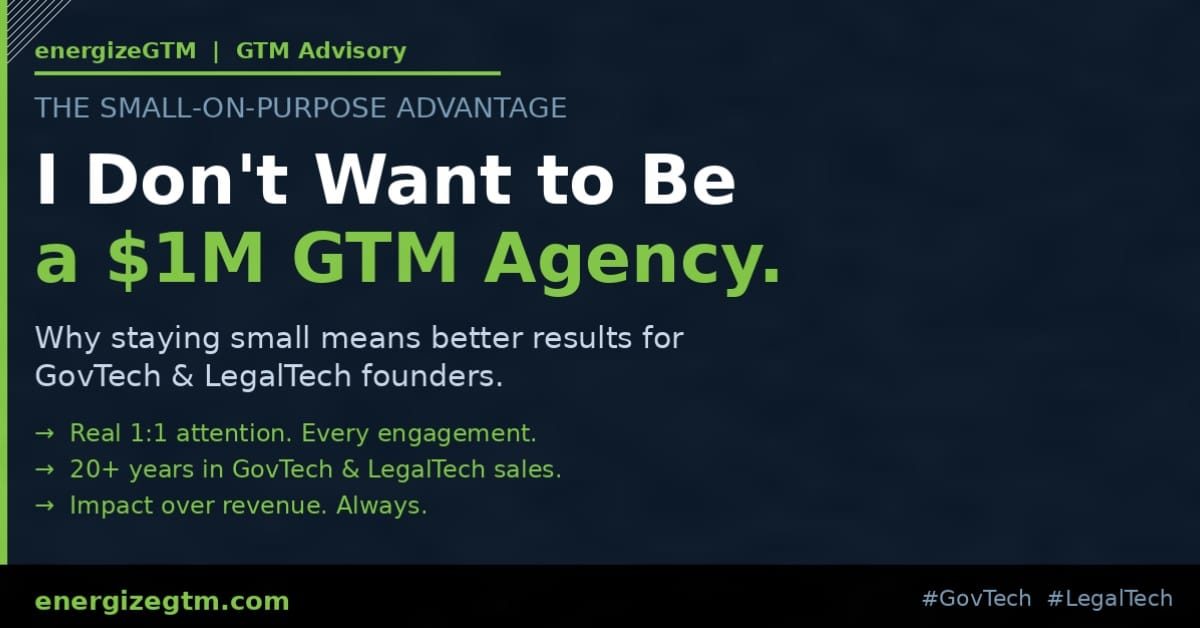
Why I Purposely Don't Want to Be a $1M GTM Agency — And What That Means for GovTech and LegalTech Founders
People think I'm crazy for turning down growth. Some have said a lot worse than that. But if you're a GovTech or LegalTech SaaS founder under $5M ARR trying to figure out your go-to-market motion, you deserve to know exactly who you're working with — and why the size of energizeGTM is a feature, not a limitation.
This post is about a deliberate choice: staying small, staying close, and measuring success by client outcomes instead of agency revenue. If that sounds like a values mismatch with what you've been sold by bigger firms, keep reading.
The GTM Advisory Trap Most Founders Fall Into
When a GovTech or LegalTech founder starts looking for GTM help, the instinct is often to find the biggest, most credentialed firm on the market. Seven-figure revenue. A roster of clients. A team of 30 with a polished deck.
That logic is understandable. But it's also how a lot of founders end up paying premium rates to be handed off to a junior associate who's never sold into a Prosecutor's Office, a water utility, or a legal department resistant to changing anything about how they work.
The GTM advisory market has the same problem as a lot of SaaS markets: scale creates distance. And distance kills the kind of nuanced, contextual guidance that actually moves revenue at your stage.
What "Scale" Costs You in a GTM Engagement
Here's what typically happens when a GovTech SaaS company or LegalTech startup signs with a growth-focused advisory firm:
- The senior partner closes the deal, then disappears into the next sales cycle
- Your account gets assigned to someone who learns your business from your onboarding doc, not from years in the field
- Strategy becomes templated — the same ICP framework, the same messaging playbook, applied to your business like a coat of paint
- Wins get celebrated in the firm's marketing. Challenges go unaddressed until they become crises.
None of that is a GTM strategy. That's a retainer with deliverables. There's a difference.
Why I Built energizeGTM the Way I Did
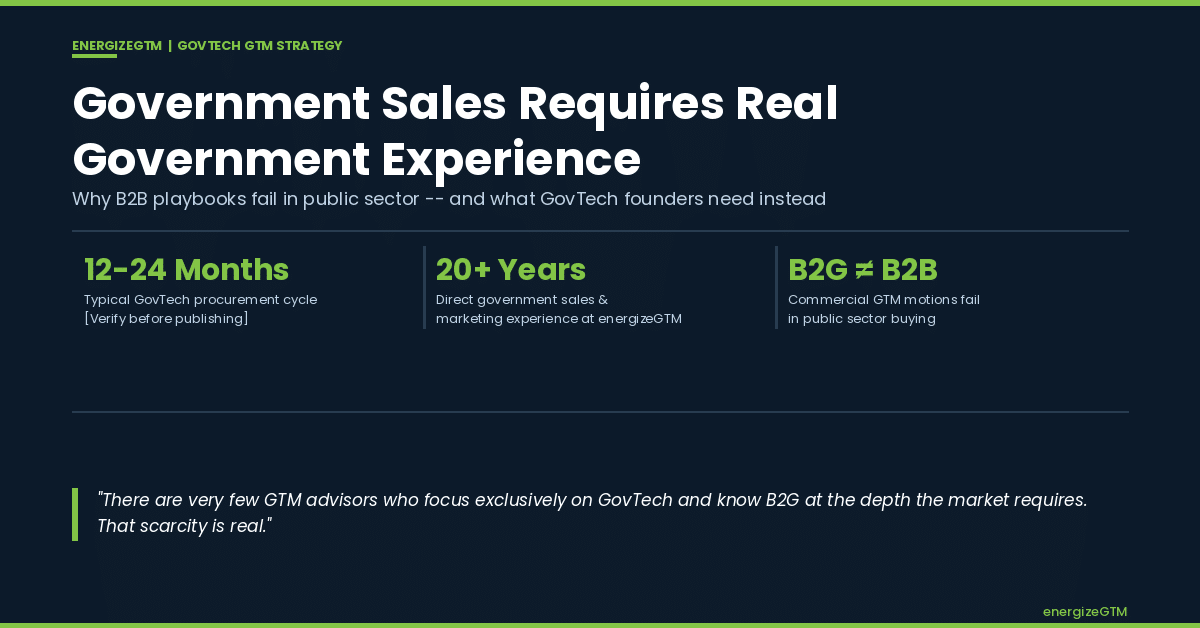
I've spent more than 20 years selling into government agencies and legal departments. I've walked into rooms where the procurement officer had never heard of SaaS, and I've navigated legal reviews that could have buried deals for years if I hadn't known how to manage them. That experience is what energizeGTM is built on.
And I made a deliberate choice: I will not scale this into something that dilutes that experience.
For founders selling public sector software or trying to crack legal department procurement, that means you get me — not a team I've trained, not a framework I've licensed out. The practitioner experience that makes the advice useful is the same practitioner who picks up the phone when you have a question on Friday afternoon.
What "Small on Purpose" Actually Looks Like
Staying intentionally small means:
- I know your business the way a co-founder would — not the way a consultant knows a client file
- When you're navigating a GovTech procurement cycle or a LegalTech legal review that's threatening to kill your deal, I've been in that situation and I know what to do
- I celebrate your wins because I was in the room when you figured out the play that created them
- I lose sleep over your challenges because I actually understand what's at stake for your company
- I pick up the phone. Every time.
That's not a marketing promise. It's an operating model.
The LegalTech Go-to-Market Problem Big Agencies Miss
LegalTech go-to-market strategy requires a level of specificity that templated GTM frameworks simply don't deliver. Legal departments are habit-first buyers. They're not looking for the best solution — they're looking for the least disruptive one that still gets the job done.
If your GTM advisor doesn't understand that dynamic, they'll build you a messaging strategy that leads with features instead of outcomes, and a sales motion that treats legal buyers like any other B2B buyer. That's not a GTM strategy for LegalTech SaaS. That's a way to get ghosted after a promising demo.
Scaling GTM for LegalTech startups means understanding why associates resist new tools, why General Counsels demand proof before they'll put anything in front of the partners, and why AI narrative sequencing inside a legal department has to be sequenced very differently than in a tech-forward buyer. These aren't things you learn from a playbook. They're things you learn from being in the room.
If you want a deeper look at how energizeGTM approaches LegalTech positioning and messaging, the energizeGTM Library has frameworks, articles, and downloads built specifically for legal department buyers.
The LegalTech SaaS Sales Playbook Requires Buyer Psychology, Not Just Tactics
The best LegalTech revenue operations strategy isn't a sequence of steps — it's an understanding of how legal professionals make decisions, what signals they respond to, and what causes them to stall or walk away entirely.
Big GTM agencies produce playbooks. energizeGTM produces understanding. Those are not the same thing, and at the sub-$5M ARR stage, the difference shows up directly in your pipeline.
The GovTech Reality That Most Advisors Haven't Lived
GovTech is a different world. Public sector software sales cycles involve procurement officers, legal review, compliance requirements, budget approval cycles, and stakeholder alignment across departments — sometimes all at once. The failure points are predictable if you've been through them. They're catastrophic if you haven't.
Most GTM advisors have never sold public safety software to a fire department, or government budgeting software to a municipal finance director who's been using the same spreadsheet system for 15 years. They've never had a deal die in legal review because no one thought to educate the City Attorney's office six months before the contract was ready to sign.
I have. And that's the kind of experience that makes energizeGTM's advice worth something beyond what a scaled agency can deliver.
For a deeper breakdown of how to navigate GovTech procurement and legal review, the GovTech Founders GTM Playbook is a practical resource built for exactly this challenge.
Why the GovTech GTM Scorecard Exists
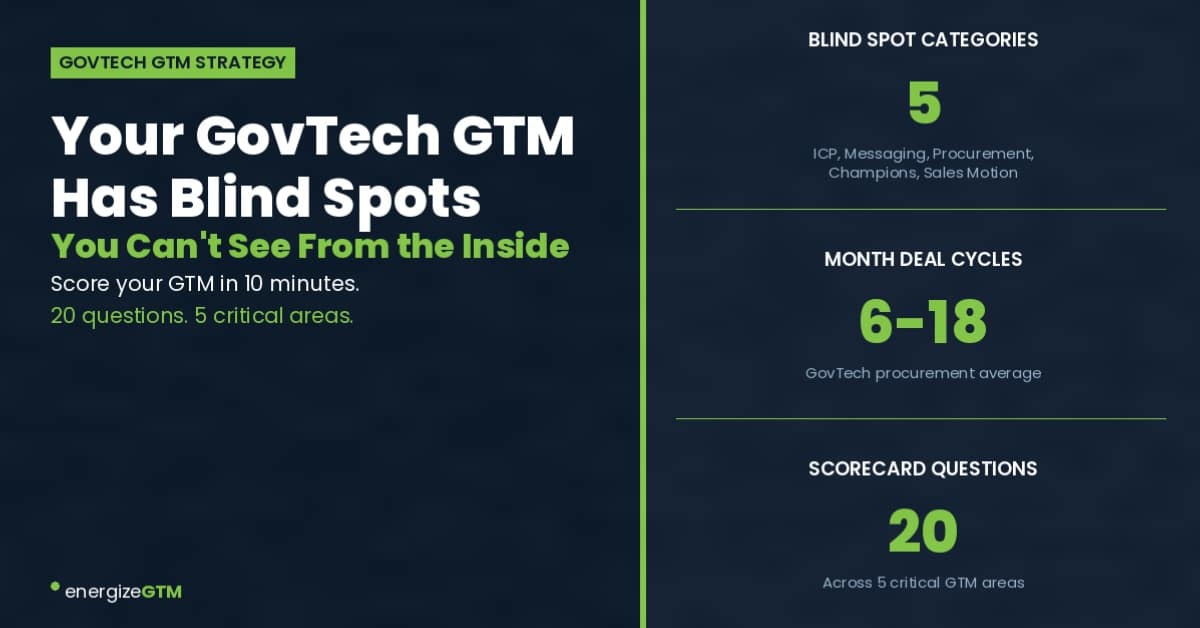
One of the tools energizeGTM built for GovTech founders is the GTM Scorecard — a diagnostic that helps founders assess where their go-to-market motion is strong and where it has gaps that procurement cycles will expose. It's not a quiz. It's a working tool designed to surface the specific vulnerabilities that cause GovTech deals to stall or die.
You can try it at the GovTech GTM Scorecard. It takes less than 10 minutes and most founders come away with at least one insight they hadn't fully articulated before.
What WIIFM Has to Do With All of This
"What's In It For Me" — WIIFM — is a framework that sits at the core of how energizeGTM thinks about stakeholder alignment in government and legal department sales. Every buyer, every approver, every gatekeeper in a GovTech or LegalTech deal has a WIIFM calculus they're running, whether they say it out loud or not.
Understanding and addressing that calculus is what separates a GTM strategy that moves deals forward from one that generates meetings that go nowhere.
If you want to understand how energizeGTM applies WIIFM in government sales contexts, you can download the WIIFM Framework from the library. It's a practical tool, not a theoretical model.
Impact Over Revenue: What That Actually Means in Practice
When I say revenue doesn't define success for energizeGTM, I don't mean revenue doesn't matter. It does — for both of us. What I mean is that I won't optimize energizeGTM's revenue at the expense of the quality of what I deliver to you.
That's a real trade-off. More clients means less time per client. Less time per client means more templated advice. More templated advice means worse outcomes for founders selling into government agencies and legal departments where context is everything.
I'd rather change 10 businesses permanently than touch 100 and deliver mediocre results to all of them. That's not a positioning statement. That's an operating constraint I've built into the structure of energizeGTM on purpose.
What This Means for How You Should Evaluate Any GTM Partner
Whether you work with energizeGTM or someone else, here are the questions worth asking any GTM advisor before you sign:
- Who will actually be doing the work — and how much access do I have to that person?
- Have you sold into government procurement cycles or legal department buying processes yourself?
- Can you show me a client who was at my stage, in my vertical, and tell me specifically what changed for them?
- What happens when a deal stalls or a strategy isn't working — who do I call and how fast do I hear back?
- Do you have a template-first or context-first approach to GTM strategy?
The answers to those questions will tell you more about a GTM partner than any case study deck or credential list.
The Podcast, the Playbooks, and the Proof
energizeGTM publishes the Built for Government GovTech Podcast, a resource for GovTech founders navigating the specific challenges of public sector software sales. The conversations are practitioner-to-practitioner — not polished marketing content, but actual conversations about what works and what doesn't when selling into government.
The library, the frameworks, the podcast, the scorecard — all of it exists because the founders I work with need more than advice. They need tools that work inside the real constraints of government and legal department procurement.
Frequently Asked Questions
What makes energizeGTM different from a traditional GTM consulting firm?
energizeGTM is intentionally small. The founder works directly with every client — no hand-offs, no junior associates, no templated playbooks dropped into a new context. The GTM guidance is built on more than 20 years of experience selling into government agencies and legal departments, which means the advice accounts for procurement cycles, legal review processes, and buyer psychology specific to GovTech and LegalTech. The operating model prioritizes depth over scale.
Is energizeGTM the right fit for a LegalTech SaaS company under $5M ARR?
Yes — the sub-$5M ARR stage is the primary focus. At this stage, GTM strategy has to account for limited resources, long legal department sales cycles, and the need to build a repeatable motion before scaling it. energizeGTM's approach is designed for founders who are still figuring out their ICP, refining their messaging, and building the sales infrastructure that will support growth. Larger firms often aren't structured to operate effectively at this stage.
What is the WIIFM Framework and how does it apply to GovTech or LegalTech sales?
WIIFM stands for "What's In It For Me." In GovTech and LegalTech sales, every stakeholder — procurement officers, legal reviewers, department heads, budget approvers — is running a personal calculus about what a new software purchase means for them individually. The WIIFM Framework is a tool for mapping those calculi and building a stakeholder alignment strategy that addresses each one. Ignoring WIIFM is one of the most common reasons GovTech and LegalTech deals stall after an otherwise successful demo. You can download the framework at energizegtm.com.
How does energizeGTM handle the GovTech procurement and legal review process?
GovTech procurement cycles and legal reviews are among the most common deal-killers for public sector software companies. energizeGTM's approach involves educating relevant stakeholders — including City Attorneys, procurement officers, and compliance reviewers — well before a contract is ready to sign. The goal is to eliminate surprises in legal review by making the process predictable and managing it proactively rather than reactively. This is a practitioner skill, not a theoretical framework.
Conclusion
If you want an agency that will impress you with their headcount and client list, energizeGTM is not that. If you want a GTM partner who knows GovTech and LegalTech from the inside, who will treat your business like it matters personally, and who will be available when the hard moments hit — that's what energizeGTM is built to deliver.
The choice to stay small is the choice to stay good. And for founders navigating the complexity of government and legal department sales, good advice delivered with real context is worth more than scaled advice delivered at arm's length.
Work With energizeGTM
If you're a GovTech or LegalTech SaaS founder ready to build a GTM motion that actually fits your buyer, here are three ways to engage:
- GovTech founders: Start with the GovTech GTM Scorecard to diagnose the gaps in your current go-to-market motion
- LegalTech founders: Download Niche Beats Noise — a framework for LegalTech GTM positioning built for sub-$5M ARR companies
- Ready to talk: Contact energizeGTM to start a conversation about your go-to-market challenges, or learn more about the energizeGTM Roadmap Process