Your GovTech GTM Has Blind Spots You Cannot See From the Inside
Most GovTech founders do not have a broken go-to-market strategy. They have a go-to-market strategy with small, invisible friction points that compound quietly over time. Public sector software sales is already hard enough. When your GTM has hidden drag you cannot identify because you are too close to it, every cycle takes longer and every deal gets harder than it should. An independent outside evaluation is not a luxury — it is the fastest way to stop paying the tax on problems you do not know you have.
Why GovTech GTM Blind Spots Are Different
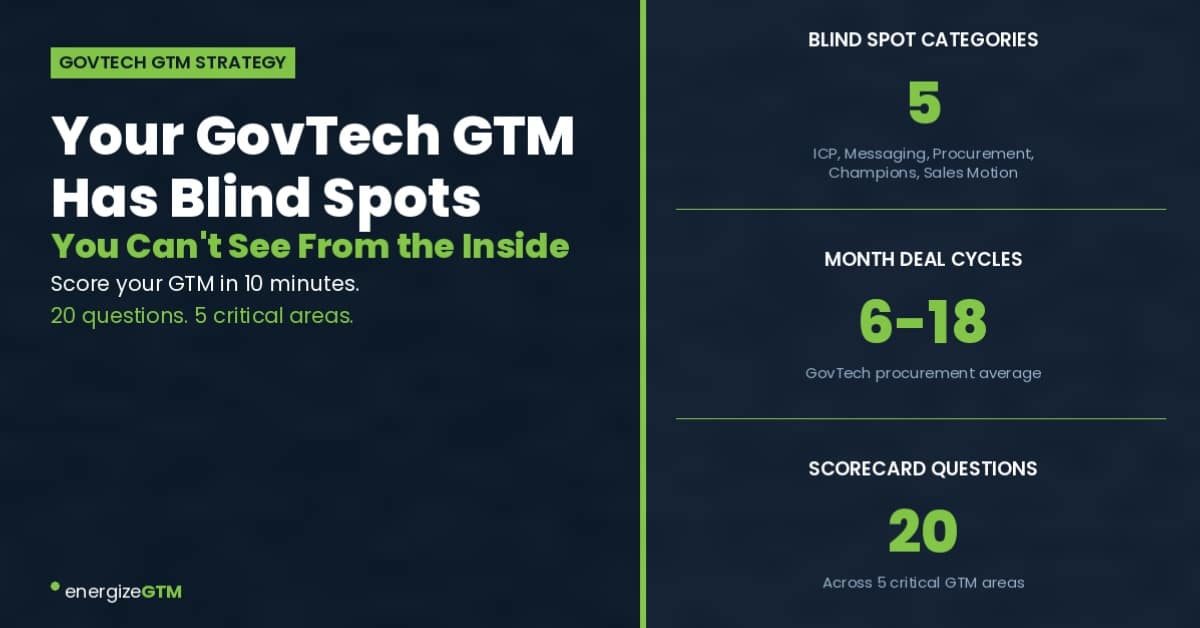
In most SaaS verticals, blind spots cost you pipeline efficiency. In GovTech, they cost you something worse: time. Public sector procurement cycles run 6 to 18 months on a good day. If your messaging misses the actual buyer, or your champion enablement is weak, or your qualification criteria do not account for how government agencies actually fund software purchases, you do not get a quick feedback loop. You get a long, expensive lesson.
Government buyers operate inside constraint systems that most commercial SaaS sales motion was never designed for. Budget approval cycles, IT governance review boards, procurement rules tied to contract vehicles like NASPO ValuePoint, Sourcewell, or state co-ops, and multi-stakeholder sign-off requirements — these are not edge cases. They are the default environment. A GovTech GTM that was not deliberately built for this environment will drift off-target and keep drifting unless someone with outside perspective identifies where the disconnect is happening.
The challenge is that drift happens gradually. Your team adapts to the friction without naming it. Workarounds become standard operating procedure. What looked like a temporary adjustment to the sales motion becomes the sales motion. Nobody inside the organization can see it clearly anymore because they are living inside it.
The Five Areas Where GovTech GTM Blind Spots Cluster
After working with GovTech SaaS founders across multiple verticals — from public safety software and EMS management software to municipal finance software and government compliance software — the same categories of blind spots show up repeatedly. These are not random. They are structural.
1. ICP Drift
You defined your ideal customer profile when you were early. You were probably right at the time. But ICPs drift as you close deals, learn more about who actually gets value from your product, and adjust your sales motion to meet the buyers you find rather than the buyers you intended to serve. If your ICP has not been formally revisited in the last 12 months, it has drifted.
In GovTech, ICP drift often looks like this: you started targeting a specific department or agency type, but over time you won deals with adjacent buyers who were easier to access. Now your sales motion is half-optimized for your real ICP and half-optimized for the buyers who happened to respond. Neither group is getting a fully relevant pitch, and your close rates are lower than they should be for a solution that genuinely solves the problem.
2. Messaging Misalignment
Government buyers do not care about features. They care about outcomes that map to their mandate, their budget justification, and their political accountability. Public sector software buyers need to be able to explain the purchase to their supervisors, their city council, and sometimes to the public. If your messaging leads with capability instead of outcome, you are creating unnecessary friction at every stage of the buying process.
The WIIFM (What's In It For Me) Framework is a useful diagnostic here. Every stakeholder in a government deal has a different definition of "winning." The department head needs operational improvement. The finance director needs budget justification. The IT director needs compliance and integration assurance. If your messaging does not address each of those priorities explicitly, you are leaving gaps that slow deals down. Download the WIIFM Framework to map your messaging against every stakeholder's real priorities.
3. Procurement Fluency Gaps
Contract vehicles are not just a paperwork issue. They are a competitive advantage when used correctly and a deal-killer when ignored. If your team cannot fluently navigate the difference between a sole-source justification and a cooperative purchasing vehicle, you are ceding ground to competitors who can.
Procurement fluency gaps also show up in how you qualify opportunities. Not all government interest is real pipeline. Some agencies issue RFPs they already know the outcome of. Some are at the very beginning of an education phase that will not convert for two years. If your qualification criteria do not account for where an agency actually is in its buying journey — including whether budget has been allocated and whether a procurement path has been identified — you are loading your pipeline with opportunities that will never close on your timeline.
4. Champion Enablement Weakness
In government sales, your champion rarely has unilateral authority to approve a purchase. They have to sell internally on your behalf. If you are not actively equipping them with the tools, language, and materials they need to do that, you are asking them to fight your battle with their bare hands.
Champion enablement for GovTech is different from commercial SaaS. Your champion needs budget justification language that fits government finance frameworks. They need compliance documentation. They need implementation timelines that account for government IT review cycles. They need reference stories from other agencies, ideally peer agencies in the same state or at the same population size. Most GovTech sales teams underinvest in this systematically, and most do not know they are doing it.
5. Misaligned Sales Motion for the Buyer's Timeline
Commercial SaaS sales motions are built around urgency. Government procurement does not operate on urgency. It operates on process. The tactics that accelerate deals in commercial markets — scarcity plays, end-of-quarter discounting, high-pressure follow-up cadences — either do not work or actively damage relationships in public sector sales.
If your sales motion was borrowed from a commercial SaaS playbook and then adapted for government, the adaptations are probably incomplete. There are almost certainly places where the commercial logic is still embedded and creating friction you cannot identify because it looks like "normal" sales behavior from the inside.
What an Independent GTM Evaluation Actually Looks For
An independent outside evaluation of your GovTech GTM strategy is not an audit of what is wrong. It is a calibration of where your motion fits the environment and where it does not. The goal is not to tear down what you have built. It is to identify the specific friction points that are costing you deals and time, and to prioritize which ones to address first.
The evaluation looks at five critical dimensions of your go-to-market motion:
- ICP definition and validation — Is your target buyer segment specific enough to drive precise outbound? Is it validated against actual closed-won data, or based on original assumptions?
- Messaging and positioning — Does your messaging map to the outcome language government buyers use? Does it address multiple stakeholder WIIFMs? Can a champion use it to sell internally?
- Procurement and sales process alignment — Is your sales motion built for how government agencies actually buy? Does your qualification process filter for real, fundable pipeline?
- Champion and stakeholder strategy — Do you have a systematic approach to identifying, developing, and enabling champions inside target agencies?
- Pipeline health and revenue operations — Are your pipeline metrics meaningful? Are your stage definitions tied to buyer actions rather than seller actions?
The friction points that matter most are rarely in the obvious places. They are in the small misalignments between how your team operates and how government procurement actually works — the places where your team adapted to friction so gradually that the adaptation became invisible.
How to Think About Your GTM from the Outside In
One of the most useful exercises for identifying GTM blind spots is what we call the outside-in diagnostic. Instead of starting with your sales process, start with the buyer's experience. Walk through every stage of a recent deal from the buyer's perspective, not your own.
What was the first piece of content or outreach they encountered? What did they do next? What questions did they have at each stage that were not answered by your existing materials? Where did they stall? What did they need to move forward that they had to ask for rather than receiving proactively?
Most GovTech founders who do this exercise find at least two or three significant gaps they did not know were there. The government buyer had needs at key decision points that the sales motion did not address. Those gaps did not kill every deal — government buyers are patient and often motivated to find a solution — but they slowed every deal down. In a market where cycle length is already measured in months, that drag is significant.
The Built for Government podcast has covered this pattern across dozens of GovTech founders. The companies that grow efficiently in public sector markets are not necessarily the ones with the best product. They are the ones whose GTM motion fits the buyer's environment most precisely.
The Cost of Proximity
There is a real cost to being too close to your own GTM. It is not just that you cannot see the blind spots. It is that the longer you operate inside your own motion without an outside calibration, the more confident you become that you understand why deals are going the way they are. Confirmation bias builds. The explanations you use for losses start to feel settled. You stop questioning the assumptions embedded in your process.
This is not a critique of GovTech founders. It is the nature of being close to your own work. The best commercial teams in any vertical bring in outside perspective regularly — not because they think they are failing, but because they know that proximity costs clarity. [Verify before publishing: industry data on frequency of external GTM reviews among high-growth SaaS companies]
The GovTech market is growing. Agencies across every vertical — water utility management software, government budgeting software, public transparency software, fire department software, grant management software — are actively looking for modern solutions. The opportunity is real. The question is whether your GTM is positioned to capture it efficiently or whether you are leaving deals on the table due to friction you cannot see.
How to Score Your GovTech GTM Today
energizeGTM built the GovTech GTM Scorecard specifically for founders and GTM leaders who want an honest, structured view of where their go-to-market strategy stands. The scorecard covers 20 questions across the five critical dimensions described above. It takes about 10 minutes to complete, and it produces a score that tells you not just how you are doing overall but where to focus first.
The Scorecard is not a sales funnel. It is a diagnostic tool. The questions are built around the specific dynamics of public sector software sales — procurement complexity, multi-stakeholder buying, long cycles, compliance requirements, and the buyer psychology unique to government agencies. You will not find commercial SaaS benchmarks dressed up in government language. The questions are written for the actual environment you are selling into.
The scoring is designed to surface the specific areas where your GTM has the most friction relative to how GovTech buyers actually buy. If your messaging is strong but your champion enablement is weak, the Scorecard will show you that. If your ICP is tight but your procurement fluency is creating qualification errors, you will see that too.
Most founders who complete the Scorecard identify at least one significant blind spot they were not aware of before taking it. Some find more. That is the point — not to confirm what you already know, but to show you what you cannot see from the inside.
Frequently Asked Questions
What is a GovTech GTM blind spot?
A GovTech GTM blind spot is a friction point in your go-to-market strategy that reduces sales efficiency but is invisible to your internal team because they are too close to the process to identify it. Common blind spots include ICP drift, messaging that does not map to government buyer language, procurement fluency gaps, weak champion enablement, and a sales motion built for commercial urgency rather than government process timelines.
How often should a GovTech SaaS company evaluate its GTM strategy externally?
At minimum, GovTech SaaS companies should conduct an independent GTM evaluation annually. More frequent evaluation — every six months — is appropriate during periods of rapid growth, entering new agency verticals, or following a significant change in product positioning. The longer a team operates without outside perspective, the more embedded its blind spots become.
What does the GovTech GTM Scorecard measure?
The GovTech GTM Scorecard measures your go-to-market strategy across five dimensions: ICP definition and validation, messaging and positioning quality, procurement and sales process alignment, champion and stakeholder strategy, and pipeline health and revenue operations. It produces a score for each area and an overall score, with guidance on where to prioritize improvement based on your results.
Why is an outside evaluation more valuable than an internal review for GovTech GTM?
Internal reviews are limited by proximity. The team that built and operates the GTM motion is also the team evaluating it, which means they are evaluating it against the assumptions embedded in the motion itself. An outside evaluator brings a perspective built on how GovTech buyers actually behave, what procurement-aligned sales motions look like, and where common friction points cluster — without the confirmation bias that builds inside any team over time.
Conclusion
The GTM blind spots that cost GovTech founders the most are not the obvious ones. They are the small misalignments that compound quietly — the ICP that has drifted, the messaging that almost fits, the champion who needed materials you did not provide, the qualification process that is loading your pipeline with non-fundable opportunities. None of these look like crises from the inside. All of them are expensive.
An independent outside evaluation is the fastest way to identify where your motion has friction you cannot see. The GovTech GTM Scorecard is the place to start. Twenty questions, five critical areas, ten minutes — and a clear picture of where to focus next.
Take the GovTech GTM Scorecard
Score your GovTech GTM at govtech-gtm-scorecard.energizegtm.net. Answer 20 questions across 5 critical areas and discover where your go-to-market strategy stands — and where to focus next.
Prefer to talk it through first? Contact energizeGTM directly to discuss what an outside evaluation looks like for your specific stage and vertical.
Not sure where to start? Learn more about the energizeGTM Roadmap Process — the structured approach we use to identify friction, build a focused GTM plan, and help GovTech founders execute with less wasted motion.
Explore frameworks, playbooks, articles, and tools built specifically for public sector software founders at the energizeGTM Library.