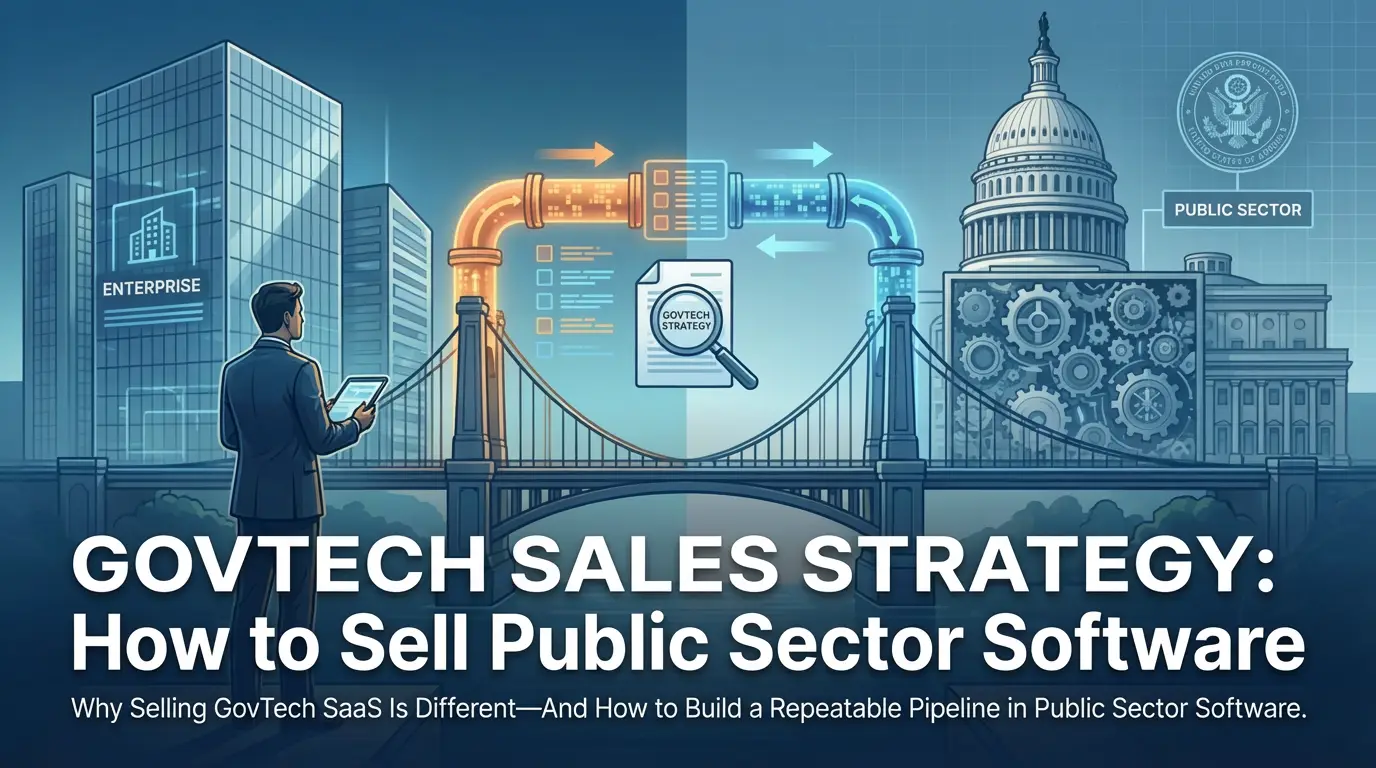
Why Selling GovTech SaaS Is Different—And How to Build a Repeatable Pipeline in Public Sector Software
Introduction
Think selling to enterprise accounts is tough? Try selling SaaS to government.
If you’re a founder, CEO, or VP of Sales at a GovTech company under $10M ARR, you’ve likely felt the unique pain of public sector sales. The deals that should close in 90 days stretch to 18 months. Budget approvals vanish overnight. And just when you think you’ve won, an administration change sends you back to square one.
Here’s the uncomfortable truth: most GovTech companies fail not because their product isn’t good enough, but because they’re applying B2B SaaS playbooks to a market that operates by completely different rules.
After two decades of selling public sector software—from municipal finance platforms to public safety solutions—I’ve seen what works and what doesn’t. This guide breaks down the strategies that are actually moving the needle for GovTech founders right now.
Whether you’re selling fire department software, water utility management software, or government accounting software, the principles remain the same. Let’s dive in.
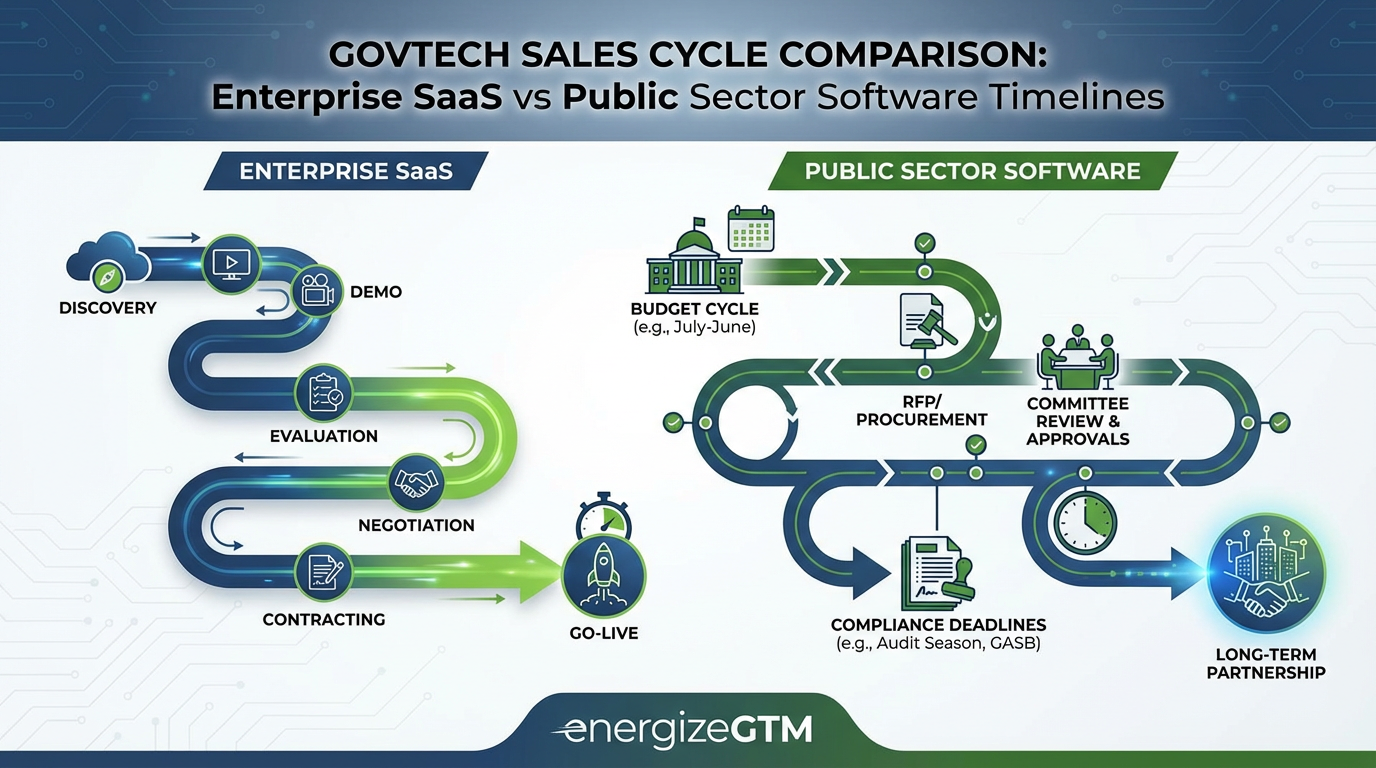
The Brutal Reality of GovTech Sales Cycles
Understanding What You’re Up Against
GovTech sales aren’t just slower—they’re structurally different. Here’s what the data shows:
Factor | Enterprise SaaS | GovTech SaaS |
Average Sales Cycle | 3-6 months | 6-36 months |
Decision Makers | 3-7 stakeholders | 10-25+ stakeholders |
Procurement Process | Negotiation-based | RFx-driven |
Budget Flexibility | Quarterly adjustments | Annual/biennial cycles |
Compliance Requirements | Industry-specific | NIST, CJIS, FedRAMP, StateRAMP |
My longest deal? Five years. Not because the product wasn’t ready or the champion wasn’t bought in—but because fiscal year-end budgets vanished, administrations flipped, and approval processes restarted from scratch. | ||
The Five Silent Killers of GovTech Deals
- RFx Traps — Responding to every RFP without qualifying whether you can actually win
- Compliance Gates — Underestimating NIST, CJIS, and government compliance software requirements
- Committee Fragmentation — Failing to align across state, county, and city agency stakeholders
- Procurement Hurdles — Not understanding contract management software for government processes
- Budget Timing Misalignment — Pushing deals that don’t match fiscal calendar realities
If you’re not accounting for these factors in your go-to-market strategy, you’re building pipeline on quicksand.
Related: Learn how we help GovTech companies navigate these challenges at energizeGTM.
Why Traditional SaaS Playbooks Fail in Public Sector Software
The Volume Trap
Here’s what I see constantly: GovTech founders and sales leaders chasing volume over precision. They pursue every agency logo, burn through customer acquisition costs, and wonder why nothing converts—or worse, why nothing repeats.
The math doesn’t work.
There are 50,000+ government agencies in the United States alone. Most of them aren’t worth chasing—at least not right now. They’re either:
- Not in an active buying cycle
- Locked into existing contracts
- Too small to justify your CAC
- Misaligned with your product’s core value proposition
When you spray and pray in public sector software sales, you don’t just waste resources—you train your team to lose.
The Feature-First Fallacy
Another common mistake: leading with product features instead of agency outcomes.
Government buyers don’t care that your municipal finance software has 47 integrations. They care whether it will help them:
- Pass their next audit without findings
- Reduce manual data entry by 60%
- Meet state reporting deadlines
- Improve public transparency software requirements
Outcome-first messaging wins in GovTech. Feature-first messaging gets you filtered out in the first RFP evaluation round.
The “One Government” Myth
Perhaps the most dangerous assumption: treating government as a single market.
A county sheriff’s office evaluating public safety software has completely different procurement processes, budget cycles, and pain points than a state environmental agency looking at wastewater management software.
Treating them the same is a recipe for failure.
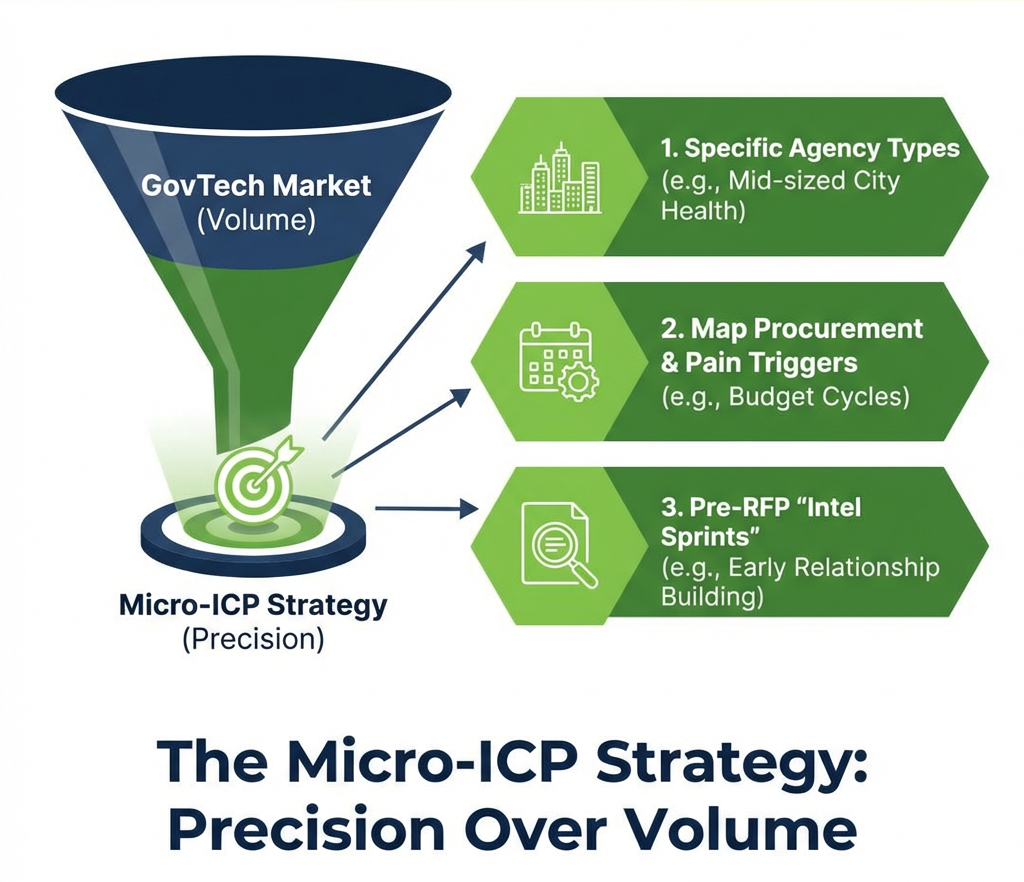
The Micro-ICP Strategy: Precision Over Volume
What’s Actually Working Right Now
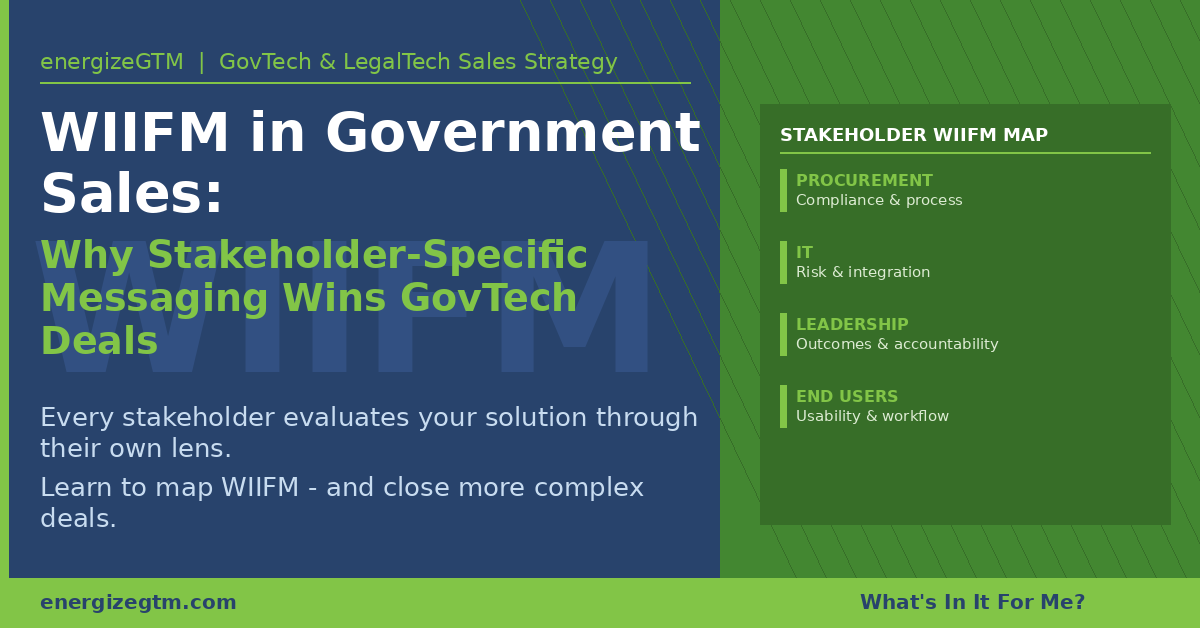
The GovTech companies seeing consistent growth aren’t casting wide nets. They’re treating agencies as micro-ICP clusters—highly specific segments that share procurement patterns, pain triggers, and budget timing.
Here’s the framework:
Step 1: Identify 3-5 Repeatable Agency Types
Instead of “we sell to government,” get specific:
- Mid-sized city health departments (population 50,000-250,000)
- County-level emergency services using legacy EMS management software
- Municipal water utilities with aging water utility management software
- School districts requiring grant
- management software for federal funding
The more specific your ICP, the more repeatable your sales motion becomes.
Step 2: Map Procurement Calendars and Pain Triggers
Every agency type has predictable patterns:
Agency Type | Typical Budget Cycle | Key Pain Triggers |
Municipal Finance | July-June or Jan-Dec | Audit season, GASB changes |
Public Safety | Often tied to grants | Compliance deadlines, incident spikes |
Utilities | Capital improvement cycles | Infrastructure failures, regulatory changes |
Schools/Education | Academic year | Grant deadlines, enrollment changes |
When you understand these patterns, you can time your outreach to land when agencies are actively looking—not when you’re actively selling.
Step 3: Run Pre-RFP “Intel Sprints”
Here’s the play that separates winners from “column fodder”:If you’re not influencing the RFP before it drops, you’re already losing.Pre-RFP intel sprints involve:
- Identifying agencies 6-12 months before they’ll issue an RFP
- Building relationships with key stakeholders (IT directors, department heads, procurement officers)
- Providing educational value that shapes how they think about the problem
- Positioning your solution’s unique differentiators as evaluation criteria
This isn’t manipulation—it’s consultative selling done right. Agencies want vendor input during the requirements-gathering phase. They just don’t want it after the RFP is published.
Curious where your GovTech go-to-market strategy stands? Take the GovTech GTM Scorecard to find out.
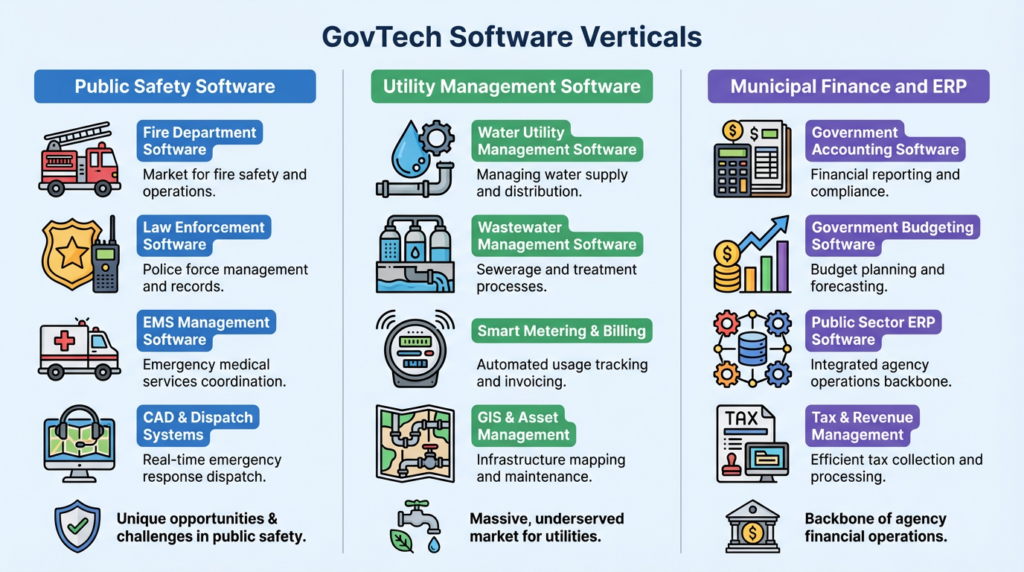
Navigating Vertical-Specific GovTech Markets
Public Safety Software
The public safety software market—including fire department software and EMS management software—presents unique opportunities and challenges.
Opportunities:
- High urgency around modernization (legacy systems create real safety risks)
- Grant funding available (SAFER, AFG, COPS grants)
- Strong peer networks (what one department adopts, neighbors notice)
Challenges:
- CJIS compliance requirements are non-negotiable
- Highly fragmented (18,000+ law enforcement agencies alone)
- Change-resistant culture
Winning approach: Focus on departments that have recently received grant funding or experienced a high-profile incident that exposed system gaps.
Utility Management Software
Water utility management software and wastewater management software represent a massive, underserved market.
Key insight: The American Society of Civil Engineers gives U.S. water infrastructure a “C-” grade. That translates to urgent replacement cycles for legacy systems.
Opportunities:
- Infrastructure Investment and Jobs Act funding flowing to utilities
- EPA compliance pressures increasing
- Aging workforce driving need for easier-to-use systems
Challenges:
- Extremely long sales cycles (utilities plan 20+ years out)
- Complex stakeholder environments (elected boards, city councils, state regulators)
Municipal Finance and ERP
Government accounting software, government budgeting software, and public sector ERP software form the backbone of agency operations.
What’s driving demand:
- GASB 87 and 96 compliance requirements
- Pressure for public transparency software capabilities
- Remote work exposing limitations of on-premise systems
The opportunity: Many agencies are stuck on 15-20 year old systems with vendors that have been acquired multiple times. They’re actively seeking alternatives—but only from vendors they trust.
Building a Repeatable GovTech Sales Engine
Pipeline Management That Actually Works
GovTech pipeline management requires different metrics than standard SaaS:
Track these instead of just pipeline value:
- Procurement stage (not just sales stage)
- Budget cycle alignment (is funding allocated?)
- Champion strength (can they actually drive internal consensus?)
- Competitive position (are you shaping the RFP or responding to it?)
Dealing with Fiscal Year-End Chaos
Every GovTech sales leader knows the drill: Q4 (whether that’s June, September, or December depending on the agency) becomes a mad scramble as “use it or lose it” budgets create sudden urgency.
How to capitalize without burning bridges:
- Maintain a “fast-close” list of qualified opportunities with budget authority
- Have procurement-ready documentation (quotes, compliance attestations, references)
- Offer pilot programs that let agencies commit smaller amounts to hold budget
- Never pressure agencies into deals that aren’t right for them (reputation travels fast in government)
Surviving Administration Changes
New elected officials and appointed leaders often want to “make their mark”—which can mean reviewing or canceling predecessor commitments.
Mitigation strategies:
- Build relationships across political lines (career staff often outlast political appointees)
- Document ROI and constituent impact (harder to cancel something with proven results)
- Structure contracts with clear deliverables and milestones
- Maintain ongoing communication, not just renewal-time outreach
Want to see how successful GovTech companies structure their go-to-market approach? Learn more about the energizeGTM process.
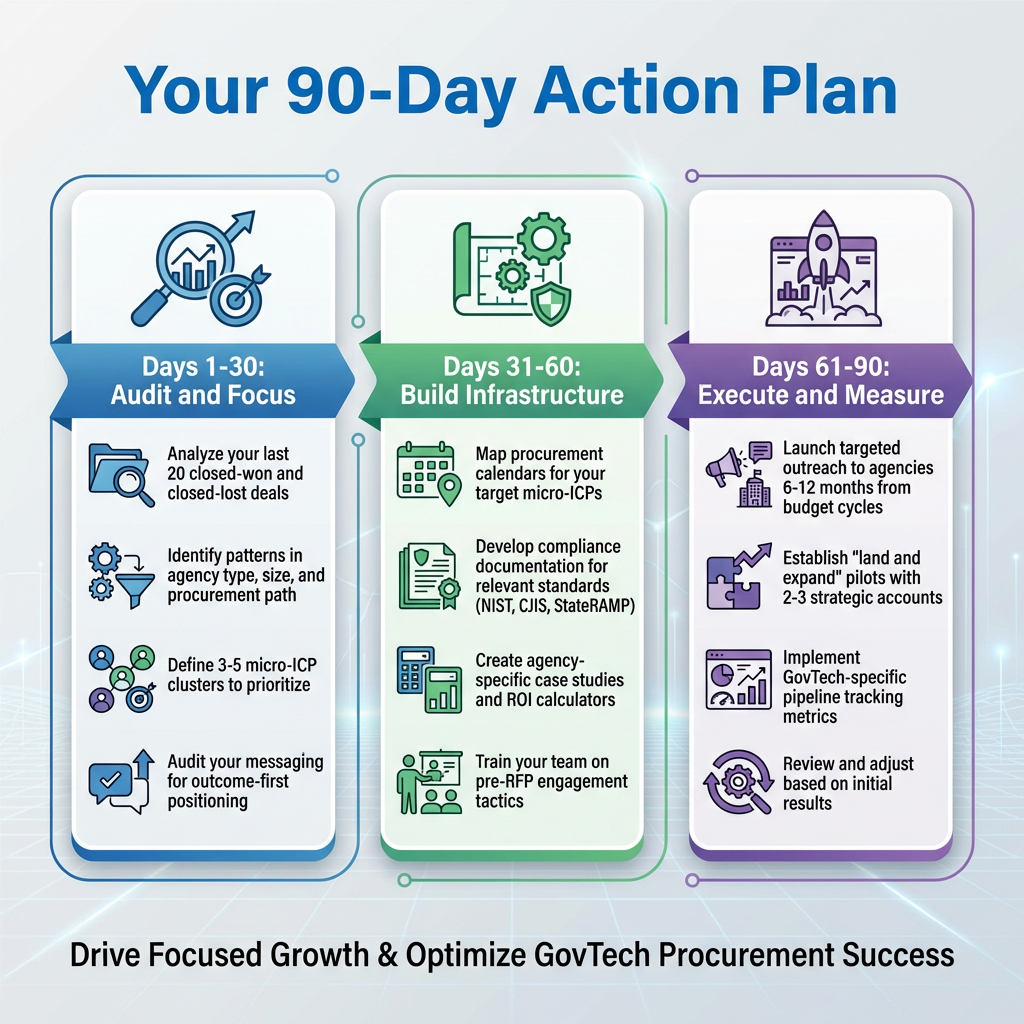
Your 90-Day Action Plan
Days 1-30: Audit and Focus
- Analyze your last 20 closed-won and closed-lost deals
- Identify patterns in agency type, size, and procurement path
- Define 3-5 micro-ICP clusters to prioritize
- Audit your messaging for outcome-first positioning
Days 31-60: Build Infrastructure
- Map procurement calendars for your target micro-ICPs
- Develop compliance documentation for relevant standards (NIST, CJIS, StateRAMP)
- Create agency-specific case studies and ROI calculators
- Train your team on pre-RFP engagement tactics
Days 61-90: Execute and Measure
- Launch targeted outreach to agencies 6-12 months from budget cycles
- Establish “land and expand” pilots with 2-3 strategic accounts
- Implement GovTech-specific pipeline tracking metrics
- Review and adjust based on initial results
Final Thoughts
Selling public sector software isn’t for the faint of heart. The cycles are long, the stakeholders are many, and the rules are different from anything you’ve experienced in commercial SaaS.
But here’s what most people miss: once you crack the code, GovTech creates incredibly durable revenue.
Government contracts are sticky. Agencies that trust you become long-term partners. And in a market of 50,000+ potential buyers, you don’t need to win them all—you need to win the right ones, repeatedly.
The founders and sales leaders who succeed in GovTech aren’t the ones chasing every RFP. They’re the ones who:
- Focus relentlessly on micro-ICP clusters they can serve exceptionally
- Engage early to shape procurement before RFPs drop
- Build trust through consistent, outcome-focused value delivery
That’s the playbook. Now it’s time to execute.
Ready to Accelerate Your GovTech Pipeline?
If you’re a GovTech founder or sales leader struggling with long cycles, RFP chaos, or fragmented agency targeting, you’re not alone—and you don’t have to figure it out by yourself.
Take the GovTech GTM Scorecard to assess your current go-to-market readiness and identify your biggest opportunities for improvement.
Or contact us directly to discuss how energizeGTM helps public sector software companies build repeatable, scalable sales engines.
Have questions about GovTech go-to-market strategy? Visit our FAQ page or explore our resources library.