Government Procurement and Budget Cycles: What GovTech Founders Get Wrong
Selling public sector software is not like selling to a private company. The rules are stricter, the timelines are longer, and the consequences of showing up at the wrong moment in a budget cycle can cost you an entire year. If you are a GovTech founder in the early stages of scaling your sales motion, understanding how government procurement actually works is not optional - it is the foundation your entire go-to-market strategy sits on.
The Mindset Shift Most GovTech Founders Miss
Most founders come to government sales with a private-sector mindset. They focus on the problem, the product, the champion inside the agency - and they assume that a strong business case will move things forward. That logic works well in the commercial world. In government procurement, it is often exactly backward.
Government agencies do not buy the same way private companies do. Budget authority is separated from end-user authority. Procurement rules exist independently of what any champion inside the agency wants to do. A department head who loves your GovTech solution may have zero ability to approve a purchase if the number exceeds a certain threshold, if the fiscal year has closed, or if the agency requires a competitive bid process.
The moment you internalize that distinction - that desire and authority are often in different hands in government - your entire approach to the sales process changes.
How Government Budget Cycles Actually Work
There is no single government budget cycle. That is one of the most important and most misunderstood facts in GovTech sales.
State governments, county governments, municipal governments, and special districts each operate on their own fiscal calendar. Some run on a July 1 to June 30 fiscal year. Others follow the federal October 1 to September 30 cycle. Some counties and municipalities use a January 1 to December 31 calendar. And within a single state, different types of agencies - a city fire department versus a county court system versus a regional water utility - may operate on entirely different schedules.
What this means in practice: if you are selling municipal finance software to a city in Texas and wastewater management software to a water authority in Colorado, you are likely working two completely different budget timelines at the same time.
Why Budget Cycle Timing Changes Everything
Budget cycles matter because they determine when money exists to be spent. Government agencies cannot legally commit funds they have not been appropriated. A champion who wants your government budgeting software today cannot cut a PO if that line item was not included in the current year's approved budget.
There are two windows that matter most in the government procurement cycle:
- Budget formation window - This is when department heads make requests for the following fiscal year. If your solution is not on someone's wish list during this window, it is unlikely to get funded in the next cycle. This window typically opens 6 to 9 months before the start of the new fiscal year.
- End-of-year spending window - Many agencies have use-it-or-lose-it budget rules. Unspent funds do not roll over. This creates a window near fiscal year-end where decisions move fast and purchases that would normally require more process get approved quickly.
Missing both of these windows means waiting for the next cycle. In government sales, that can mean a 12 to 18 month delay. For a GovTech founder under $5M ARR, that kind of miss is not a minor setback - it is a significant hit to your growth trajectory.
Understanding Procurement Thresholds and RFP Triggers
One of the most practical pieces of knowledge a GovTech founder can carry is a clear understanding of procurement thresholds - the dollar amounts at which different buying processes kick in.
Most government agencies have a tiered procurement structure. A small purchase - say, under $5,000 - might require only a supervisor's approval. A mid-range purchase - often between $5,000 and $25,000 - might require a department head sign-off and some competitive quotes. A larger purchase - often $25,000 to $100,000 or more, depending on the jurisdiction - may trigger a formal RFP (Request for Proposal) process or a public competitive bid requirement.
These thresholds vary significantly by state and by type of government entity. A municipal utility running water utility management software procurement has different rules than a county using grant management software funded through a federal pass-through grant.
Why Avoiding an RFP Can Accelerate Your Sale
This is where knowledge becomes a direct competitive advantage. A formal RFP process can add 6 to 18 months to a deal timeline. It introduces competitors. It shifts the evaluation criteria to a committee of people you may have limited access to. And it often commoditizes the buying decision in ways that hurt differentiated solutions.
There are legal, legitimate ways to help agencies purchase without triggering a formal RFP. Many states allow government entities to purchase through cooperative purchasing agreements - frameworks like OMNIA Partners, NASPO ValuePoint, or state-specific vehicles that allow agencies to piggyback on contracts already awarded through a competitive process. If your public sector software is listed on one of these vehicles, you may be able to close deals that would otherwise require a full RFP.
Understanding the specific thresholds for your target agencies - and structuring your pricing and contracting accordingly - is not gaming the system. It is operating the way experienced GovTech sellers operate. For more on building a complete government sales process, the GovTech Founder's Sales Reality Check covers these dynamics in depth.
Building Relationships With Procurement - Not Just Your Champion
Most B2B sales training focuses on finding your champion - the internal advocate who believes in your solution and will push it through. In GovTech sales, that instinct is correct but incomplete.
In government, your champion often has limited authority over the procurement process. They may have the organizational influence to get your government compliance software or public sector ERP software on the approved vendor list, but the actual mechanics of how and when money moves sits with a procurement officer, a finance director, or a purchasing department that your champion may have only an arm's-length relationship with.
The implication is direct: build a relationship with procurement early, even when you have a strong champion. Ask your champion to introduce you to the procurement contact before any formal process begins. Understand the procurement officer's timeline, their preferred vendor onboarding process, their documentation requirements. Get on the approved vendor list before there is a deal in motion.
How to Have the Procurement Conversation
Many founders avoid talking to procurement because it feels premature or presumptuous. That instinct costs them time. The procurement conversation does not have to be a sales pitch - it should not be. It is a discovery conversation about process.
Questions worth asking when you get in front of a procurement contact:
- What is the agency's fiscal year, and when does the budget formation process typically begin?
- At what dollar threshold does a purchase require a formal bid or RFP?
- Does the agency participate in any cooperative purchasing agreements?
- What does the preferred vendor registration process look like?
- Are there specific documentation requirements - insurance certificates, W-9s, certifications - that need to be in place before a PO can be issued?
Getting answers to these questions early saves you from expensive surprises at the end of a long sales cycle. It also signals to the agency that you understand how government procurement works - which builds credibility with exactly the people who control the final steps of every deal.
If you want a broader framework for structuring your government sales approach, the GovTech Founder's GTM Playbook walks through how to build a repeatable motion designed specifically for the public sector buying environment.
The Internal Procurement Process: Who Actually Controls the Buy
Even within a single government agency, the path a purchase takes from "we want this" to "PO issued" can involve multiple departments, approval layers, and review steps that have nothing to do with whether anyone likes your product.
A typical mid-size city government might route a software purchase through:
- The requesting department head
- An IT review for security and infrastructure compatibility
- A legal review if the contract includes data sharing or cloud hosting terms
- The city attorney's office for contract language approval
- The finance department for budget verification
- The city council for purchases above a certain threshold
- The procurement or purchasing department for final PO issuance
Each of those handoffs is a potential delay point. Each department in that chain has its own timeline, its own workload, and its own set of questions about your contract management software for government or your public transparency software or whatever category you are selling into.
The founders who navigate this well are the ones who map this process early. They ask their champion to walk them through the internal approval path. They find out which departments typically slow deals down. They get ahead of IT security reviews by having their security documentation ready. They pre-clear contract language with their own legal team so redlines are minimal.
Practical Calendar Alignment for GovTech Sellers
Given how much timing matters in government sales, treating the fiscal calendar as a core part of your sales planning process is non-negotiable.
Here is a practical way to think about aligning your outbound activity to the government procurement calendar:
- 9 to 12 months before fiscal year-end - This is when budget requests are being built. Get in front of department heads during this window. Your goal is to make sure your solution is in someone's budget request for the next fiscal year.
- 6 to 9 months before fiscal year-end - Budget requests are being reviewed and trimmed. Stay close to your champion. Provide any ROI data, case studies, or peer agency references that help justify the line item staying in the request.
- 3 to 6 months before fiscal year-end - Budgets are being finalized. If you are not already in the budget, you are probably not getting funded this cycle - focus on keeping the relationship warm for next year.
- Last 90 days of fiscal year - End-of-year spending window. If an agency has unspent budget, decisions can move quickly. Be ready to accelerate. Have your documentation, contract, and onboarding materials ready to go so you are not the bottleneck.
This timing framework applies across GovTech categories - whether you are selling fire department software, EMS management software, government accounting software, or public safety software. The underlying procurement mechanics are the same.
Listening In: Procurement Mindset and Budget Cycles on Built for Government
This topic was the focus of a recent episode of Built for Government, the energizeGTM podcast for GovTech SaaS founders. The conversation goes deep on the mindset shift from private-sector selling, how to map agency-specific procurement rules, and how to use budget cycle awareness to shrink your sales cycle. The full episode is worth 30 minutes of your time if you are actively selling into government agencies.
Frequently Asked Questions
What is a government procurement threshold and why does it matter for GovTech sales?
A government procurement threshold is the dollar amount at which a different buying process is required. Below the threshold, an agency may be able to purchase with minimal approvals. Above it, a formal competitive bid or RFP process is typically required. For GovTech sellers, knowing the thresholds in your target agencies helps you understand whether a deal can close quickly through a simplified process or whether it will require a full RFP, which can add 6 to 18 months to the timeline.
How do I find out when a specific government agency's budget cycle starts?
The most reliable way is to ask directly - either your champion inside the agency or the procurement contact. Many state and local government budgets are also posted publicly, and agencies often publish their budget calendars or annual reports online. Your champion can typically tell you when department budget requests are due, which is the most useful timing signal for planning your outreach.
What is a cooperative purchasing agreement and can it help my GovTech company close deals faster?
A cooperative purchasing agreement is a pre-competed contract vehicle that allows government agencies to buy from an approved vendor without running their own competitive bid process. Examples include OMNIA Partners, NASPO ValuePoint, and various state-specific cooperative programs. If your public sector software is listed on one of these vehicles, agencies that participate in the program can often purchase from you directly, bypassing the RFP requirement. This can significantly shorten deal timelines and reduce friction in the procurement process.
Should I try to sell below procurement thresholds to avoid triggering an RFP?
There are legitimate ways to structure pricing and contract terms that keep purchases within simplified procurement thresholds - such as annual subscription pricing at a per-seat level, or phased implementations. However, structuring deals specifically to circumvent procurement rules can create legal risk and damage the agency relationship. The better approach is to understand the thresholds, price honestly, and where possible get your software onto cooperative purchasing vehicles that give agencies a compliant fast path to buying.
How do I get introduced to a procurement officer when my only contact is a department champion?
Ask your champion directly. Frame it as making sure you do not create any procurement headaches for them down the line. Something like: "I want to make sure we are set up as an approved vendor and understand your procurement process before we get further into this conversation - would you be comfortable introducing me to whoever handles that?" Most champions are relieved when a vendor proactively wants to handle the administrative side correctly. The introduction request rarely creates friction when it is framed as a service to them, not a sales move.
Bottom Line: Government Sales Rewards Preparation
The GovTech founders who shorten their sales cycles are not the ones with the best pitch decks. They are the ones who have done the homework - who know the agency's fiscal calendar, understand the procurement thresholds, have built a relationship with procurement before there is a deal in motion, and have their contracting and documentation ready to go when the spending window opens.
None of this is secret information. It is operational discipline applied to a market that runs on process, rules, and timing. Treat procurement knowledge as part of your product knowledge, and your government sales results will follow.
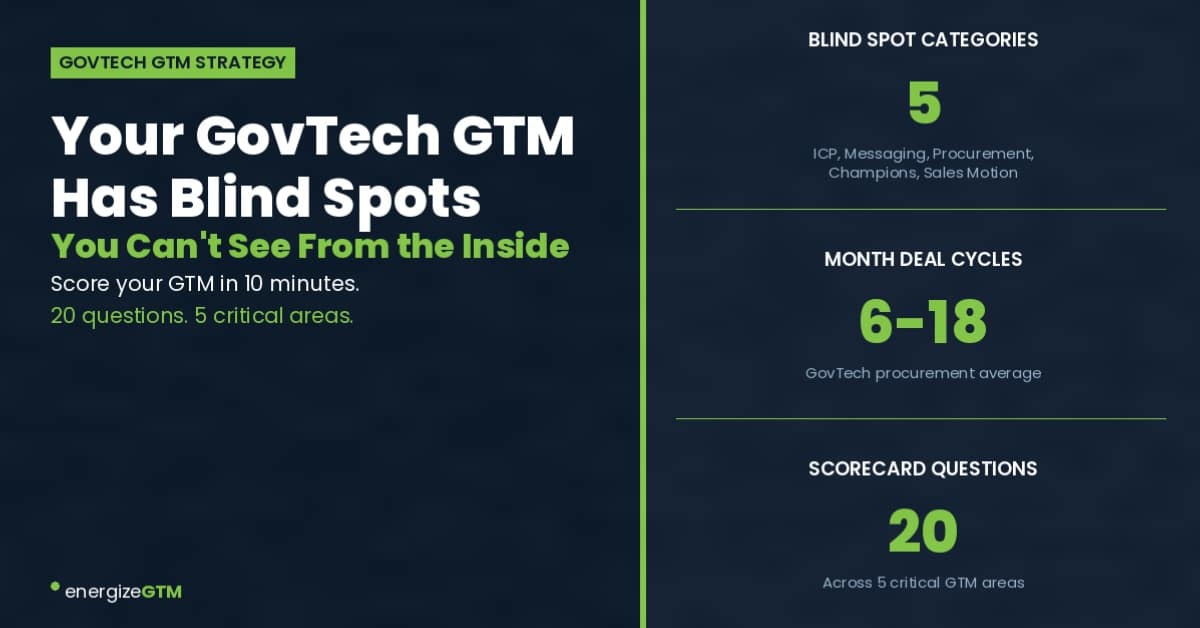
If you are building your GovTech sales motion and want a structured way to assess where your gaps are, try the GovTech GTM Scorecard - a free tool that gives you a fast read on where your go-to-market is strong and where it needs work.
And if you are ready to go deeper on the GTM fundamentals, the WIIFM Field Guide for GovTech gives you the messaging framework to connect your solution to what government buyers actually care about.
Questions about your specific situation? Reach out directly - every GovTech market is a little different, and the details matter.