How to Sell SaaS Into State and Local Government: A Practical GovTech Sales Playbook
Government buyers don’t buy like B2B buyers. If you’re applying a standard SaaS sales motion to public sector accounts, you’re not just leaving money on the table — you’re probably losing deals you should have won. This guide breaks down exactly how to sell public sector software into state and local government agencies, from your first outreach through procurement and close.
Why GovTech Sales Requires a Different Playbook
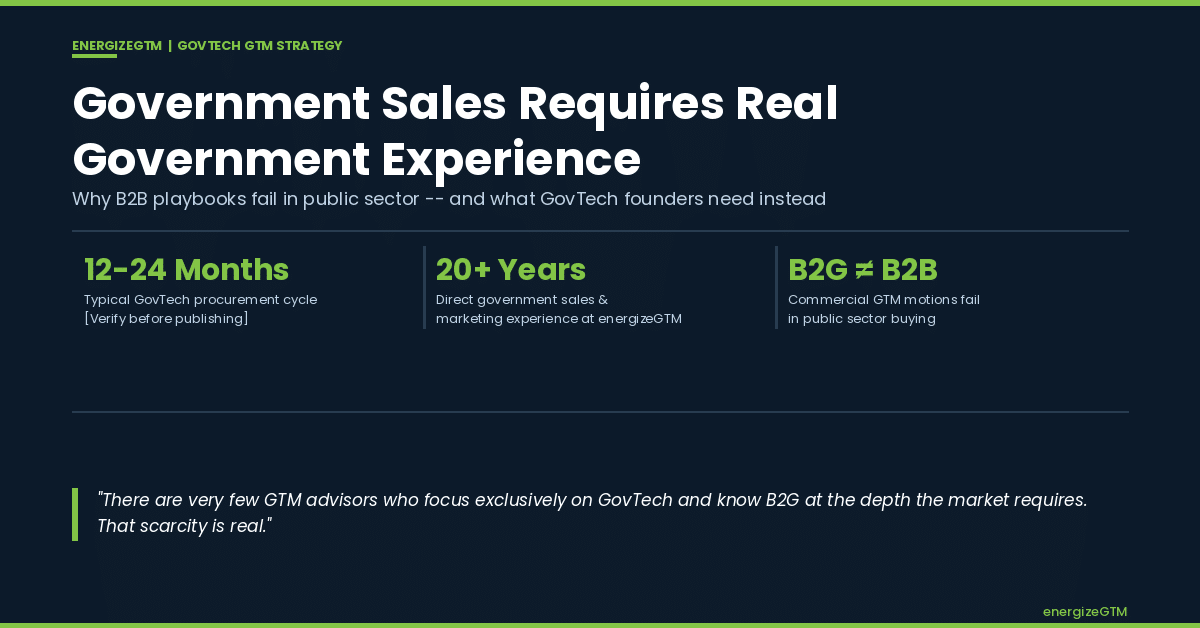
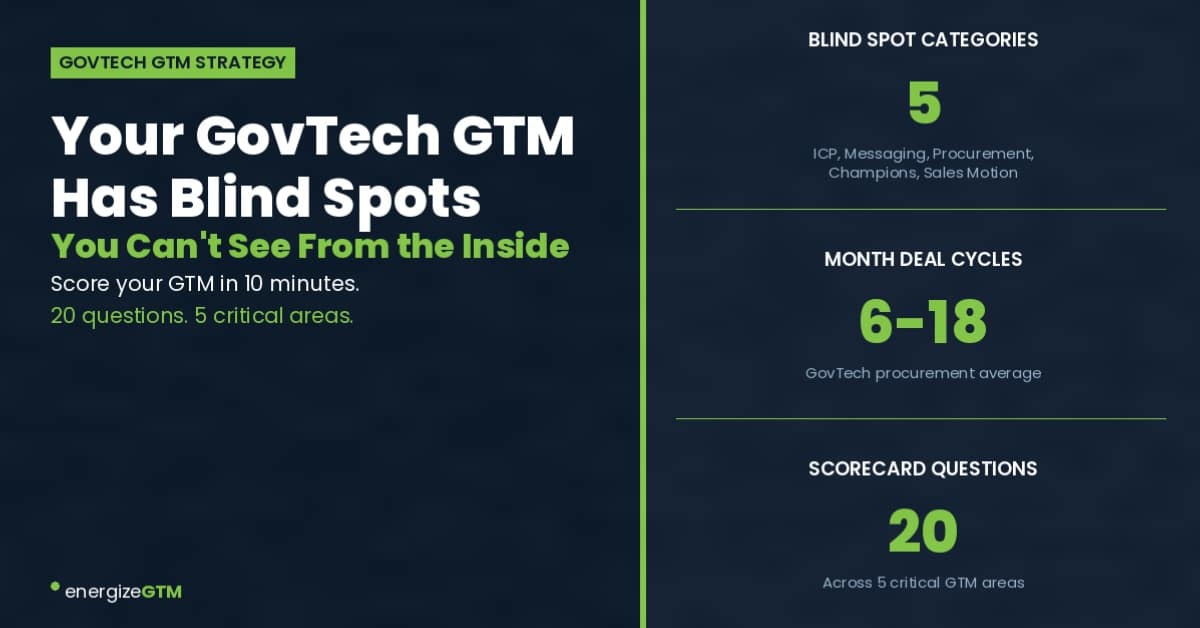
In commercial SaaS, a champion with budget authority can often move a deal from intro call to signed contract in 30 to 60 days. In government, that same process routinely takes 6 to 18 months — and that’s when everything goes smoothly.
The reasons aren’t bureaucratic dysfunction. They’re structural. Public agencies spend taxpayer dollars, which means purchasing decisions go through layers of oversight that have no equivalent in the private sector. Procurement laws, budget cycles, board approvals, and competitive bidding requirements all exist by design.
If you fight those structures, you lose. If you learn to work with them, you build a sales motion that generates compounding advantages — because most of your competitors never bother to figure it out.
Understanding the GovTech Procurement Landscape
Budget Cycles Drive Everything
State and local government agencies operate on fixed fiscal years. Many run on a July 1 to June 30 cycle; others use a calendar year or an October 1 federal alignment. Whatever the schedule, unspent budget usually can’t roll over — which creates predictable buying windows if you know where to look.
This means your pipeline needs to be built well before the budget window opens. If an agency’s fiscal year starts July 1, they’re allocating budget in the fall and winter of the prior year. You need to be in the room during that planning phase, not pitching after the money has been committed elsewhere.
- Map fiscal year calendars for your target agencies before you build your outreach plan. Most publish their budget adoption schedules publicly.
- Plan your first meaningful touchpoint 9 to 12 months before the fiscal year starts. That’s not a typo — government sales rewards the patient and the prepared.
- Watch for supplemental appropriations and emergency spending authority. Especially relevant for public safety software, EMS management software, and emergency response tools that can get expedited funding.
Procurement Rules Are Not Optional
Most state and local agencies are required by law to competitively bid contracts above certain dollar thresholds. Those thresholds vary by state and municipality — sometimes as low as $10,000, often in the $25,000 to $75,000 range for IT purchases.
Below threshold, a department head may have direct purchase authority. Above it, you’re entering the formal procurement process: RFIs, RFPs, vendor evaluations, scoring matrices, public award notices. Understanding how government procurement works at each threshold level is foundational to GovTech sales — not optional knowledge.
The good news: procurement processes, while slow, are also predictable. Once you understand the pattern, you can sequence your sales activities to match what the agency actually needs from you at each stage.
How to Sell Public Sector Software: Stage by Stage
Stage 1 — Identify the Right Entry Point
Government agencies have multiple stakeholders, and the person with formal purchasing authority is rarely the person who feels your problem most acutely. Your goal in the early stage is to find the operational champion — the department director, IT administrator, or program manager who is living with the problem your software solves.
For municipal finance software or government budgeting software, that champion is often a finance director or budget officer. For public safety software or fire department software, it’s typically a chief, deputy chief, or operations coordinator. For wastewater management software or water utility management software, you’re looking for the utility director or plant superintendent.
- Research the organizational chart before you reach out. Most agencies publish staff directories on their websites. LinkedIn fills in the gaps.
- Lead with the operational problem, not your product. Government buyers are skeptical of vendors. Lead with what you know about their specific challenges.
- Reference peer agencies — if a neighboring city or similar-sized county uses your software, name them. Social proof travels fast in government networks.
Stage 2 — Build Internal Support Before You Ask for Anything
In commercial sales, you find a champion and push for a meeting with the economic buyer. In government sales, that impulse will get you killed. Budget authority in public agencies is diffuse. You need multiple internal advocates before you ever ask for formal procurement action.
Think of this as a coalition-building exercise. The department director wants operational improvement. IT wants security compliance and integration simplicity. Finance wants total cost of ownership and audit-readiness. The procurement office wants a clean competitive process. Each stakeholder has a different definition of success — and a different reason to block you if you haven’t engaged them.
The GovTech founders GTM playbook maps out exactly how to sequence multi-stakeholder engagement inside government accounts without burning relationships or triggering defensive responses from procurement.
- Map every stakeholder who can say yes — and everyone who can say no. Government deals rarely die from lack of enthusiasm at the top. They die from an unaddressed objection somewhere in the middle.
- Arm your champions with internal talking points. They need to sell your solution inside their organization. Give them the business case, the ROI framing, and answers to common objections — in plain language, not your sales deck.
- Stay in contact between meetings. Government sales cycles are long enough that people change roles, budgets shift, and priorities evolve. Consistent, low-pressure contact keeps you on the radar without being a pest.
Stage 3 — Navigate the Procurement Process Strategically
Once an agency decides they want to move forward, procurement takes over. This is where inexperienced GovTech sellers either stall out or make avoidable mistakes.
The most common mistake: treating the RFP as the beginning of the process. By the time an RFP hits the street, the agency already has a strong sense of what they want. If you’re not already in the picture, you’re responding cold to a document that was written with someone else in mind.
The alternative: get involved before the RFP is written. Agencies conducting market research, issuing RFIs, or running vendor demos are telling you that procurement is coming. That’s your window to help shape the requirements — legally, ethically, and within the rules of engagement — so that your solution’s genuine strengths are reflected in the evaluation criteria.
- Monitor procurement portals for your target agencies. Most states have centralized eProcurement systems. Set alerts for relevant categories: government compliance software, public sector ERP software, grant management software, contract management software for government.
- Respond to every RFI, even when it seems low-stakes. RFI participation signals market presence and gives you intelligence about what the agency is actually planning to buy.
- Write RFP responses to score well, not to impress. Procurement officers evaluate against stated criteria. If a criterion is weighted heavily, address it thoroughly. Eloquent narrative is worthless if you miss a scored requirement.
- Understand cooperative purchasing vehicles. Contracts like NASPO, OMNIA Partners, and state-specific cooperatives let agencies buy from pre-approved vendors without a full competitive bid. Getting on these vehicles dramatically shortens sales cycles for the right deals.
Stage 4 — Demonstrate Value in the Government Context
Government buyers evaluate software differently than commercial buyers. ROI framing matters, but return on investment for a public agency isn’t profit — it’s staff efficiency, service quality, compliance risk reduction, and constituent outcomes. You need to translate your value proposition into their language.
Demos and pilot programs also play differently in government. A demo that wows a commercial buyer with slick UI may leave a government evaluator cold if you haven’t addressed integration with legacy systems, data security standards, accessibility requirements, or staff training needs.
The Built for Government podcast has covered this translation challenge in depth — how GovTech founders who came from commercial SaaS backgrounds had to fundamentally rethink what “value” means to a public agency buyer.
- Lead your demo with the agency’s specific workflow, not your product tour. Show them their problem, solved. Not a generic feature overview.
- Quantify efficiency gains in headcount-equivalent terms. “This saves your team 8 hours per week” lands harder in government than “15% efficiency improvement.”
- Address security and compliance requirements early. FedRAMP, StateRAMP, CJIS, SOC 2 — know which apply to your buyer and have your documentation ready before they ask.
- Offer a structured pilot where possible. Low-risk proof of concept programs reduce the perceived risk of a first-time government purchase and build internal champions through direct experience.
The GovTech Sales Timeline: What to Realistically Expect
Government sales cycles compress when you’ve done the pre-work correctly and expand when you haven’t. Here’s a realistic view of what the timeline looks like for a mid-market public sector software sale:
| Phase | Typical Duration | Key Activities |
|---|---|---|
| Discovery and champion building | 3 to 6 months | Outreach, stakeholder mapping, problem validation, relationship development |
| Budget alignment and internal advocacy | 2 to 4 months | Business case development, department approvals, budget request submission |
| Formal procurement process | 2 to 6 months | RFP response, vendor evaluation, oral presentations, scoring |
| Contract negotiation and award | 1 to 3 months | Legal review, contract terms, board approval if required, execution |
The total ranges from 8 to 19 months for most deals. Smaller contracts or cooperative purchasing routes can move faster. Multi-year enterprise deals with large agencies can take longer.
The implication for GovTech founders and sales leaders: your pipeline needs to be 3 to 4x deeper than in commercial SaaS, and you need leading indicators that don’t depend on contract signatures to measure progress.
Common Mistakes That Kill GovTech Sales Cycles
Most lost deals in public sector software sales aren’t lost on product quality or price. They’re lost on process failures that are entirely avoidable once you know what to watch for.
- Pitching before the budget is real. Enthusiasm from a department head means nothing if there’s no budget allocation. Always qualify whether funding is confirmed, requested, or speculative.
- Ignoring IT and procurement until it’s too late. These are not gatekeepers to route around — they’re decision influencers who will be in the room when the award is made. Engage them early and genuinely.
- Underestimating the importance of references. Government buyers call references. A lot. Other government agencies, specifically. If you don’t have government-specific customer references, that gap will cost you deals.
- Treating the contract as the finish line. Implementation quality determines renewals, expansions, and referrals. Government agencies have long institutional memories. A rocky go-live will follow you in that market for years.
- Discounting without understanding the procurement constraints. Aggressive discounting can actually hurt you in government — it raises questions about how you priced the original proposal and whether your financials are stable enough to support a long-term contract.
Where AI Fits Into GovTech Sales Strategy
AI-powered tools are changing how GovTech sellers research, qualify, and engage public sector accounts — but they’re also creating new risks if used without discipline. Not every government buyer wants to hear about AI features. Many are actively constrained by internal policies on AI adoption.
If you’re using AI in your sales process or selling AI-enabled public sector software, it’s worth understanding where the technology genuinely adds value versus where it creates friction. The 9 AI reality filters for GovTech is a practical framework for separating hype from legitimate use cases in public sector sales and product positioning.
How to Accelerate Without Shortcutting
The fastest GovTech sales cycles come from reducing uncertainty at every stage — not from pushing buyers harder. Government decision-makers are risk-averse by nature and by mandate. Every action you take should reduce their perceived risk of choosing you.
That means documentation matters. Case studies from peer agencies, compliance certifications, implementation references, user testimonials, and financial stability signals all function as uncertainty reducers. Build your content library with that lens.
It also means your internal process needs to match the government buying process. If an agency is at the budget request stage, your job is to give their champion the content they need to justify the spend internally — not to push for a demo or a proposal.
Frequently Asked Questions: Selling SaaS Into State and Local Government
How long does it typically take to close a government software contract?
Most state and local government software contracts take 8 to 18 months from initial engagement to signed agreement. Smaller purchases below formal bid thresholds can close faster, sometimes in 60 to 90 days. Deals that enter a formal RFP process with extended evaluation periods can exceed 24 months. The best way to compress timelines is to begin stakeholder engagement well before the formal procurement process starts.
Do I need to be on a cooperative purchasing contract to sell public sector software?
Not necessarily, but cooperative purchasing vehicles like NASPO ValuePoint, OMNIA Partners, and state-specific contracts significantly lower the barrier to purchase for government agencies. They allow agencies to buy from pre-approved vendors without issuing a competitive RFP, which reduces their administrative burden and your sales cycle length. For GovTech SaaS companies targeting multiple states or municipalities, getting on one or more cooperative vehicles is usually worth the investment.
What’s the difference between selling to state agencies versus local government?
State agencies typically have more formal procurement structures, larger IT governance functions, and longer approval chains. Local government agencies — cities, counties, special districts — often have more direct access to decision-makers but may have less budget certainty and more political variability. For most early-stage GovTech SaaS companies, starting with local government allows for faster learning cycles before tackling the complexity of state-level procurement.
How important are government-specific customer references in public sector sales?
Extremely important. Government buyers trust other government buyers far more than they trust vendor claims. A single strong reference from a peer agency — similar size, similar function, similar geography — can move a deal faster than any amount of marketing content. If you’re early and don’t yet have government references, structured pilots and small proof-of-concept projects are the fastest way to build them.
How should I handle an RFP that seems written for a competitor?
First, determine whether the specifications are legitimately aligned with the agency’s needs or improperly tailored. If you believe the RFP was written to favor a specific vendor in violation of procurement rules, you have a formal protest process available in most jurisdictions. More often, the solution is to have been in the room earlier. If you can’t win this particular procurement, use the RFP as intelligence — understand what the agency valued, engage with the evaluation team after the award, and position for the next cycle.
Conclusion: Government Sales Rewards the Systematic
Selling public sector software is not harder than commercial SaaS — it’s different. The buyers are smart, the problems are real, and the contracts are long-term. When you win government business, you win sticky, multi-year revenue that compounds through renewals and expansions.
The founders and sales leaders who succeed in GovTech are the ones who respect the process, build genuine relationships, and create systems that match how government actually buys. That’s not a limitation. It’s a competitive moat against every competitor who refuses to learn how to do it right.
If you’re ready to build a GovTech sales motion that works, the tools and frameworks to get there are closer than you think.
Ready to Build a GovTech GTM Motion That Converts?
Start by benchmarking where your current sales process stands against the realities of public sector procurement.
- Take the GovTech GTM Scorecard to identify exactly where your sales motion breaks down — and what to fix first: govtech-gtm-scorecard.energizegtm.net
- Learn how energizeGTM builds systematic public sector sales motions from discovery through close: The energizeGTM Roadmap Process
- Talk to our team directly about your specific GovTech GTM challenges: energizegtm.com/contact