The FBI is reportedly investigating a breach of the National Crime Information Center (NCIC), the database that police, sheriffs, courts, and prosecutors use to check warrants, protection orders, missing persons, and stolen property. GovTech founders who build public safety software now face a practical question. How much extra proof will agencies demand from every vendor that touches criminal justice information?
Vendor security scrutiny in public safety software is the added evidence of patching, access control, logging, and incident response that agencies and state CJIS Systems Agencies require from companies connected to criminal justice information. This post covers what is confirmed about the NCIC incident, what the FBI's CJIS Security Policy already requires, where buyers will likely push harder, and how a founder under $5M ARR can prepare before the first security questionnaire arrives.
energizeGTM advises GovTech founders, CEOs, and VPs of Sales at SaaS companies under $5M ARR. Moments like this one tend to reshape a buyer's checklist, and the vendors with documented answers hold the stronger position.
What We Know and Don't Know About the NCIC Breach
Reporting on the incident is thin and moving fast. Here is the confirmed picture and the open questions.
- CNN reported on November 20, 2026 that the FBI is investigating an apparent breach of NCIC, citing two people briefed on the investigation.
- President Trump said on November 21 that the database was targeted in a hack, and the FBI declined to comment to ABC News.
- The FBI has not publicly confirmed what data was accessed, how the attackers got in, or whether any records were viewed, copied, altered, or deleted.
- No hacking group has been publicly named or officially linked to the incident.
- Reports describe it as the second reported FBI-system compromise in two months, after the FBIJobs.gov breach that the ShinyHunters group claimed in September.
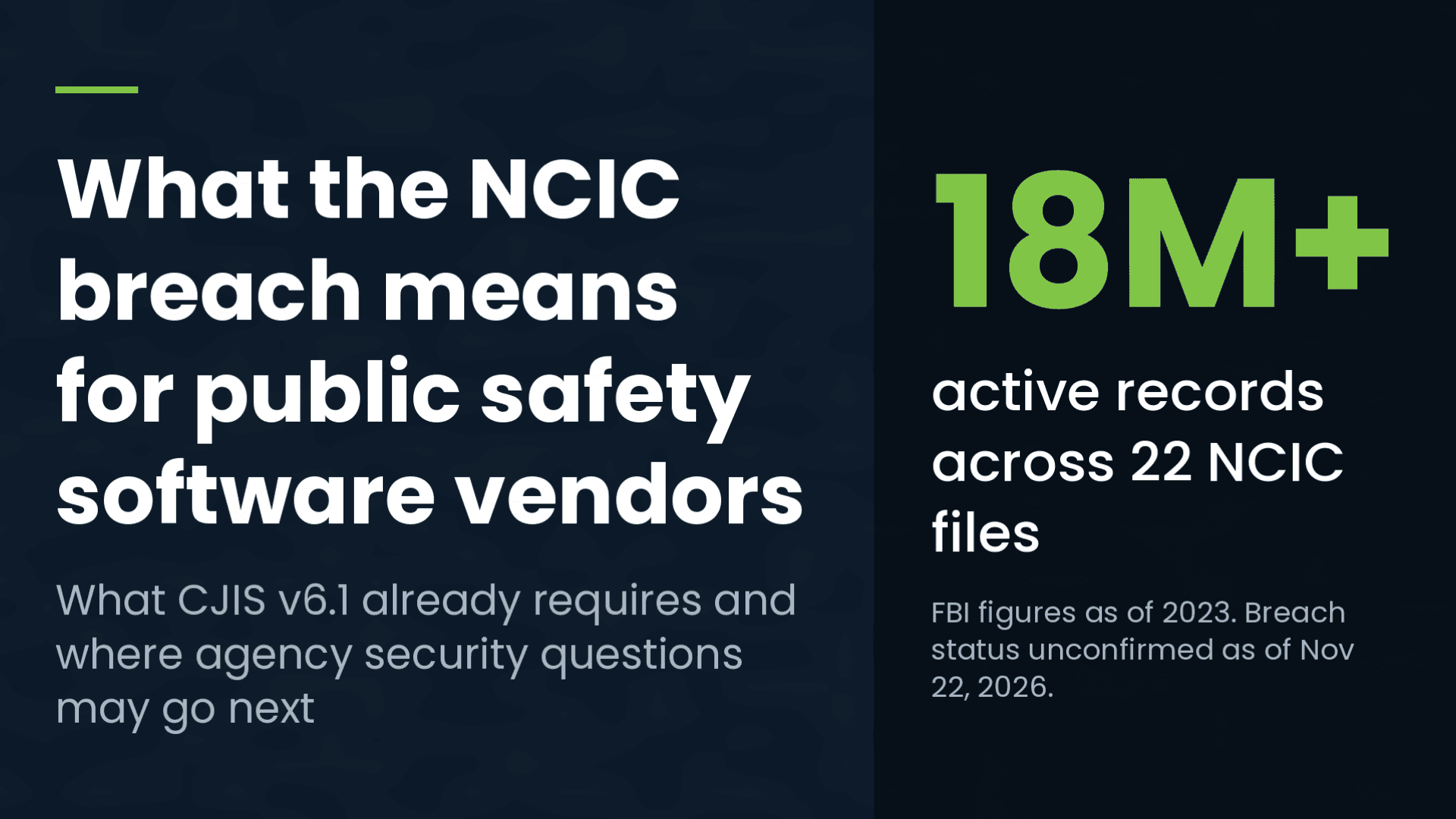
NCIC is large. According to the FBI, the system held 22 files and more than 18 million active records as of 2023. When facts are this thin, discipline matters more than speculation. The 9 AI Reality Filters cover the verification habit this moment calls for: label what is confirmed, label what is inference, and refuse to present a guess as fact.
Why NCIC Exposure Reaches Every Public Safety Software Vendor
NCIC works as a federation, not a single public application. Agencies connect through CJIS Systems Agencies, usually a state police agency or state bureau of investigation, and each agency carries a nine-character Originating Agency Identifier (ORI). One security analysis argues that the attack surface is every authorized endpoint, credential, and interconnection, which makes the whole system only as strong as its weakest participant.
Public safety software vendors sit directly on those connection paths. Computer-aided dispatch (CAD), records management systems (RMS), mobile data terminals, fire department software, EMS management software, and NCIC gateway tools all move or display criminal justice information (CJI). A vendor does not need to be the entry point for an incident to land on its desk.
The compliance structure adds pressure. Vendors sign the CJIS Security Addendum, and their personnel with CJI access complete fingerprint-based background checks. The agency, not the vendor, owns compliance and gets audited. One analyst notes that no formal "CJIS certification" exists for products or companies. Agencies that carry the audit risk will push their questions down to the vendors they buy from.
The same analyst raises a second concern that matters for software builders: record integrity. Stolen records create a privacy problem. Altered or suppressed records change field decisions, such as whether an officer sees an active warrant. That argument turns audit trails and change logging into selling points for public safety software, not just compliance items.
What the September FBI Breach Teaches Public Safety Software Vendors About Patching
The NCIC incident follows a separate breach. On September 23, 2026, the FBI said it was aware of a cybercriminal group claiming a compromise of the FBIJobs.gov portal and employee personal data. On October 5, the FBI's cyber chief, Brett Leatherman, blamed the breach on a security failure of a platform managed by a third-party organization that failed to apply a security patch. The FBI removed the contractor.
No public evidence connects the September breach to NCIC. The lesson still applies to every vendor in the supply chain. Verizon's 2026 Data Breach Investigations Report found that vulnerability exploitation became the leading initial access vector for the first time in the report's 19-year history. Defensive guidance from Mandiant, as summarized by one analyst, favors applying the vendor patch over relying on web application firewall rules.
A patch timeline is now a sales asset. A vendor that can show how quickly it applies critical patches to systems touching CJI answers the first question a nervous agency will ask.
What CJIS Security Policy v6.1 Already Requires of Public Safety Software Vendors
The FBI released CJIS Security Policy version 6.0 on December 27, 2024, rebuilding the policy around NIST SP 800-53. Version 6.1 followed on June 25, 2026 with corrections and additions. Several requirements bear directly on government compliance software and the vendors that supply agencies.
- Multi-factor authentication applies to privileged and non-privileged accounts, whether access is local, network-based, or remote.
- Encryption for CJI outside physically secure locations moved to at least 256-bit strength in transit and at rest, per one summary of the update.
- Vulnerability scanning rose from a quarterly minimum to monthly.
- One analysis reports a one-hour window to report incidents and a 15-day window to remediate critical vulnerabilities.
- Priority 2, 3, and 4 controls remain in a non-sanctionable "zero-cycle" status until September 30, 2027.
State audit schedules vary. Texas, for example, continues auditing against version 5.9.5 through March 31, 2027, according to one summary. Founders should confirm expectations with the State CJIS Systems Agency in each target state.
Where Public Safety Software Buyers Will Likely Push Harder
No agency has published new vendor requirements tied to the NCIC incident. The table below is an inference about where buyers will probe, based on the confirmed CJIS requirements and the September breach.
| Buyer Concern | Likely Question to Vendors | Evidence to Have Ready |
|---|---|---|
| Patch management | How fast do you apply security patches to systems that touch CJI? | Written patch policy, remediation timelines, recent scan results. |
| Access control | Is multi-factor authentication enforced for every account, including vendor support staff? | MFA configuration evidence and access review records. |
| Logging and audit | Can you reconstruct who queried or changed a record? | Log retention policy, a sample audit trail, and agency access to logs. |
| Incident response | What is your notification window, and who do you call first? | Incident response plan, tabletop exercise record, and contract notification language. |
| Third-party risk | Which subprocessors and hosting providers touch CJI? | Current subprocessor list, signed CJIS Security Addendums, and personnel screening records. |
| Encryption | What protects CJI in transit and at rest? | Encryption standards documentation and a key management summary. |
Contract terms will likely follow the same pattern. One analysis recommends that agencies specify breach notification windows, log access rights, and audit rights in vendor contracts, and inventory every vendor with a network path to criminal justice information. Founders who draft that language first control the negotiation.
What a Security Review Costs a Public Safety Software Deal
Security reviews carry real money in this market. Civic IQ's tracking of early 2026 contracts lists a $125,000 cloud migration for a Montana county from CentralSquare, a $952,000-plus seven-year SaaS agreement for Moore Police and Fire in Oklahoma from Tyler Technologies, and an $8,000,000 CAD upgrade for Newark Public Safety in New Jersey from Mark43. A stalled security review on any one of those deals pushes revenue into the next budget cycle.
Compliance frameworks such as CJIS act as eligibility gates, not checkboxes. A vendor that cannot answer a security question quickly loses momentum with the buyer who asked it, and that buyer is often not the champion.
The WIIFM Framework (What's In It For Me) maps that dynamic. Each stakeholder in a public safety deal carries a different motivation.
- The chief or sheriff wants officer safety, reliable data, and public trust.
- The agency IT lead or CJIS Systems Officer wants clean audit results and no surprises.
- The city manager or county commissioner wants to avoid a headline and defend the spend in public.
A security package that answers all three speaks to the whole buying committee, not only the champion.
How to Build a Public Safety Software Security Package Before Buyers Ask
A founder under $5M ARR can assemble a credible package in weeks, not quarters. Start with these moves.
- Write a one-page CJIS posture summary that lists the controls you meet, the controls in progress, and the policy version you map to.
- Document your patch timelines and follow them, because a contractor's missed patch sat at the center of the FBI's September breach.
- Prepare contract language for breach notification windows, agency access to logs, and audit rights.
- Keep a current list of subprocessors, hosting providers, and staff with access to CJI.
- Rehearse the incident call: who notifies the agency, who notifies the state CJIS Systems Agency, and who speaks to the press.
- Train every salesperson and founder to answer security questions from one approved source, not from memory.
The last bullet matters most for sales teams. An improvised answer to a security question creates risk for the agency and for the vendor. The GovTech Founders GTM Playbook lays out how to build repeatable answers into the sales motion so every conversation starts from the same facts.
Why Small Public Safety Software Vendors Can Win on Security Responsiveness
Smaller GovTech vendors can out-execute legacy incumbents on agility and responsiveness, especially with small and mid-sized agencies. Security is a place to show it. A founder who answers a questionnaire in days, with the engineer on the call, gives a nervous agency something a large vendor's account team often cannot.
That advantage holds only when the evidence is real. A claim of CJIS compliance without a documented posture creates risk for the agency and the vendor alike. The Built for Government podcast interviews GovTech founders about how they sell into agencies, and security questions belong in that conversation.
Frequently Asked Questions About the NCIC Breach and Public Safety Software Security
Does the NCIC breach mean public safety software vendors were compromised?
No public reporting points to a vendor as the entry route. The FBI has not confirmed the scope or method of the breach. Vendors still sit on the connection paths to criminal justice information, so agencies will likely ask vendors about their controls.
Is there a CJIS certification for public safety software companies?
One analysis says no formal CJIS certification exists for companies or products. Vendors sign the CJIS Security Addendum, personnel with CJI access complete fingerprint-based background checks, and the agency owns compliance and audits. Some vendors market products as CJIS-compliant, so buyers should ask for evidence.
Which CJIS controls matter most for a startup selling public safety software?
Multi-factor authentication, encryption, vulnerability scanning cadence, logging, and incident reporting draw the most attention in the current policy. Confirm exact expectations with the State CJIS Systems Agency, because states audit on their own schedules.
Will CJIS rules change after the NCIC breach?
No policy change tied to the incident has been reported as of November 22, 2026. Policy recommendations flow through the CJIS Advisory Policy Board to the FBI director, so changes would take time to appear.
Prepare for the Questions Before They Arrive
The NCIC investigation is still unfolding, and the facts will shift. The pattern is already visible. Agencies carry the audit risk, vendors carry the connection risk, and public safety software buyers will want proof that the two line up.
Founders who document their patching, access control, logging, and incident response now will answer the first security question in a day instead of a quarter. The next step is to see where your go-to-market stands against that standard.
Next Steps for GovTech Founders
- Try the GovTech GTM Scorecard.
- Contact us to learn more.
- Learn more about the energizeGTM process.
- Visit the energizeGTM Library for articles, downloads, podcasts, playbooks, and frameworks.
- Download the WIIFM Framework.