GovTech CAC Isn't the Problem — Your ICP and LTV Story Might Be
High customer acquisition cost stops GovTech founders cold. They see a $14,000 CAC, flinch, and pull back from the very segment that could make their company. If you sell public sector software and you're letting CAC anxiety drive your outbound decisions, this post is for you. We'll break down what a real deal analysis looks like, why complexity in justice, courts, and agencies is a feature of your business model — not a flaw — and how to run precision outbound that makes the math work.
The $14k CAC That Changed Everything
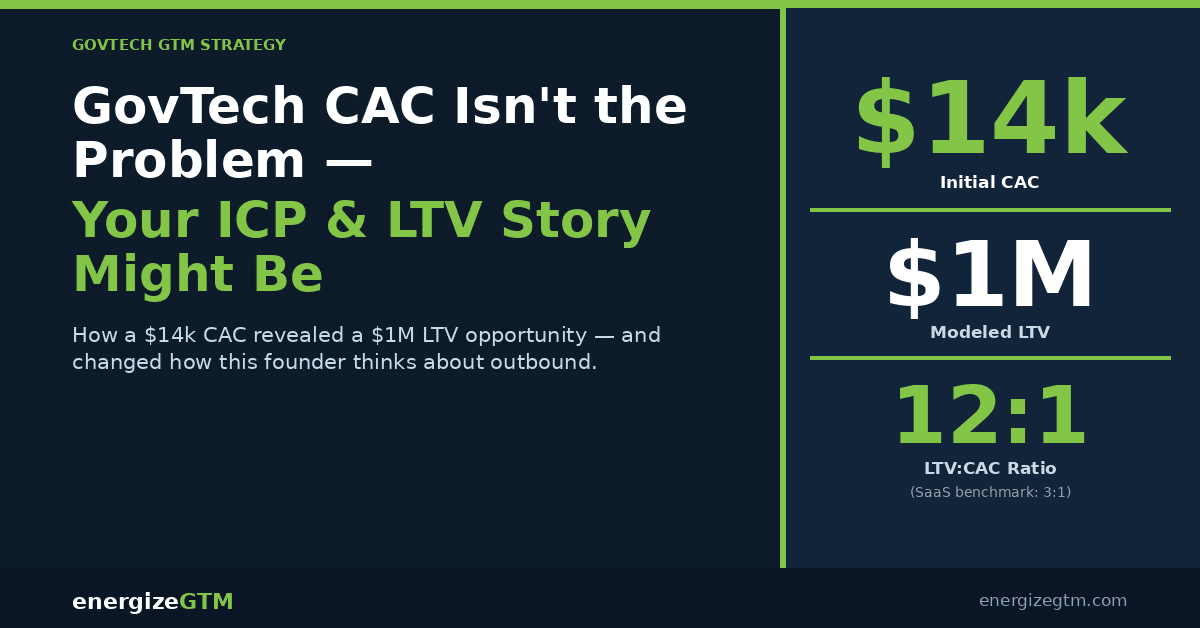
A founder and I sat together staring at one line in a pipeline report: Justice outbound — CAC approximately $14,000.
At roughly $150k ARR, that number felt like an indictment. The instinct was to shut down the outbound test and retreat to what felt safe — inbound, referrals, warm intros. The kind of motion that produces a tidy CAC number and a slow, grinding path to scale.
But here's what we knew about the justice segment: high pain, long contracts, deep workflow integration, and near-zero churn once a platform goes live inside an agency. Before we killed the experiment, we owed it a proper autopsy.
The LTV Math Nobody Was Running
The $14k CAC looked ugly in isolation. It looked completely different when we modeled the other side of the equation.
One justice deal from that test landed at an ACV near $150,000. When we factored in contract term, renewals, and realistic expansion — the LTV on that logo approached $1 million. Churn risk in public safety and justice environments is structurally low. These agencies don't rip out their core software. They build workflows around it. They train staff on it. Switching costs are enormous.
The LTV:CAC ratio on that deal was approximately 12:1. In SaaS, anything above 3:1 is considered healthy. At 12:1, you don't have a CAC problem. You have an ICP conviction problem.
Why GovTech Founders Misread High CAC
The mistake is comparing GovTech CAC to the SaaS benchmarks you see at B2B tech conferences. Those benchmarks are built on shorter sales cycles, lower switching costs, and buyers who can move without committee approval. Public sector software doesn't work that way — and it shouldn't be measured that way.
Three things systematically inflate CAC in GovTech without damaging unit economics:
- Security review: Many government compliance software and public sector SaaS buyers require SOC 2, FedRAMP, or state-specific security attestations before a contract can move. That review process takes time and founder attention. It's not waste — it's a moat. Competitors who can't clear it get screened out.
- Procurement structure: Contract management for government often runs through purchasing departments, legal teams, and budget authorities who all have to sign off. Each handoff adds days or weeks to the cycle. None of that is negotiable. You plan for it or you fight it.
- Multi-stakeholder committees: In EMS management software, fire department software, or municipal finance software, the economic buyer and the end user are often different people in different departments. You're not selling to one person. You're building a coalition.
None of these factors make the deal bad. They make the deal defensible once you win it. That's a very different problem than high churn or commoditized pricing.
Outbound as a Scalpel, Not a Cannon
The test that produced that $14k CAC wasn't a spray-and-pray campaign. It was custom messaging for each agency, and the founder personally on the key calls. That's precision outbound — and it's the only kind that works in GovTech.
If you're selling wastewater management software or water utility management software to municipal operators, sending 5,000 cold emails to a purchased list doesn't move the needle. The buyers you want aren't going to respond to a templated sequence. They respond to specificity — proof that you understand their procurement environment, their regulatory constraints, and what happens inside their department when software fails.
Precision outbound in public sector software looks like this:
- Research on each agency: budget cycle, current vendor, recent RFP activity, known pain points
- Custom first-touch messaging that references something real about their operation
- Founder involvement on at least the first discovery calls in a new segment
- A defined follow-up cadence that respects government procurement timelines
This approach costs more per contact. It should. You're not trying to generate 200 meetings. You're trying to find the 5 agencies that will become $150k ARR logos with 10-year retention.
The Complexity Tax Is a Feature, Not a Bug
GovTech founders often describe the procurement process as a tax on doing business with government. That framing is accurate, but the conclusion most draw from it is wrong.
Yes, government budgeting software deals require legal review. Yes, government accounting software contracts require compliance verification. Yes, grant management software sales involve procurement officers who move slowly and ask detailed questions. All of that is true.
It's also true that every competitor you have faces the same tax. The ones who treat it as an obstacle lose. The ones who build it into their process — timeline, pricing, resource allocation, legal readiness — win. And then they own the account for a decade.
The GovTech founders sales guide covers this in depth: complexity in government procurement is a qualification filter, not just a timeline drag. When you clear it, your competitors often can't follow.
Pricing for the Complexity Tax
If your pricing model was built for SMB velocity — low ACV, fast close, high volume — it will break in government. You need to price for the resources you actually spend during the sales cycle. That means factoring in:
- Legal and compliance review time (yours and theirs)
- Security documentation and questionnaire responses
- Pilot or proof-of-concept periods that agencies often require before full commitment
- Onboarding complexity in environments with legacy systems and limited IT staff
If your ACV doesn't reflect the true cost of acquiring and onboarding a government customer, you'll feel every deal in your margin. Fix the pricing before you scale the motion.
How to Run the Real ICP and LTV Analysis
Before you write off a segment because of CAC, run this analysis. It takes two hours and it will change how you see your pipeline.
Pull your five best current customers — not biggest by revenue, but best by retention, expansion, and reference value. For each one:
- What was the actual CAC, including founder time?
- What is the current ACV?
- What is the realistic 5-year LTV based on contract term and expansion history?
- What is the probability they churn in year 3?
Then calculate LTV:CAC for each. If you're at 8:1 or above across your best accounts, your CAC is not the constraint. Your pipeline volume is the constraint. The answer is more precision outbound to the right ICP — not cheaper acquisition of the wrong one.
The GovTech GTM Scorecard walks through this exact framework and helps you score your current go-to-market against where you need to be at each ARR stage. If you haven't run it yet, start there.
The Question That Reframes Everything
When a GovTech founder tells me outbound is too expensive, I ask one question before we look at any numbers:
Do you have a CAC problem — or do you have an ICP and LTV story you don't trust yet?
Most of the time, it's the second one. The segment they're avoiding is the right segment. The CAC isn't actually out of line when measured against the LTV. But the founder doesn't believe in the LTV yet because they haven't won enough deals in that segment to trust the math.
That's an information problem, not a unit economics problem. The fix is to run a small, rigorous outbound test — not to retreat to the comfortable motion that's producing median results.
The GovTech founders GTM playbook covers outbound sequencing and ICP targeting in detail — including how to build your call list for justice, courts, and public safety segments specifically.
When CAC Is Actually the Problem
To be clear: high CAC can be a real problem. It just usually isn't the one GovTech founders think they have.
CAC is genuinely a problem when:
- LTV:CAC is below 3:1 on your best accounts
- You're spending heavily on segments that produce short-term contracts and medium churn
- Sales cycle length isn't justified by ACV — you're spending 12 months to close $18k ARR deals
- Your team is generating meetings but not converting because the ICP is wrong, not because the pitch is wrong
In those cases, the fix isn't cheaper outbound. It's tighter ICP definition. You need to find the segment where the LTV story holds up and move your resources there. If you're not sure where that segment is, the Built for Government podcast covers real deal analysis with founders who have navigated this exact problem in public safety software, utility management software, and public sector ERP software.
Frequently Asked Questions
What is a healthy LTV:CAC ratio for GovTech SaaS companies?
In traditional SaaS, a 3:1 LTV:CAC ratio is considered the minimum for a healthy business. GovTech companies with strong ICP fit in segments like public safety software, justice, or municipal finance software regularly achieve 8:1 to 15:1 — because churn rates are structurally low and contract terms are long. If your LTV:CAC is above 6:1, your CAC is almost certainly not the problem. Focus on pipeline volume and ICP targeting instead.
When should a GovTech founder stay on outbound calls instead of delegating to a sales rep?
In any new segment you haven't closed before, the founder should be on the first five to ten discovery calls personally. Government buyers — especially in law enforcement software, EMS management software, or government compliance software — respond to domain authority and peer conversation. A junior rep reading from a script will lose deals that a founder who understands the operational context can close. Once you have a repeatable talk track validated by actual buyer conversations, you can delegate. Not before.
Does a long GovTech sales cycle always mean bad unit economics?
No. A 12 to 18 month sales cycle is only a problem if your ACV doesn't justify the resources spent. In justice, courts, or public sector ERP software, a 14-month cycle that closes a $150k ACV deal with a $1M LTV is a strong business. The question is never the cycle length in isolation — it's always cycle length relative to the ACV and LTV on the other side of the deal.
The Bottom Line on GovTech CAC
If you're avoiding your real ICP because the CAC looks scary, you're making a math error — not a strategic insight. High CAC in GovTech is often a signal that you're in the right place. Complexity, long cycles, and multi-stakeholder committees are the price of winning accounts that stay for a decade and expand over time.
Run the LTV math. Run a small outbound test. Have the founder on the calls. Then decide whether you have a CAC problem or an ICP conviction problem.
Most of the time, it's the second one.
Ready to pressure-test your GovTech GTM? Try the GovTech GTM Scorecard to see where your go-to-market stands today — and what to fix first.
Want to go deeper? Learn how the energizeGTM Roadmap Process works with GovTech founders at the $150k to $5M ARR stage to build the right outbound motion for their ICP.
Visit the energizeGTM Library for frameworks, playbooks, and downloads built specifically for GovTech and LegalTech founders — including the WIIFM Framework for government stakeholder alignment.
Questions about your specific situation? Reach out directly — we work with a small number of GovTech founders at a time and conversations are always worth having.