
Niche Beats Noise: Why GovTech Founders Who Focus Win More Public Sector Software Deals
In public sector software, trying to sell to everyone is the fastest path to selling to no one. Government buyers do not respond to generic. They respond to specific — a vendor who speaks their language, understands their constraints, and has done this exact thing before. This post breaks down what niching down actually means for GovTech SaaS founders, why it matters more in government than almost any other vertical, and how to build the discipline to say no to the wrong deals so you can win the right ones.
The Problem With Trying to Serve Every Government Buyer
There is a version of every GovTech pitch deck that tries to cover every base. The TAM slide is enormous. The use cases span municipal, county, state, and federal. The homepage says something like "Built for modern government" or "The platform for every public agency."
Founders who build their go-to-market this way are not naive — they are scared. Scared of leaving revenue on the table. Scared that a narrow focus means a small market. Scared that a buyer will ask "have you worked with agencies like ours?" and they will have to say no.
But 25-plus years of selling into government agencies has taught one consistent lesson: the fastest way to lose a public sector deal is to walk in without a clear, specific answer to that question.
Public agency buyers are not generalists. They live in a world defined by procurement cycles, compliance requirements, cooperative purchasing rules, multi-stakeholder approval chains, and workflows that have been embedded for years. When a vendor cannot speak that language with precision, they do not get a second meeting.
Niche beats noise. Every single time. If you are building a GovTech company and your go-to-market strategy still targets "government agencies" as your ICP, this post is for you.
What Niching Down Actually Means for GovTech
Niching is not about making your product smaller. It is about making your go-to-market sharper.
Your public sector software might technically work for a county government, a water utility, a fire department, and a state agency. That does not mean you should be selling to all four simultaneously — especially when you are still building your reference base and refining your sales motion.
Niching down means making three deliberate decisions:
- Who you serve. Your Ideal Customer Profile should be specific enough that a new sales hire can qualify or disqualify a prospect in the first five minutes of a discovery call. Not "government agencies" — but "mid-size county governments in the US with populations between 100,000 and 500,000 running on legacy case management systems." Not "utilities" — but "mid-market water utility management software customers managing distribution systems for communities under 150,000 residents." The more specific, the more credible.
- Who you refuse. This is the part most founders skip. Your ICP is incomplete without a documented list of who you will not pursue — even when they have budget and want to buy. Federal agencies when you are not FedRAMP authorized. Municipalities under 25,000 residents when your implementation model does not work at that scale. Every "yes" to the wrong customer is a "no" to three right ones.
- How you show up. Your messaging, your case studies, your references, your demo — everything should reflect the world your buyer lives in. If you are selling municipal finance software, your demo should show fund accounting and budget transfers, not generic ledger screens. If you are selling grant management software, your ROI story should be in compliance hours recovered and audit findings reduced, not vague "efficiency gains."
The rule of thumb: if a prospect reads your website and thinks "this was built for someone exactly like me," you are niched correctly. If they think "this could work for us," you are not niched enough.
Why Niching Is Especially Critical in GovTech Public Sector Sales
Government procurement is not a standard sales cycle. It is a qualification process. Before a dollar can be spent, buyers need to answer a series of internal questions: Is this vendor compliant with our security requirements? Does this solution fit within an approved purchasing vehicle? Has anyone in our peer network used them?
Cooperative purchasing vehicles — NASPO ValuePoint, Sourcewell, OMNIA Partners, TIPS, the GSA Schedule — exist precisely because public agencies want to reduce procurement risk. When you are on those vehicles and your vertical positioning matches the agency type using them, you move from "unknown vendor" to "vetted solution" almost overnight.
But being on a cooperative purchasing vehicle and being positioned correctly are two different things. If your profile reads like you sell to everyone, buyers will not self-select you — even when you are the best fit.
The Multi-Stakeholder Reality of Government Buying
Public agency buying decisions rarely belong to one person. A city IT director might champion your government compliance software, but procurement, finance, legal, and department leadership all have a seat at the table. Add city council approval for larger contracts and you have a six-to-twelve month cycle with multiple veto points.
The vendors who win those cycles are not the ones with the most features. They are the ones who have done this before — who can say "we have worked with 14 county governments in the mid-Atlantic region and here is how we helped them navigate the budget cycle and get council approval."
That is a niched value proposition. That is what closes.
Peer References Are Currency in Public Sector Software Sales
A buyer in Maricopa County will pick up the phone and call a peer in Travis County. If you have reference-quality customers in a defined segment, use them. If you do not, getting to your first three or four references in a specific niche is worth more than ten scattered wins across different agency types.
Public sector buyers are risk-averse by design. A peer who has already navigated the implementation, the council approval, and the first audit cycle with your software removes the single biggest objection in the room. You cannot manufacture that credibility across a fragmented customer base. You build it by going deep in one place first.
If you want a framework for building that reference base strategically, the GovTech Founders GTM Playbook walks through how to sequence your early wins for maximum market penetration.
Where GovTech Niche Positioning Creates the Biggest Advantage
The public sector software market looks monolithic from the outside. It is not. Each sub-vertical has distinct procurement dynamics, compliance requirements, buyer personas, and purchasing timelines. Treating them as interchangeable is a positioning mistake that costs deals.
Fire Department and EMS Software
Fire department software and EMS management software buyers care about NFIRS compliance, CAD integration, and ISO ratings — not general government functionality. A vendor who walks into a fire chief's office and speaks that language immediately earns credibility that a generalist cannot match.
Wastewater and Water Utility Management Software
Wastewater management software and water utility management software buyers live in a world of EPA reporting, CIP planning, and rate study justification. They are not reading generic utility software pitches. They are talking to vendors who can speak to Clean Water Act compliance and asset management lifecycle costs. If your positioning does not reflect that, your outreach will not convert.
Municipal Finance and Government Accounting Software
Municipal finance software and government accounting software buyers are accountable to auditors, bond rating agencies, and elected officials. They need vendors who understand fund accounting, GASB standards, and CAFR reporting — not vendors who adapted a commercial accounting platform and added a "government module."
Grant Management and Government Compliance Software
Grant management software and government compliance software are two of the fastest-growing categories in GovTech right now [Verify before publishing], driven by the volume of federal pass-through funding flowing to state and local agencies. Buyers in this space are managing compliance timelines, sub-recipient monitoring, and single audit requirements. A vendor positioned specifically for that challenge will always beat a generalist.
Writing the Rules: Who You Serve and Who You Refuse
The most clarifying exercise for any GovTech founder is this: write two lists. The first is your ICP — made specific enough that a new sales hire could use it to qualify or disqualify a prospect in the first conversation. The second list is who you refuse. Not "we prefer not to work with" — but a documented, intentional set of criteria for deals you will not pursue.
Most founders resist the second list. It feels like leaving money on the table. But consider what chasing the wrong deals actually costs:
- Sales cycles that drag on and never close because the fit was never right
- Implementation effort that pulls your team away from customers you can actually make successful
- References that are lukewarm because you were never a great fit to begin with
- A product roadmap pulled in six directions because your customers have nothing in common
- Government contracting vehicles that do not align to the agencies you are actually winning
Here is a sample "Who We Refuse" list for a GovTech company selling public sector ERP software:
- We do not pursue federal agencies until we have FedRAMP authorization
- We do not pursue municipalities under 25,000 residents — our implementation model does not work at that scale
- We do not pursue agencies mid-procurement with an incumbent unless they have explicitly identified a switching trigger
- We do not pursue special districts outside our three core verticals — water, fire, and transit — until we have 10-plus reference customers in each
When you can say "that is not an agency we work with, and here is why," buyers trust you more — not less. It signals that you know exactly who you are built for. That confidence is a form of positioning that no amount of broad-based marketing can replicate.
The Built for Government GovTech Podcast covers this exact tension — between the fear of narrowing your market and the discipline that actually produces results — with founders who have been through it.
Your GovTech Niche Checklist
Use this checklist to assess whether your GTM niche is sharp enough to do its job in public sector software sales:
| Checkpoint | What "Niched Enough" Looks Like |
|---|---|
| ICP Specificity | One sentence that includes segment, size, geography if relevant, and trigger event. If it takes a paragraph, it is not specific enough. |
| Buyer Language | Your website uses the words your buyers use — their job titles, compliance acronyms, procurement terminology, and pain points. Not generic SaaS language. |
| Case Study Alignment | Your case studies feature customers that look exactly like your target ICP. Not a mixed bag of whoever agreed to participate. |
| Refusal Criteria | Your sales team has a written list of deal types you will not pursue — and it is actually used in pipeline reviews. |
| Purchasing Vehicle Alignment | You are on the cooperative purchasing contracts your target buyers actually use — and your profile on those vehicles reflects your niche positioning. |
| Reference Network | You can name five customers in your target niche who would take a peer reference call. If not, that is your first GTM goal — not more pipeline. |
How AI Tools Are Changing — But Not Replacing — Niche Discipline
AI-assisted prospecting, personalization at scale, and content generation are all real capabilities that GovTech companies can use today. But they amplify whatever positioning you start with. AI cannot fix a weak ICP. It can only make it easier to reach more people with a message that does not resonate.
If you are evaluating AI tools for your GovTech GTM motion, the 9 AI Reality Filters from energizeGTM cut through the noise and help you assess which tools actually move the needle for public sector sales teams — and which ones are a distraction.
The discipline of niche positioning and the efficiency of AI tools are not in conflict. The most effective GovTech sales teams use both: a razor-sharp ICP and the tools to reach that ICP with precision and scale.
FAQ: Niching Down in GovTech Public Sector Software
What does "niching down" mean for a GovTech SaaS company?
Niching down means deliberately narrowing your go-to-market focus to a specific type of public agency, a specific use case, and a specific set of buyer personas — rather than positioning your product as a solution for all government buyers. In practice, it means defining an ICP specific enough to disqualify bad fits in the first discovery call, documenting the customers you will not pursue, and building your messaging, case studies, and references around a defined segment. The goal is not a smaller product. It is a sharper go-to-market motion.
Why is niche focus more important in GovTech than in commercial SaaS?
Government procurement is a qualification process, not a standard sales cycle. Public agency buyers need to verify compliance, fit within approved purchasing vehicles, and validate decisions through peer networks before any deal moves forward. Generic positioning fails at every one of those checkpoints. A vendor with a specific track record in a defined segment — fire department software, water utility management software, grant management software — can answer "have you done this before?" with concrete references. A generalist cannot. In a market driven by risk reduction and peer validation, specificity is the competitive advantage.
How specific should a GovTech ICP actually be?
Specific enough to disqualify a prospect in the first conversation. "Government agencies" is not an ICP. "County governments" is barely an ICP. "Mid-size US county governments with populations between 100,000 and 500,000 that are running end-of-life ERP systems and have a budget cycle that opens in Q3" is an ICP. It includes segment, size, geography, technology trigger, and timing. If a new sales hire cannot use your ICP definition to qualify or disqualify a prospect in five minutes, it is not specific enough.
What happens if I niche down and miss a big deal outside my ICP?
You will miss some deals. That is the point. Every "yes" to the wrong customer comes with hidden costs: a prolonged sales cycle, an implementation that strains your team, a reference customer who does not send referrals, and a product roadmap pulled toward requirements that do not serve your core market. The math almost always favors the focused approach. A handful of wins in a defined segment where you are the known expert will generate more compounding revenue — through references, renewals, and expansions — than the same number of scattered wins across disconnected agency types.
Do cooperative purchasing vehicles replace the need for niche positioning?
No. Being listed on NASPO ValuePoint, Sourcewell, or the GSA Schedule puts you in front of buyers who are already cleared to buy without a full RFP process — but it does not make you findable or credible to your specific buyer type. Your cooperative purchasing profile, your positioning on the vehicle's category pages, and your outreach to agencies using that vehicle all need to reflect your niche. A generic profile on a cooperative purchasing contract generates generic results. A niche-specific profile connected to the right agency segment turns the vehicle into a revenue engine.
The Bottom Line: Focus Is How You Win in Public Sector Software
The GovTech founders who build repeatable revenue are not the ones who try to sell to every agency type. They are the ones who pick a segment, go deep, build references, and let the credibility compound over time.
Niche positioning is not a constraint on your growth. It is the mechanism for it. It is how you get on the preferred vendor list. It is how you get the peer reference call. It is how you win the 12-month procurement cycle against competitors who have more features but less credibility in your buyer's world.
If you are not sure where your GovTech GTM focus stands right now, start with an honest assessment of your current ICP, your refusal list, and your reference network. The gaps will tell you exactly where to focus next.
Take the Next Step
energizeGTM helps GovTech SaaS founders build go-to-market strategies that are specific, repeatable, and grounded in how public sector buyers actually buy.
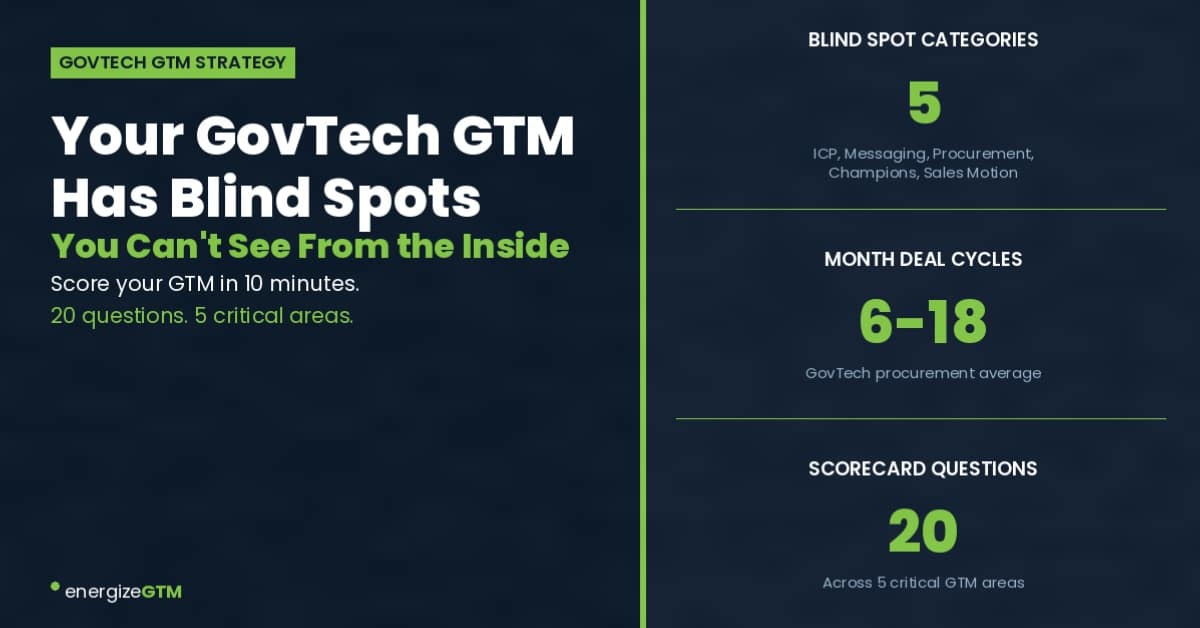
- Score your GovTech GTM today: Try the GovTech GTM Scorecard and find out exactly where your go-to-market stands.
- Learn the process: See how the energizeGTM Roadmap Process works and how it applies to your growth stage.
- Talk to us: Contact energizeGTM to discuss where your GovTech go-to-market needs to go next.