Why Small Public Sector Software Vendors Are Outperforming the Giants
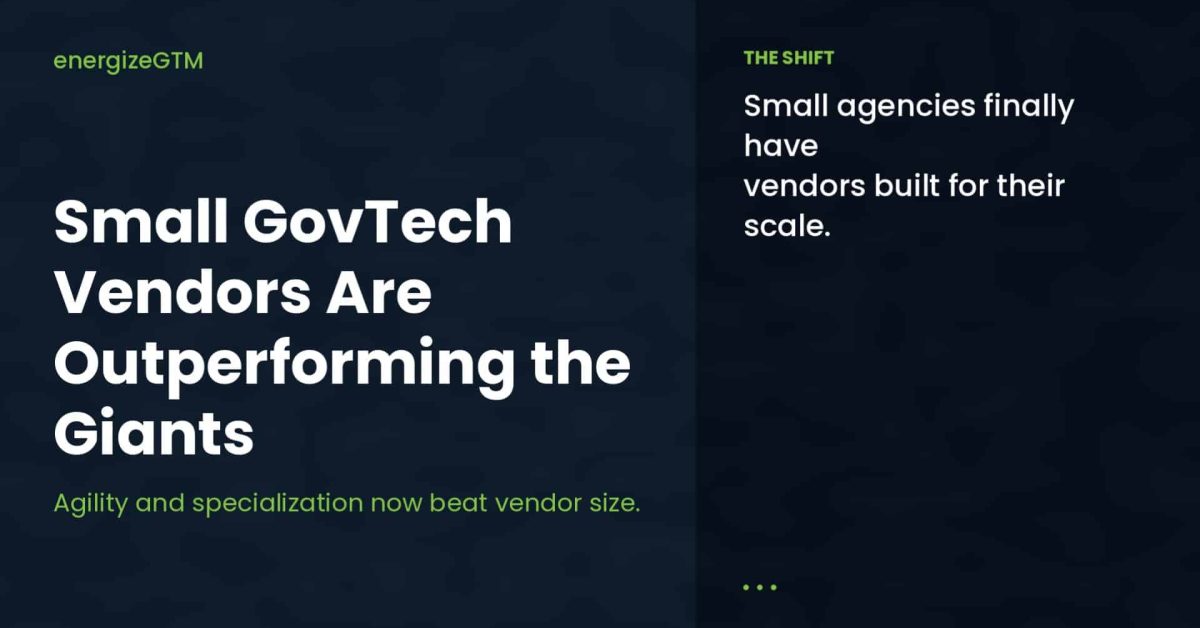
For decades, government agencies equated vendor size with vendor safety. That assumption is breaking down fast.
Public sector software buyers now weigh responsiveness, specialization, and delivery speed more heavily than headcount or brand recognition. Small GovTech SaaS companies can build enterprise-grade public sector software today, and they are using that capability to win business from agencies that legacy vendors priced out for years. This shift matters most for small to mid-sized agencies, the buyers who historically got left with the leftovers.
The Old Assumption Behind Public Sector Software Procurement
For most of the last two decades, agencies bought public sector software from the biggest name available. Size signaled staying power. A large vendor could survive a budget cycle, weather a lawsuit, and still show up for the next contract renewal.
That logic made sense when only well-capitalized companies could afford to build robust public sector ERP software or municipal finance software. Development was expensive. Compliance certifications took years. Small companies simply could not compete on feature depth.
Agencies defaulted to size for a few specific reasons.
- Perceived financial stability over a multi-year contract term
- A long reference list from other government customers
- Broad feature sets that covered multiple departments at once
- An established compliance and security track record
[Verify before publishing] Historically, a small number of large incumbents have captured the majority of GovTech software spend, particularly in government accounting software and public sector ERP software categories. That concentration is now eroding.
Compliance requirements reinforced the pattern. Agencies buying government compliance software or handling sensitive public safety data needed vendors who could clear security reviews, sign data processing agreements, and pass audits without missing a beat. Only companies with dedicated compliance staff could move through that process quickly, and small teams often got screened out before they ever reached a demo.
What Changed: Small GovTech Vendors Can Now Build Enterprise-Grade Software
Cloud infrastructure removed the biggest barrier to entry. A three-person engineering team can now deploy secure, scalable fire department software or EMS management software on the same infrastructure a Fortune 500 company uses.
Modern integration standards did the rest. Small vendors no longer need to build every module from scratch. They connect to existing financial systems, permitting platforms, and records systems through APIs, which shrinks both build time and build cost.
The result is a new category of vendor. Small GovTech SaaS companies now ship water utility management software, wastewater management software, and grant management software with the same reliability and compliance posture as the legacy players, at a fraction of the overhead.
Lower overhead is not a compromise. It is a structural advantage that flows directly into pricing and responsiveness.
Remote-first hiring changed the talent equation too. A small GovTech vendor building public safety software no longer needs to recruit locally or compete with legacy vendors for the same limited pool of enterprise engineers. They can hire specialists anywhere, which means a five-person product team can now match the technical depth of a department that used to require fifty people.
Compliance also got faster to achieve. Third-party security and compliance platforms compressed audit timelines from years to months, giving small vendors a realistic path to the same certifications that used to be a large-vendor moat.
Listening Before Building: The Nimble GovTech Advantage
Large public sector software vendors route feature requests through account managers, product committees, and multi-quarter roadmaps. By the time a fix ships, the agency that requested it has often found a workaround or given up.
Small vendors work differently. A department head can talk directly to the person building the product. That direct line compresses the feedback loop from quarters to weeks.
This is the core advantage worth naming clearly: small GovTech vendors win by listening before they propose a solution, not after. Agencies notice the difference immediately during a demo, and they notice it again six months into implementation when a requested feature actually ships.
Direct access to technical leaders builds a different kind of trust than a glossy reference list. It signals that the vendor will still be reachable after the contract is signed.
Consider a small water utility district asking for a specific reporting format inside its water utility management software. A large vendor logs the request and schedules it against a broader roadmap serving hundreds of customers. A small vendor with twenty customers can prioritize it, ship it, and turn that one district into a reference for the next ten deals.
Procurement leaders increasingly ask about this directly during evaluations. They want to know who answers support tickets, how fast product changes ship, and whether the person on the sales call is the same person who will handle their account a year later.
Specialization Beats Broad Portfolios in Public Safety Software and Utility Management Software
Large vendors sell breadth. One platform, they argue, can cover finance, permitting, utility billing, and public safety all at once. That pitch works well on a slide and less well in daily use.
Specialized vendors build depth instead. A company focused only on fire department software or EMS management software understands the specific workflow of a shift change or an incident report in a way a generalist platform never will.
The tradeoff is easiest to see side by side.
| Factor | Broad-Portfolio Vendor | Specialized Small Vendor |
|---|---|---|
| Feature turnaround | Quarters | Weeks |
| Access to product decision-makers | Filtered through account teams | Direct |
| Depth in a single workflow | Moderate, spread across modules | High, purpose-built |
| Pricing fit for small to mid-sized agencies | Often out of reach | Built for this budget tier |
Specialization is not a limitation. In categories like water utility management software and municipal finance software, it is becoming the deciding factor in procurement.
[Verify before publishing] Procurement leaders increasingly cite depth of workflow fit, not breadth of platform, as their top evaluation criterion for new GovTech purchases under a certain contract size. That trend favors specialized small vendors over generalist suites every time an agency's needs are narrow and specific.
Why Small to Mid-Sized Agencies Are the Real Winners
Enterprise-grade public sector software used to belong to agencies with enterprise-sized budgets. A large city police department or a major regional water utility could afford the license fees and implementation costs. A rural fire district or a small water utility district usually could not.
That gap is closing. Small GovTech vendors build lean, price accordingly, and target exactly the agencies the giants priced out.
A small to mid-sized agency evaluating contract management software for government or government budgeting software today can access functionality that would have required a seven-figure enterprise deal a decade ago.
This is the part worth championing directly: small agencies are no longer stuck with outdated spreadsheets and legacy systems while larger agencies get modern tools. They now have a real seat at the table, served by vendors built for their scale and their budget.
Picture a small county's grant office still tracking federal and state grants in a shared spreadsheet. A modern, right-sized grant management software platform built by a small GovTech vendor can replace that spreadsheet at a price the county's actual budget can absorb, without the multi-year implementation timeline a legacy ERP suite would require.
The same story is playing out in public transparency software and government budgeting software, where small agencies used to publish budget data manually because the enterprise tools built for major metros were never priced for a town of five thousand residents.
What This Means for GovTech Founders Under $5M ARR
If you are a GovTech founder building toward your first few million in ARR, this shift is your opening, not your obstacle. Trying to out-feature a large incumbent is a losing game. Out-listening and out-executing them is not.
Start by getting disciplined about who you serve. energizeGTM built the Anti-ICP Framework specifically for this problem: a structured way to identify the buyers, agency types, and deal profiles that will drain your team's time without ever closing, so you can redirect that energy toward the small to mid-sized agencies who are your strongest fit.
Once you know who you are serving, the next challenge is getting the right stakeholders inside that agency to say yes. The WIIFM Framework exists for that exact moment. It gives founders a repeatable way to answer "what's in it for me" for every stakeholder in a public sector deal, from the department head to the procurement officer to the elected official who signs off on the budget.
Founders who want a deeper walkthrough of how this plays out in practice can read the Founders GTM Playbook, or hear it discussed directly on the Built for Government podcast.
Execution, Not Size, Is the Real Differentiator in GovTech
None of this works without follow-through. Agencies do not remember which vendor had the longest feature list during the sales cycle. They remember which vendor showed up on time, fixed what broke, and kept its word through implementation.
Small GovTech vendors that win consistently share a pattern. They under-promise on timelines, over-communicate during rollout, and treat every small to mid-sized agency contract as a long-term reference relationship instead of a one-time close.
That pattern is learnable, and it is exactly what separates small vendors who scale past their first few public sector contracts from those who win once and struggle to repeat it. Positioning, messaging, and stakeholder alignment all have to reinforce the same story: this vendor delivers.
Frequently Asked Questions
Why are small GovTech SaaS companies now able to compete with larger public sector software vendors?
Cloud infrastructure and modern API integrations lowered the cost of building enterprise-grade software. Small teams can now ship secure, compliant public sector software without the multi-year build timelines that once only large vendors could afford.
Do small to mid-sized government agencies get the same software quality as agencies working with large vendors?
Yes. Specialized small vendors often deliver deeper functionality within a single workflow, such as fire department software or water utility management software, than broad-portfolio vendors that spread development across many modules at once.
How should GovTech founders position agility as a competitive advantage?
Founders should lead with direct access to their product and technical leaders, faster feature turnaround, and a track record of listening to agency feedback before proposing a solution. These points directly counter the size-equals-safety assumption that used to favor large incumbents.
What is the Anti-ICP Framework and how does it help GovTech founders?
The Anti-ICP Framework is an energizeGTM process for identifying which government buyers, agency types, and deal profiles a company should actively avoid. It helps founders under $5M ARR protect their limited sales capacity for the small to mid-sized agencies most likely to buy and succeed with their product.
The Real Differentiator in GovTech Is No Longer Size
Government buyers are done equating headcount with capability. They are evaluating public sector software vendors on responsiveness, specialization, and whether the people building the product will still answer the phone after the contract is signed.
For small GovTech SaaS companies, that shift is the opening of a lifetime. Small to mid-sized agencies finally have vendors built for their scale, and founders who understand their ICP clearly can win deals that used to belong exclusively to the giants.
The vendors who win the next decade of public sector software contracts will not be the ones with the biggest booth at the trade show. They will be the ones who picked up the phone, listened to a small agency's actual problem, and shipped a fix before the incumbent finished routing the request through committee.
If you want a structured look at how the GovTech Founders Sales Guide can sharpen your positioning, or want to pressure-test your current messaging against real buyer behavior using the 9 AI Reality Filters, energizeGTM can help.
Next Steps
- Try the GovTech GTM Scorecard: govtech-gtm-scorecard.energizegtm.net
- Download the WIIFM Framework: energizeGTM WIIFM Framework
- Learn more about the energizeGTM process: The energizeGTM Roadmap Process
- Visit the energizeGTM Library for articles, downloads, podcasts, playbooks, and frameworks: energizeGTM Library
- Contact energizeGTM to talk through your GTM strategy: energizegtm.com/contact